Brief
Many fine artists have developed systems and processes to create their work, and these approaches often cross boundaries between drawing, painting, sculpture and photography. Some famous ones are:
- Robert Morris
- Mario Merz
- Agnes Martin
- Bruce Nauman
- Eva Hesse
- Overall, Joseph Kosuth’s working process is characterized by a rigorous commitment to conceptualism, an emphasis on intellectual engagement, and a careful consideration of language and its relationship to art. His work challenges viewers to think deeply about the nature of art and language, making it a significant and influential part of the conceptual art movement.
Research some of these artists’ work and working processes and reflect on these in your learning log.
OCA text book- Visual skills 2- Visual Exploration
Robert Morris
Robert Morris (1931-2018) was an American artist known for contributions to minimalist and post-minimalist art movements. His work consisted of many forms, dance performance, minimalist sculpture, earthworks, drawing, painting, film, photography, collage, readymades and theoretical essays.
In his works, Morris frequently used industrial materials such as plywood, fibreglass, aluminium, steel and felt. These were used to make simplified geometric forms.
Robert Morris’s Process with Sculpture.
While researching his approaches and focusing on some of his sculptures, I realised that his most famous works appeared in the middle of the 1960s, and Morris had a unique approach to this medium that began with minimalism. He would distance himself from his artwork while working in order to concentrate on the process of creation. which he continually highlighted as a significant component of his work. He once quoted:
“There’s information and there’s the object; there’s the sensing of it; there’s the thinking that connects to process,” he once explained. “It’s on different levels. And I like using those different levels.”
(Morris, 1960, as cited in The Art Story, 1915).
Morris appears to be discussing a process of engaging with and understanding the object he is constructing.
There is a distinction, for example, between what the artwork is about and what it shows. During his working process, Morris would investigate the artwork using his five senses.
Morris then goes through a cognitive process in which he reflects on, analyses, and interprets the artwork. When employing this working style, it is important to distinguish between each of the cognitive processes because it is this way that helps him to have a better understanding of his work.
Mario Merz
Mario Merz (1925-2003) was an Italian artist who was part of the Arte Povera movement which began in Italy in the late 1960s.
Following WWII, the fast development of industrialisation and advanced technology in Italy (and Europe) prompted the country’s transition to modernism. Other movements welcomed the modern age, but Arte Povera saw it as a threat. Mario Merz and other artists rebelled by frequently creating work from cheap-to-hand materials like mud, rags, glass, neon lights and twigs. This creative process is intended to push the boundaries of art in the modern day.
Merz’s work frequently incorporated these everyday objects to create sculptures, installations, and paintings that addressed topics of nature, culture, and society. His artistic process used a mix of mathematics, geometry, and the natural world.
I found it interesting that he frequently used the Fibonacci sequence in his work. This is a mathematical sequence found in nature. This influence can be seen in the image shown below where he has used spirals and numerical patterns.
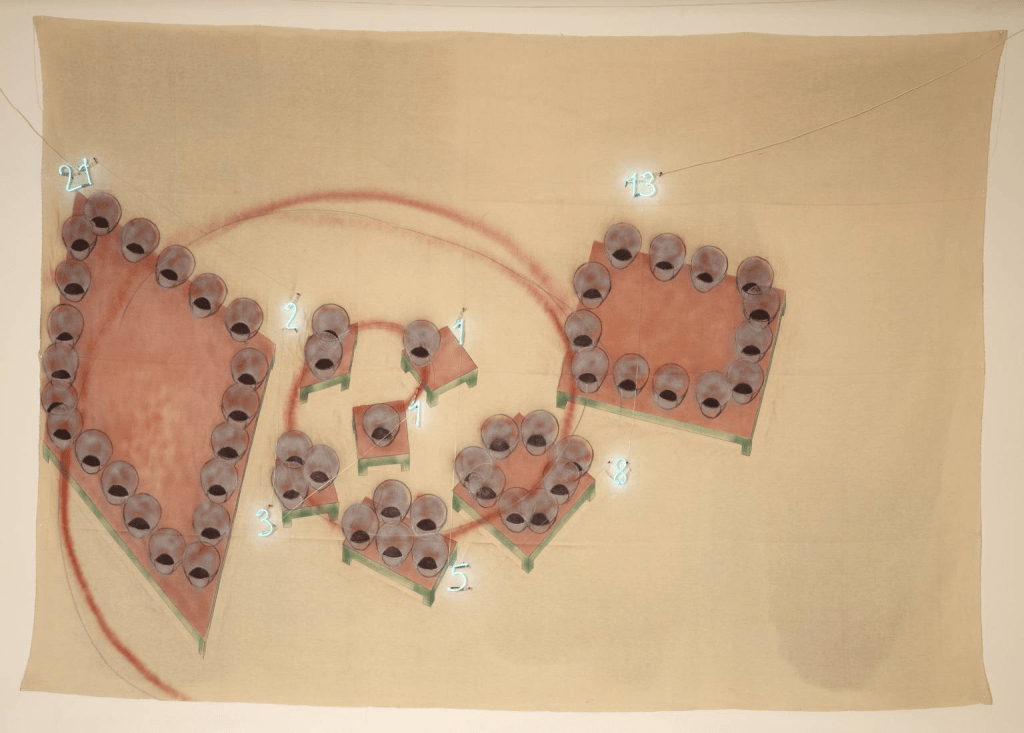
One of Merz’s most iconic works is his igloo series. From the 1960’s until his death, he made thirty of these sculptures. These igloos are made from various materials, including clay, glass, and metal, and again they often incorporate the Fibonacci sequence in their construction. The use of the igloo symbolises the idea of shelter and the interconnectedness of human beings and nature.
Merz’s artwork also included political and social satire. Merz once phrased on one of his sculptures “If the enemy masses his forces, he loses ground; if he scatters, he loses strength,” The phrase prompts viewers to think about Giáp (who was the general of the Peoples Army of Vietnam.), and other Vietnamese’ conduct throughout the Vietnam War, which had been going on for over a decade when Merz produced this sculpture. At the same time, the sculpture encourages viewers to think about their behaviours in the present day by engaging with the object. He was a critic of modern society’s excesses, and his art frequently attempted to question it. So he could promote a more environmentally friendly and peaceful interaction between humans and the environment.
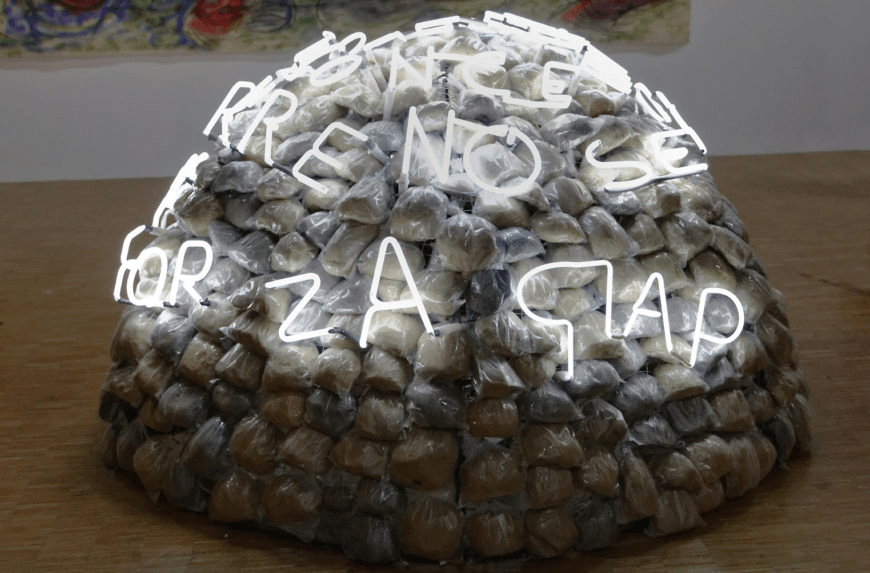
Overall, Mario Merz’s creative technique was defined by the combination of mathematics, nature, and everyday materials and an in-depth study of humanity.
Joseph Kosuth
Joseph Kosuth is an American conceptual artist best known for his investigation of language and philosophy through visual art. He has made numerous contributions to the conceptual art movement that started in the 1960s and has continued to create thought-provoking art throughout his career.
His working process involves research, careful selection of language and texts, and careful consideration of the context in which his artworks will be shown.
Neon text installations are one of Kosuth’s most renowned types of art. He displays words, phrases, or quotes in neon lights, frequently in a language or script other than the viewer’s, encouraging people to consider the meaning of the words. He often displays definitions or lists of synonyms to investigate how language affects our views of reality and objects.
Below are some examples of his work
Overall, Joseph Kosuth’s working process is characterized by creating conceptual art, which focuses on engaging the viewer with careful thought about the language he uses and its relationship to the artwork.
Reflections
It was interesting to learn about these artists because they are not the type of artists I generally study. It was fascinating to learn about the purpose behind each artist’s work, their creative process, and how intellectually perceptive some of the pieces are once you know what they are about. Overall, all these three artists employ a minimalist approach, carefully selecting and analysing their medium and artwork.
It’s great to see how different artists begin their work, how they decide when a piece is finished, and what they hope to achieve.
Reference list
Auz, Dr.L. (2021). Mario Merz, Giap’s Igloo. [online] Smarthistory. Available at: https://smarthistory.org/merz-giap-igloo [Accessed 7 Sep. 2023].
king, N. (2010). OpenAthens / Sign in. [online] go-gale-com.ucreative.idm.oclc.org. Available at: https://go-gale-com.ucreative.idm.oclc.org/ps/i.do?p=ITOF&u=ucca&id=GALE%7CA460761404&v=2.1&it=r&sid=summon [Accessed 7 Sep. 2023].
Leonie Huber (2019). Robert Morris – Refractions – Berlin. [online] Sprüth Magers. Available at: https://spruethmagers.com/exhibitions/robert-morris-refractions-berlin/ [Accessed 2 Sep. 2023].
Merz, M. (1974). Fibonacci Tables. [Charcoal, Acrylic paint, Metallic Paint and Neon on Canvas] Tate Gallery online. Available at: https://www.tate.org.uk/art/artworks/merz-fibonacci-tables-t03673 [Accessed 6 Sep. 2023].
Rajesh, P. (2020). Mario Merz. ProQuest, [online] Jan., pp.100–101. Available at: https://www.proquest.com/docview/2328344975?accountid=14178&parentSessionId=%2FWUXklpy%2Bx7r4RQqy08ROLctM03Lj2mi%2Fzar4NlSuGg%3D&pq-origsite=summon [Accessed 7 Sep. 2023].
The Art Story (2015). Minimalism Movement Overview. [online] The Art Story. Available at: https://www.theartstory.org/movement/minimalism/.
Wikipedia Contributors (2018). Võ Nguyên Giáp. [online] Wikipedia. Available at: https://en.wikipedia.org/wiki/V.
Witney musem (n.d.). Robert Morris. [online] Sprüth Magers. Available at: https://spruethmagers.com/artists/robert-morris/.
Zelazko, A. (2023). Joseph Kosuth | Biography, Conceptual Art, Artworks, One and Three Chairs, & Facts. [online] Encyclopedia Britannica. Available at: https://www.britannica.com/biography/Joseph-Kosuth.
Illustration list:
Figure 1. Fibonacci Tables (1974-1976) [Painting] At:https://www.tate.org.uk/art/artworks/merz-fibonacci-tables-t03673 (Accessed on 06.09.23)
Figure 2. Igloo di Giap (1968 ) [Sculpture] At:https://smarthistory.org/merz-giap-igloo/ (Accessed on 07.09.23)

 Visual Skills 2