Brief
To consider how collage and montage also influenced design and typography, you can access and read critic Simon Morley’s essay ‘Writing on the wall: word and image in modern art’ at the OCA library resource.
Look at the work of three of the artists referenced in this Collage & Montage section. You can search their names online, find them on Wikipedia or other websites, or look for their work on the OCA library resources. Here are some of them again with some others as well:
- Jean Arp
- Enrico Baj
- Julie Cockburn
- Max Ernst
- Linden Eller
- Hannah Hoch
- John Heartfield
- Peter Kennard
- Eugenia Loli
- Eduardo Paolozzi
- Jamie Reid
- Linder Sterling
- John Stezaker
- Isabel Reitemeyer
- Martha Rosler
- Annegret Soltau
Visual Skills 2: Visual Exploration p69.
- Make notes about your thoughts on Morley’s essay and the different images that some of the artists use, how they incorporate them into pictures, and what the intention is behind the work. Consider these questions:
- Where do they find the images that become part of their collages from? Which images do you find the most striking?
- Do their images relate to the politics or social issues of their time? If not, what are they concerned with? Are they related to psychology, or dreams, or are they purely visual experiments? Discuss their relevance to the period they were made in.
- Do the concerns of the images have a new relevance in today’s world, and if so, how?
Notes on Morley’s essay
Simon Morley examines the social and historical reasons that led to the rise of Constructivism as a reaction to the Dada and Futurist movements in his essay ‘Writing on the Wall: Word and Image in Modern Art’ (Morley, 2003). He discusses how artists have used written words or text in their visual works and how they combine a variety of artistic movements, techniques, and mediums in their work.
The essay investigates how artists have adapted to society in which words are used and play an important role in communication and culture. Morley investigates the cultural and social conditions that influence artists’ choices. A study of the magazine of the Paris-based Purist movement, L’Esprit Nouveau demonstrates this by comparing pieces of text, one handwritten and one typewritten.
The typewriter was perceived as a sign of order and progress in opposition to the turmoil and disappointment that followed World War I, and it was heavily impacted by the movements of Futurism and Dada.
Throughout history, various art trends have impacted the art world and how we see and use art today. The Futurist movement, for example, had an impact on art in the early twentieth century. It was distinguished by a heavy emphasis on the modern era, technology, and speed, as well as a rejection of tradition and history as it was thought of as outdated.
Futurist art often depicted motion and energy. An example of an artist who practised this is Giacomo Balla with his oil painting Dynamism of a Dog on a Leash which was completed in 1912.
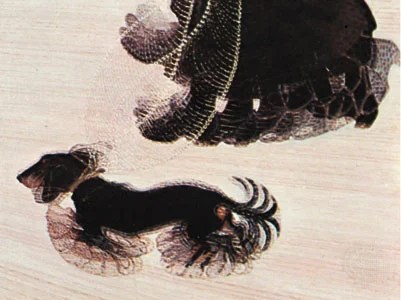
Fig 1. Dynamism of a Dog on a Leash (2012)
The people of this movement wanted to celebrate the modern world of industry and technology and did this using Neo Impressionism and Cubism.
During World War One, another movement known as Dada emerged out of anger and resentment for the war’s bloodshed and tragedy. Its goal was to question social norms and create artwork that would shock, people, such as satirical art.
Another growing movement during this time is constructivism. The people behind this movement wished to develop a new visual and verbal language that could be used by everyone. This form of art was associated with significant advances in machine mass manufacturing, and they believed in using logical design and technology to advance and better both art and society. El Lissitzky was one of the painters that contributed to the popularity of this movement.This style of art consisted of strong lines, high contrast in colour, and simple composition.
Morley explores the ways in which mass media has shaped and modified creative approaches. For example, industry, politics, and technology were all part of the constructivist theory. There was advancement in technology during the later 1920’s for example, the media-printing revolution, advancements in Radio, photography, film and lithograph.
All of these movements amongst a few others have had a lasting impact on art and design we see today. Especially Constructivism. Modern artists and designers can still be seen to practice some of the principles from these past movements. Such as, artist who are still exploring the use of basic shapes, lines, and colours in their work. For example, Georgia Nassikas is a modern day artist who creates art using mixed media and uses geometric shapes.
Below is one of her artworks created with wax and oil paint.
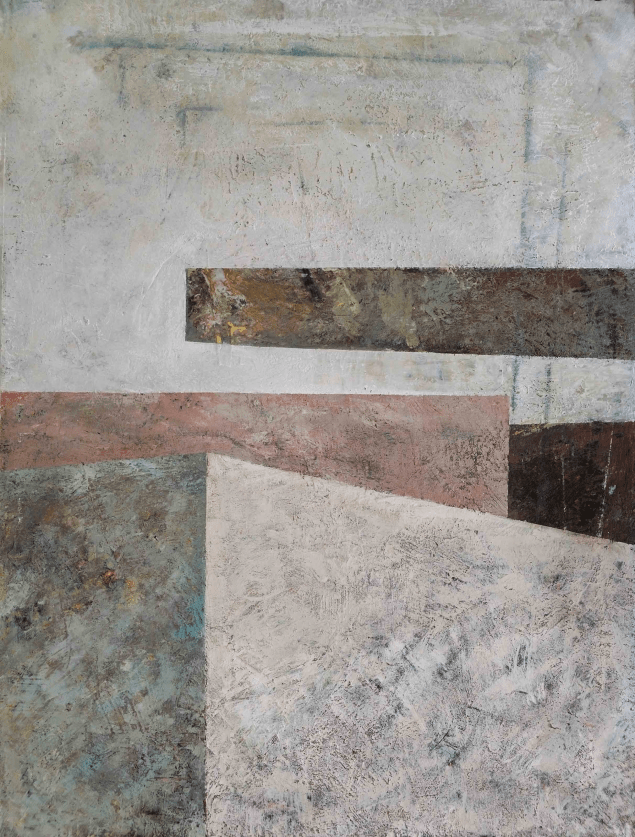
Fig. 2 Around (2016)
Many artists and designers use minimalism in their work today, and they continue to experiment with new materials and technology to express themselves. In conclusion, the influence of Constructivism can still be seen today in the continuous investigation of abstraction, geometric forms, and the use of modern materials. Its concepts continue to inspire artists who want to push the boundaries of creativity and engage with the changing environment around them.
Julie Cockburn
Julie Cockburn is a sculpture and a British Visual Artist known for turning old photographs into three dimensional objects.
Where does the artists get their images from? and what images do I find most striking?
Cockburn finds inspiration in a variety of places, including old family photos, vintage postcards, junk shops, and the internet. She will make several changes to these photographs, including cutting, sewing, and painting. Julie creates new and unexpected narratives in this manner, which the audience can interpret in their own way.
There are several images of hers that I find striking because of her excellent and bold use of colour that enhances the visual impact of her work. Cockburn’s use of colour triggers a wide range of emotions in audiences, from nostalgia from the use of an old photograph to surprise and excitement from the geographical shapes and pops of colour.
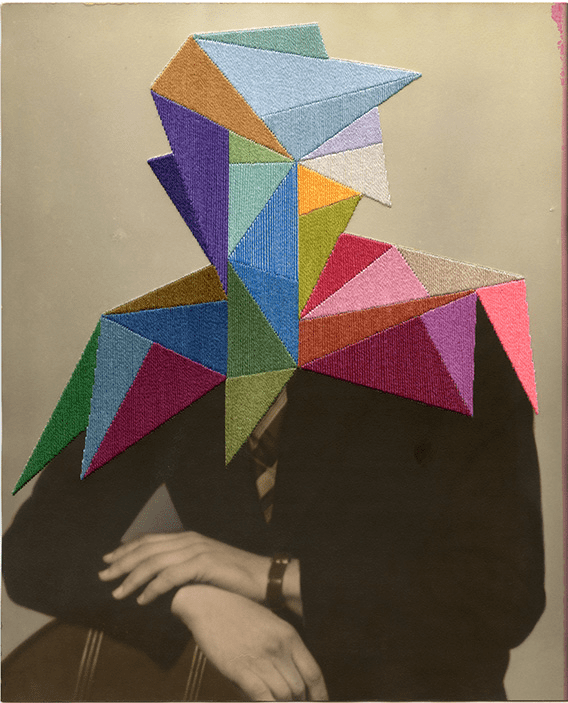
Fig. 3 Armour (2019)
I like the way this image provokes the viewers to think about who is behind the embroidery. The colour and transformation gives an old nostalgic photograph a new meaning.
What are the images related to?
Julie Cockburn’s artworks are based on themes such as memory, as evidenced by the usage of vintage postcards. Another topic emphasised is how she gives a feeling of personality to still portrait photographs, giving them a new life. Another theme in her art is transformation, which is shown through the use of embellishments and accentuating depth to a two dimensional image. Her subjects that she focuses on are specific – men, women, landscape and still lives.
Relevance in todays world
Julie’s work is relevant today because it invites the audience to contemplate and discuss the pieces, making their own interpretation of the work. What is now a digital age and currently a world concerned for the environment it is refreshing to see an artist using recycled materials and handcrafting them into something beautiful.
Linden Eller
Linden Eller is a mixed media artist who uses a variety of materials such as a variety of papers, tracing paper, found fragments, sewing thread, paint and pastels.
Where does the artists get their images from? and what images do I find most striking?
Often her work features recycled materials such as old paintings and book pages that she collects from thrift stores.
Although I enjoyed looking at all of her artwork I particularly liked her series of paintings entitled Rhythms of Motherbaby. I think this is because I probably felt a deeper connection to these works being a mother myself and how she may have felt while creating them.
Below is one of these paintings from the series entitled ‘Sleep’
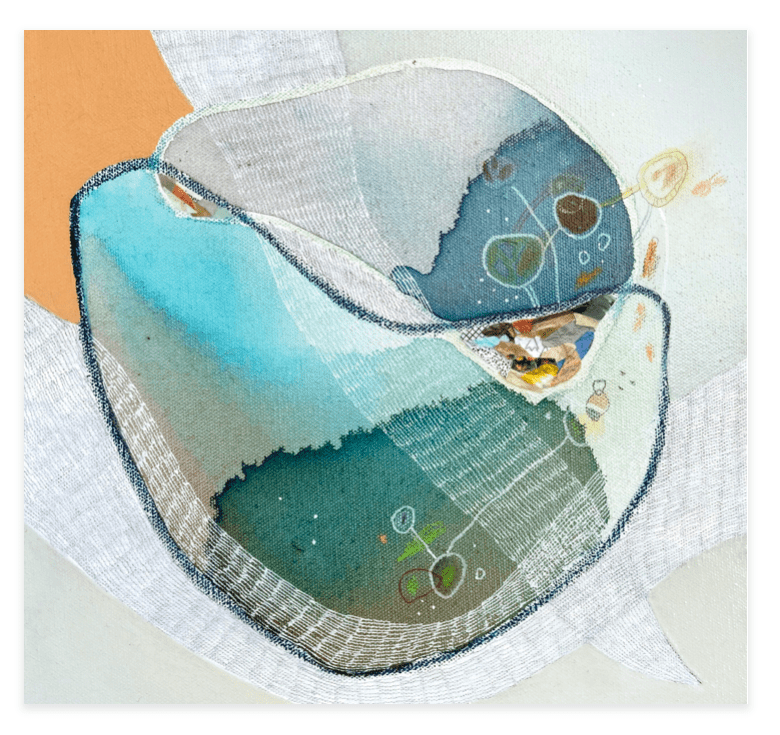
Fig. 4 Sleep (2022)
What are the images related to?
Linden created these paintings shortly after the birth of her son after being inspired by a book she bought called ‘A Life’s Work’ by Rachel Cusk. The paintings show the transition into motherhood and the connection felt with the new growing child.
Linden’s artwork in general is created with a pale colour palette and a mixture of different collected materials. When finished the work expresses her memory, childhood, longing, home and architecture. The work explores creatively how memories are processed, altered, and renewed.
Relevance in today’s world
Linden’s art work is relevant in today’s world not only because she is producing multimedia art during modern times but because her artwork addresses timeless subjects that resonate with modern audiences. Such as the work shown above. Her work is experimental and playful and often explores the human mind and our emotions which in todays era I think is very important especially with the turmoil people have faced with Covid and the Wars going on around the globe.
John Heartfield
John Heartfield was a Germaan photomonatage artist that produced artwork to fight against Nazism and fascism by using political satire.
Where does the artists get their images from? and what images do I find most striking?
John Heartfield, obtained images from magazines and newspapers such as AIZ (Arbeiter-Illustrierte-Zeitung). He would use some of these images to create his photomontages. Sometimes he would take his own photographs to use in his photomontages and also use found images in advertising materials, posters.
Another way he obtained images was by working with other artists such as George Grosz and Rudolf Schlichter, who provided him with some of the images he used in his photomontages.
Heartfield occasionally used official propaganda materials, particularly those created by the Nazi regime, to and critique the government’s messaging. He repurposed these materials to create satirical and critical works.
By recreating image from various sources, John Heartfield was able to craft visually striking and politically charged photomontages that had a significant impact on politics and artists during his time. His work is still celebrated for its powerful commentary on the socio-political events of the early 20th century.
The images I found most striking is ‘”The Meaning of Geneva.” or commonly known as ‘A Puppet in Thyssen’s Hand!) Due to copywriter issues I am unable to post a picture on this site. However it can be accessed at the link below.
This image was created during Hitler’s rise to power in the run-up to World War II. It implies that Hitler was a tool in the hands of more powerful people, such as the Nazi party, who manipulated and supported his rise to power. The depiction of Hitler as a puppet implies that he is not an individual leader but is rather controlled by the Nazi regime. It’s an intriguing piece of work that, sadly, could be remade today for example Donald Trump as the puppet and the Russians pulling his strings. Or Belarusian President Alexander Lukashenko, pulling Vladimir Putin’s strings.
What are the images related to?
His images are related to the Dada movement, political activism,
and satire. As previously mentioned Heartfield used photomontage to confront Hitler and his enforcers. He attempted to raise social and political awareness while also criticising Hitler’s regime. Shockingly, I discovered Heartfield was number five on Hitler’s most wanted list, and Hitler sent his law enforcers to vandalise his art studio and attempted to murder Heartfield. Luckily John managed to hide and, fortunately, escape. I find it amazing he used his artwork to make an incredible change to peoples lives and that he risked his own life while doing it.
Relevance in todays world
John Heartfield’s artworks continue to be as powerful now as they were in the 1930’s for several reasons. With each of his photomontages he has managed to create a visual record of political and social issues that were happening during his time. I feel it is important for people to study his work and be able to understand the tragedy’s that happened during his time. By studying his work it can remind us to fight against dictatorship, promote social justice, and to keep using art as a medium for activism and change.
Reference list
David, E. (2019). Telling it Slant: Julie Cockburn’s Intricate Visual Language Challenges How We Perceive Each Other | Yatzer. [online] http://www.yatzer.com. Available at: https://www.yatzer.com/julie-cockburn-telling-it-slant [Accessed 11 Nov. 2023].
Eller, L. (2022). Rhythms of Motherbaby. [online] Linden Eller Studio. Available at: https://www.lindeneller.com/work/rhythms-of-motherbaby [Accessed 11 Nov. 2023].
hear field, J. (n.d.). John Heartfield Art As A Weapon Part One. [online] http://www.youtube.com. Available at: https://youtu.be/Af8r0g7Jw9k [Accessed 11 Nov. 2023].
Heartfield, J. (2023). Political Art. Official John Heartfield Exhibition. Integrity. Courage. Genius. [online] John Heartfield Exhibition. Available at: https://www.johnheartfield.com/John-Heartfield-Exhibition/.
Jones, J. (2019). Dynamism of a Dog on a Leash | Work by Balla. In: Encyclopædia Britannica. [online] Available at: https://www.britannica.com/topic/Dynamism-of-a-Dog-on-a-Leash.
Post, K. (2023). EXPLAINED: Who are Russia’s Allies? A List of Countries Supporting the Kremlin’s Invasion of Ukraine. [online] Get the Latest Ukraine News Today – KyivPost. Available at: https://www.kyivpost.com/post/13208.
Rise Art. (n.d.). Georgia Nassikas, Artist | Contemporary Art for Sale. [online] Available at: https://www.riseart.com/artist/64482/georgia-nassikas [Accessed 11 Nov. 2023].
Spicer, E. (2019). Julie Cockburn – interview: ‘My Work Is about Telling the truth, but in a Really Circuitous Way’. [online] http://www.studiointernational.com. Available at: https://www.studiointernational.com/julie-cockburn-interview-telling-it-slant-flowers-gallery-kingsland-road-london.
Tate (2014). El Lissitzky 1890-1941 | Tate. [online] Tate. Available at: https://www.tate.org.uk/art/artists/el-lissitzky-1519.
Tate (2017). Futurism – Art Term | Tate. [online] Tate. Available at: https://www.tate.org.uk/art/art-terms/f/futurism.
The Art Story (2016). Theo Van Doesburg. [online] The Art Story. Available at: https://www.theartstory.org/artist/van-doesburg-theo/.
Wikipedia Contributors (2019). L’Esprit Nouveau. [online] Wikipedia. Available at: https://en.wikipedia.org/wiki/L.
http://www.getty.edu. (n.d.). Agitated Images (Getty Center Exhibitions). [online] Available at: https://www.getty.edu/art/exhibitions/heartfield/.
http://www.lomography.com. (2015). Lomography – an Interview with Julie Cockburn. [online] Available at: https://www.lomography.com/magazine/313332-an-interview-with-julie-cockburn [Accessed 11 Nov. 2023].
Illustration list
Figure 1. Dynamism of a Dog on a Leash (2012) [Oil painting] At: https://en.wikipedia.org/wiki/Dynamism_of_a_Dog_on_a_Leash (Accessed on 31.10.23)
Figure 2. Around (2016) [Mixed media] At: https://www.riseart.com/art/73959/around-by-georgia-nassikas (Accessed on 31.10.23)
Figure 3. Armour (2019) [Hand embroidery and ink on found photograph] At: https://www.studiointernational.com/julie-cockburn-interview-telling-it-slant-flowers-gallery-kingsland-road-london ( Accessed on 31.10.23)
Figure 4. Sleep (2022) [Mixed media] At: https://www.lindeneller.com/work/rhythms-of-motherbaby (Accessed on 31.10.23)

 Visual Skills 2