For this last exercise of the chapter, Getting Started, OCA wanted me to arrange a 15-20 minute conversation with my new tutor. This is for us to discuss how best to schedule my time, document my work, and share it.
Unfortunately, I had not read the OCA text book or started any of the questions when I first spoke to my tutor. We had already scheduled a date to talk via google meet. As I have already completed many units, I knew what sort of questions I wanted to ask. Yet, it will be interesting to show my tutor all my reflections on these questions and research tasks to get her opinion on what I have written.
For this exercise, the OCA advised me to get in touch with other students. Recommending I share something about my practice. This is because it can provide a social support for my studies.
For the first three units, I kept in constant contact with fellow OCA students through Discord chat. It was great because I felt part of a community and could share my work for critique and see other student’s work. However, during the last unit, there were a lot of upsetting and personal circumstances that prevented me from completing the coursework, and I was a little embarrassed at how far I had fallen behind.
Yet, I have decided this is a silly attitude and I still need the support that these students gave me and I hope I helped others, too. Therefore, I am about to introduce myself back to the group.
The next task to look at before beginning the unit is how am I going to manage my time?
To begin with, I read how long the OCA expects the unit to take to be completed, which is 600 learning hours. I checked on when I enrolled and what time I have left to finish the entire degree in order to plan effectively.
I enrolled on the degree course on 19/02/2016, and have a maximum of 12 years from this date to complete the degree in its entirety.
I have until the 14/04/2024 to complete this last unit (visual skills 2) of Level 2 studies and will have 3 years from the day I enrolled to my first Level 3 unit to complete Level 3.
To plan effectively,I answered the following questions:
How much time will I allocate to study each week?
I aim to work a minimum of five hours, five days a week, which will allow me to complete the unit in a year. I need to remember twenty percent of this time is for me to reflect on my learning log, too. However, when I can, I plan to work more hours.
What is my most/ least productive time of day?
Least productive times and things that impede my studies.
From 7am until 10am I am getting the kids ready for school, doing the school runs and walking the dogs.
Weekends I can work, but it depends on balancing time with my children.
I go to the gym for a minimum of an hour five times a week.
House chores (1 hour) 10 -11am
Demanding puppy
Taking children to kid’s clubs.
Making time for family and friends (5.30pm-8pm cooking and kid’s bedtime routine)
Most productive time of day
11am – 2.50pm & 4pm-5pm (roughly 5 hours)
Plus, minimum of 6 hours split over the weekend.
How well do I manage time?
To be honest, not very well. I try to plan, but it’s only now I realise I have not been looking at my most productive times to work.
What is a realistic schedule to undertake Part One, and when is the first dead line?
As written above, I have realised the times I can study and have set with my tutor the first assignment to be submitted on the 3rd of April.
Throughout this degree, I have used WordPress as a way of recording my learning log. As it has been a successful way to record my work, I created a new blog just for this unit. It took me a while to remember how to set up all the menus and was a bit frustrating, but now they are complete, it will be easy to reflect on my work.
I have found WordPress is a good way to document my work and easy for my tutor to find relevant work because it is all broken down under the relevant headings.
Although it would be nice to have a handwritten learning log, I would get frustrated with my punctuation and spelling being wrong because of my dyslexia.
Now that I have set my learning log up for this unit, I am excited to add my first piece of work. I hope whoever is reading this enjoys looking at through my work.
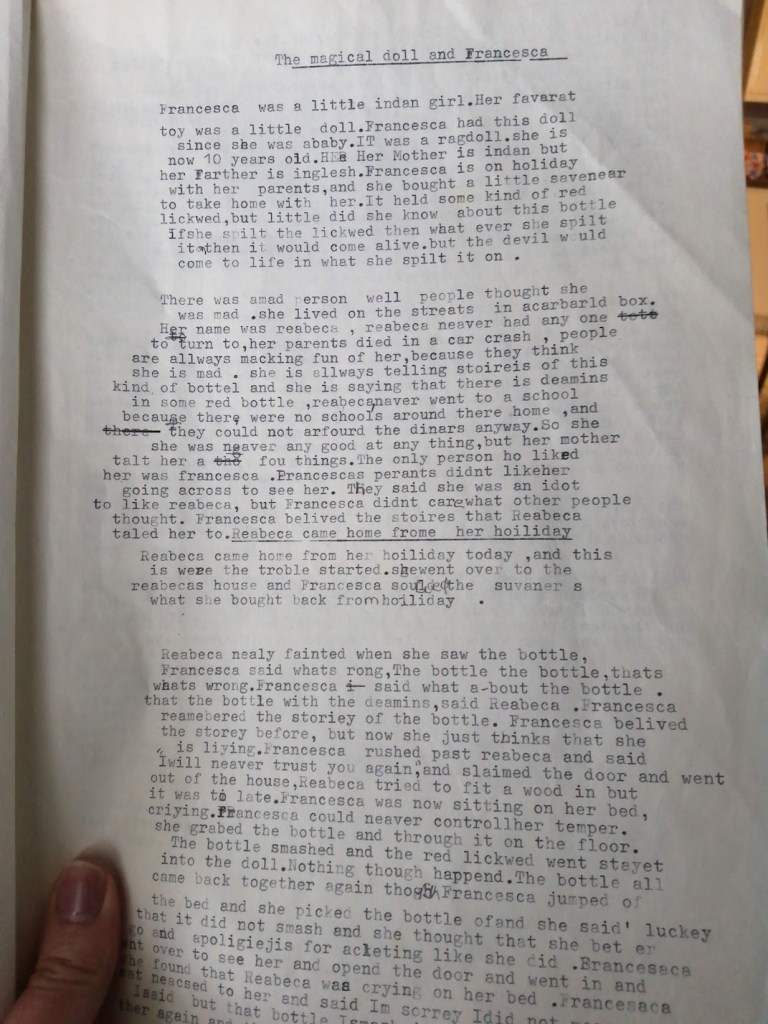
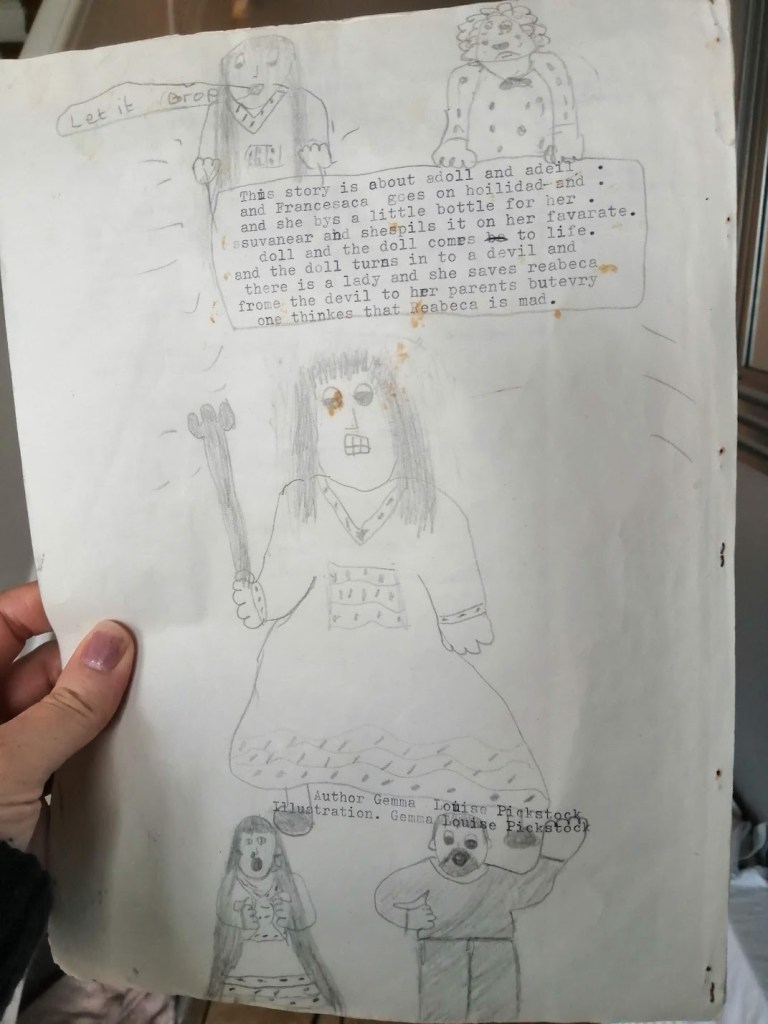
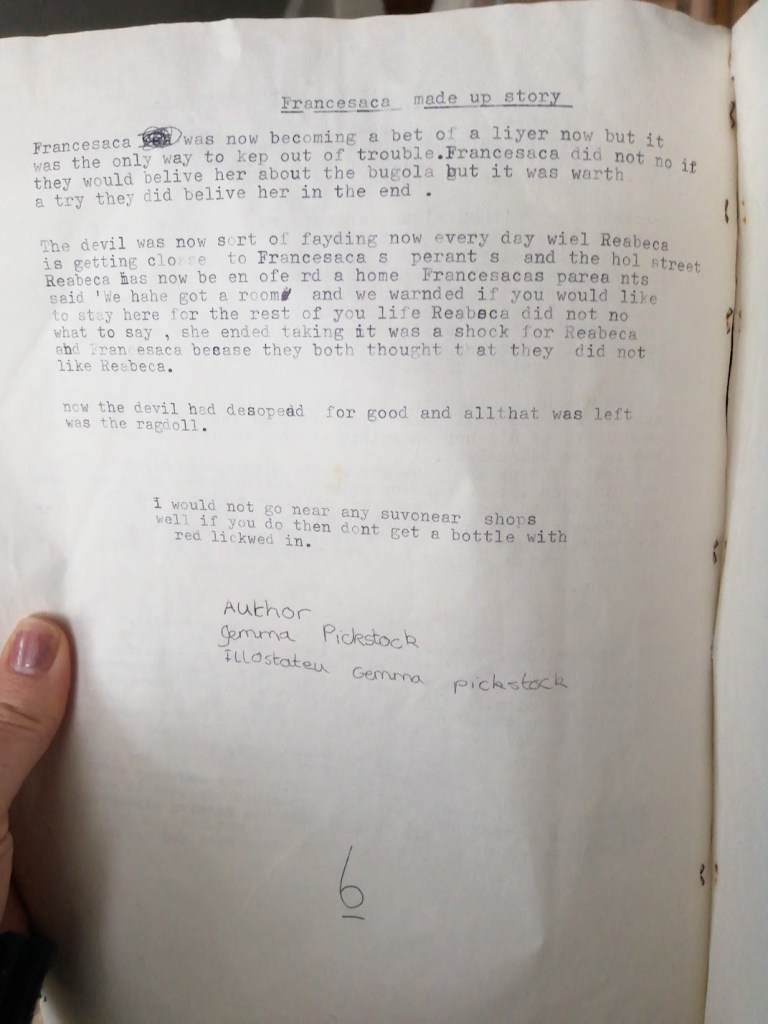
As a small child, all I can remember is writing stories and illustrating them. I remember tapping away on my typewriter for hours on end. My spelling and grammar was never great and now I know it was due to me having dyslexia, but it didn’t stop my imagination. I knew when I was four I wanted to be an illustrator and if I was to fail; I thought I would be a zoo keeper instead.
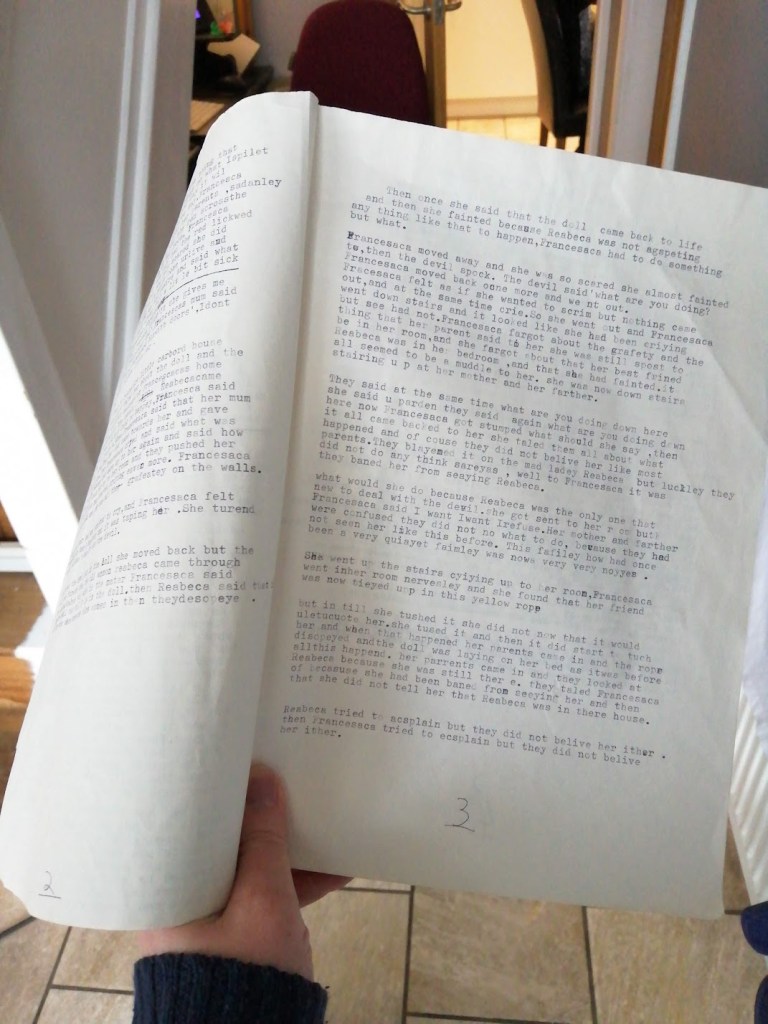
As you can see below is a book that I wrote at age eight using my typewriter.
As I got older, I continued to draw and write and whilst at secondary school, during an English class, the teacher set some homework, which was to write a story. I became so engrossed in this homework that I made a fully illustrated book at age 12. Not realising at the time that all the teacher was expecting was a short story in my exercise book. However, the teacher loved it and the school awarded me a certificate of commendation and a five-pound voucher to spend in a bookshop.
Moving on, my GCSEs were approaching and at the time my only interests were English and Art & Design. Therefore, my main option selected was Art and Design.
After successfully completing my Art GCSE, I wanted to go onto college and and study Advanced GNVQ Art and Design. Unfortunetly, I did not have good grades in English or maths GCSEs. Therefore, the college informed me I would not be accepted. Yet, I was adement that I wanted to study this subject and arrived at the college with my portfollio. After the tutors from the course looked through my work, they accepted me on to the campus providing I resat my maths and English.
Successfully completing the course with Merit, I wanted to go on to extend my knowledge of Art at university and study illustration or fine art. At the time, sadly it was not finacially viable. Yet, this didn’t stop me trying to succeed as applied constently for jobs in the creative field and at age 19 became a Graphic Assistant for an architect company. Sadly a few years later, the company was struggling for clients and I was made redundant. After, I tried numerous companys in the creative field for employment but without a degree it seemed difficult to be taken notice of.
As a temporary measure, to help with my life costs, I took a job as a sales assistant within a garden centre. Yet, I have to say I was not expecting to enjoy it so much and because of the team I worked with and loving the job I stayed for five years, working as a tropical fish manager in an acqatics company. It was here that me and my husband decided it was time to try for children.
When my first born turned one, I wanted to return to work from parental leave but didnt want to leave my son in a nursery. Thinking about different options I decided to set up my own business as a childminder. Again, this was a rewarding job in that I could raise my own child at home but was given the privilege in caring for other parents children, and watching them grow into caring, talented young children.
However, when my second child was born we moved home and the house needed repair work. This meant I could no longer work as a childminder because the house was not OFSTED fit for working. Whilst our home was under going major repair, and watching my two children developing quickly I realised it was now my time to return to what I set out to do originally and that was illustration.
What do I need from the course
I guess why I am writting all my back story is for me to come back to this page from time to time and remind myself of my passion and my life time goals. Sometimes I think I am to old to try and fulfil my dream (40). It scares me a little that there are people that went to university at 19, 20 and will have twenty years work experience compared to me. However, I know I am grounded, commited and can succeed.
What I hope to gain whilst completing this unit is:
Constructive critique.
Encouragement.
Advice from my tutor and peers, as they will and may have had many more years working in the creative industry.
Help with pushing myself out of my comfort zone.
To keep pushing myself creatively and step away from technology.
Areas throughout this degree, that I have enjoyed are designing and creating bookcovers, this aspect really appeals to me because I want to do the author justice, to make the book stand out from the crowd and above all for the book to be taken home. I also enjoy creating illustrations for childrens books. Knowing that children are entering a world partly constructed by my by drawings is rewarding.
Areas I need to develope more based on my learning journey so far are the following:
Allowing enough time to creatively explore different options and not just stick to the initial idea.
Get a better understanding of formal grid layouts and composition.
Understand the correct use of fonts better and possibly create my own.
Improve time management and stop procrastinating.
By doing this unit I think it will greatly improve my creativity.


 Visual Skills 2