The Open College of the Arts asked me to read an essay entitled ‘Point, Line, Plane’. Written by graphic designers Ellen Lupton and Jennifer Cole Phillips. In this blog, I have made notes on the essay.
Essay Reflection
“Point, line, and plane are the building blocks of design. From these elements, designers create images, icons, textures, patterns, diagrams, animations, and typographic systems.”
(Phillips, 2014)
The quote above is from an essay ‘Point, Line, Plane’.
You can access the essay from the OCA Library here:
The author goes into considerable detail regarding the ideas of point, line, plane, space, and volume, as well as drawing with code. It was intriguing to discover ways of using points in a drawing depending on where they are positioned and how they might link to their surroundings. Points can have hardly any value to a drawing or be extremely valuable. (Phillips, 2014) The description of each topic has given me more insight into how to use point, line, plane, space, and volume more effectively in the future. It was helpful to see drawings and photographs with visual examples of every concept.
At the end of the chapter, there were two projects that challenged students to consider new ideas. I thought this may be helpful for me in the future, so have made notes on the exercises and I have written them up into short briefs for me to complete in the future.
Exercise 1: Three objects, thirty-three ways
Brief
Observe, represent, and abstract visible objects using a variety of materials and techniques.
Visit an unusual place with surprising things to see and observe, such as a local museum, aquarium, or botanical garden.
Produce observational drawings of three objects, pay special attention to the appearance of form, colour, texture, and materials.
Create a word lists and drawing from memory create ninety-nine studies.
Exercise 2: Spatial translation
Brief
Chose a space to observe it from multiple points of view.
Observe it from multiple psychological points of view.
Produce images using diverse media and mediums.
In your images, you may be representational, literal, abstract, iconic, indexical or symbolic.
finally, create a series of representations using dot stickers, tape, and cut paper.
Using the previous observations create a sequence of ten images suitable for an accordion fold book.
Reflection
Reading the book extract has taught me that patience, observation, and perseverance are key assets to being a creative designer, and I hope that finishing the two briefs from the book will help enhance my own skills. Unfortunately, I know I lack patience and find it difficult to draw random objects without a goal, but the knowledge gained from this research activity has provided me with an objective to aim for. By completing these briefs, I will be able to measure my progress and watch how my sketching skills change.
References
Phillips, J. C. (2014) ‘Point, Line, Plane’, in Graphic Design: The New Basics. New York, NY, USA: Princeton Architectural Press, pp. 33–47; 15 pages.
I was relieved to hear that my blog is simple to use, as this will make it easy for visitors to find and read my work.
I said in part one that I struggle with managing my time, and getting some help from my tutor was great. My tutor advised me of the 888 principles, so I investigated this more (Kit.,2020). Planning eight hours of study, eight hours of ‘me time’, and eight hours of sleep will assist me in better managing my everyday life. I may not have the exact schedule, but it offers me something to plan for.
My tutor also advised me to use a stopwatch for me to sit and study for a designated time such as an hour, so I did this as a test and it did stop me from being interrupted by social media, phone calls, or coffee breaks. She also suggests that I use a Gantt chart to visualise time I have available for each assignment. I researched it, but I also found a very user-friendly app called the Todolist. I have now added all of my upcoming tasks to this app. It is useful since I can now see the work I have to perform in the upcoming days, weeks, and months. To further help me keep organised, I have also created a computerised daily schedule. Both of these new strategies will make it easier for me to calculate how much time I have left to study. There is also a choice to add personal events to the daily schedule.
My tutor has suggested a book to help with writing about art, (Barnet, 2014) which I will borrow from the library, and I was relieved to find that, despite my dyslexia, my written work is developing positively.
It was discouraging to learn that my citations were not correct. Every time I have written something from a source, I have ensured I included references. I was unaware, however, of the unreliability of Wikipedia and the Tate as research sources and that my format was incorrect. It was fortunate that my tutor pointed out that I was not properly referencing because she informed me that the university library offers a tutorial that would teach me how to do it correctly.
It is interesting that my tutor said it might be time for me to launch a website; this is something I have been considering doing for a while. I currently have a digital portfolio that needs additional work still, but it is not a website. I have not felt prepared to do this because I have thought the only work I can show is what I have done during this degree. Reflecting on this issue it has made me realise I ought to be producing work that I enjoy doing in my leisure time, too. Now that I have a time management strategy in place, this will be simpler to do.
The last assignment of part one helped my practice by allowing me to think differently about making mistakes and being more confident. Hopefully, I will remember to practise this skill throughout the rest of the course.
Overall, I have learned a lot from the work produced in part one of this course and can now go forward with new ideas and new strategies of working.
Bibliography
Barnet, S. (2014) A short guide to writing about art, global edition. 11th edn. London: Pearson Education.
Kit., C. (2020) 8–8–8 Rule: Living a Balanced and Happy Life. Singapore: CKSPACE. Available at: https://youtu.be/hZizLOgrVBo.
The purpose of this task is to find artists who use “flow and “play” theory in their work and I hope to eventually apply what I have learnt to my work.
Firstly, I looked at the recommended essay entitled Memory, Instinct, and Design: Beyond Paul Rand’s “Play Principle” Michael Golec
The essay was incredibly detailed, and I found it to be quite difficult to read so I hope I have understood it. I believe it to be a critical examination of the famous graphic designer Paul Rand’s design philosophies “Memory, Instinct, and Design Beyond Paul Rand’s “Play Principle.” The essay specifically criticises Rand’s emphasis on the “play principle” in design, which he claimed was essential for producing work that was both visually appealing and useful.
Analysing the quote above and from my understanding of the essay, the author of the essay is arguing that, while the play principle can be useful as a starting point for designers, it is insufficient to produce magnificent work. Instead, to push the boundaries of what is possible and create designs that truly resonate with spectators, designers must be willing to draw on a variety of different cognitive resources such as instinct and memory.
Next, I looked at some of the recommended artists and I researched first Hilma af Klint.
Hilma af Klint
Hilma af Klint was a Swedish painter best known for her abstract works. Originally, she began as a botanical and landscape artist. Her later works were created in the late nineteenth and early twentieth centuries, long before abstract art as we know it today. Her paintings were notable for their use of bright colours and geometric shapes, as well as spiritual and mystical themes.
Many of Hilma’s paintings were part of a series titled “The Paintings for the Temple.” She explored various spiritual ideas through these paintings. What fascinating was that she began holding seances, during which she said the spirits would send her images, which she would then paint. I am not religious, but could she have seen something from the spirit world? Surprisingly, these artworks included a total of 193 pieces. The paintings frequently feature complex geometric patterns and abstract forms that are meant to represent spiritual ideas and concepts. Her paintings frequently feature bold and vibrant colours that radiate energy. Her paintings also use a variety of textures and patterns, with some using intricate lines and others using large, sweeping brushstrokes.
Below are some examples of the works.
When discussing a painting she created in 1907, Hilma af Klint said:
“The pictures were painted directly through me, without any preliminary drawings and with great force. I had no idea what the paintings were supposed to depict; nevertheless, I worked swiftly and surely, without changing a single brushstroke.” (Paintings for the Temple | The Guggenheim Museums and Foundation, no date, para. 2)
Above describes the act of play and flow extremely well.
Joan Miró
Following that, I looked at Joan Miró (1893-1983), a Spanish surrealist painter, sculptor, and printmaker. His work drew me in because of its playful and childlike style, which employs simple forms and bright colours to create dreamlike compositions. The colour palette and style reminded me a little of some of my previous work, which can be seen here.
The Surrealist movement, which emphasised the subconscious and unconscious mind, had a strong influence on Miró. He frequently used biomorphic shapes, abstract forms inspired by living organisms, to create works that evoked a sense of mystery.
Miró began to experiment with varied materials and techniques later in his career, creating sculptures and ceramics in addition to his paintings. He kept using bright colours and playful imagery.
Overall, Miró’s work is characterised by a sense of freedom and experimentation, as well as a deep connection to the unconscious mind.
Bob Cobbing
I then looked at Bob Cobbing (1920-2002). I was interested in learning more about him for several reasons: one, I liked his artwork; two, I struggle with typography and thought I could learn something from his work; and three, I enjoy poetry.
He was a British poet and artist known for his work in concrete poetry, I discovered. Concrete poetry is a type of visual poetry in which the design and layout of the words on the page are as important as the words themselves. Cobbing was a key figure in the British concrete poetry movement, and his writing, performance, and publishing activities helped to popularise the genre. Cobbing’s work often featured experimental typography. He used a range of techniques to create his concrete poetry, including cut-up and collage methods, as well as hand-drawn lettering and experimental printing techniques.
Cobbing’s work, in general, pushed the boundaries of traditional poetry and helped to broaden the definition of what poetry could be.
Conclusion
From this research I have discovered that playing (meaning drawing without purpose) and drawing are both important activities that can stimulate creativity and imagination, but they serve different purposes and can have different benefits.
Drawing and playing (drawing without a purpose) are both important activities that can stimulate creativity and imagination, according to my research, but they serve different purposes and have different benefits.
Playing is important because it allows us to experiment and explore without feeling pressured to achieve a specific result or goal. We can try new things, make mistakes, and learn from them. Aside from that, it can assist us in relaxing and improving our mood. As a result, many people enjoy mindful colouring books, which have the same effect.
Drawing, on the other hand, is a more focused and deliberate activity that requires a result, which can be stressful at times. However, drawing can be a useful tool for capturing our thoughts and observing people and objects.
While drawing is important, it can also be structured and rigid at times. Simply playing would allow me to break free from my usual habits and thought patterns. It would motivate me to take risks and explore new opportunities. It would also be useful to ‘play’ if I were stuck for ideas or starting a project and was intimidated by the blank page. To summarise, both playing and drawing have distinct advantages.
For this research, I needed to read some OCA student quotations about their creative process. Then view a Stephen Johnson film that explains the source of good ideas and recognize any statements I agreed with.
“I generally start with an idea and a plan. But the plan usually changes during the process.”
Ros, OCA Textiles, Level 1.
I am in full agreement with the previous statement. I start with a concept and develop a plan from there. As I work on the first idea, the plan can change, and a completely different idea can come out of it.
“I have not been making art for very long yet and only just started to reflect on the process. For OCA exercises, I tend to start with realistic pencil drawings in order to get to know my subject. I then gradually leave that by changes in media and bolder interpretations. It is at this stage I feel creativity kicking in. I try to do many different versions because the doing sets in motion a chain of thoughts, ideas and things to explore. I stop when the ideas cease or I have a picture I am happy with.”
For my own work I go a similar path if I start with an idea of what I want to do. If I haven’t I mess around with water and water soluble media until I see something emerge. I then use that as a starting point. This makes for very surprising subjects and often abstract ones.
Ideas pop up at unexpected times and I have started to jot them down. When I am not able to develop them visually I use words. I think I should combine the two – visual and verbal – as they lead to different things. Verbal is faster and so allows for a train of thought to flow more freely. Visual development takes hold of a first idea and develops that out of the processes involved.”
Sibylle, OCA Drawing, Level 1.
I agree with the above statement. In my work, I usually begin with a pencil sketch and then when I am sure of what I am attempting to accomplish, I become more at ease with the question. This then gives me more motivation to try more mediums.
“I often start out with an intention but the work finds its own way somewhere else and that’s ok. Sometimes work that I’ve done for an exercise will offer itself up for development into something else and that’s fine. Once the work’s started it often feels as if I’m chasing after it rather than guiding the work.”
Kate, OCA Photography, Level 1.
The above statement is sometimes the way I work. I can have an initial idea, but as I work on it, it can lead to something different.
Next, I watched the recommended video ‘Where Good Ideas Come From’ by Steven Johnson. Then answered the following questions in response to the video.
Do you agree with Johnson that ideas take time to develop?
I agree with Steven Johnson’s idea that good ideas take time to develop. In his video, Johnson argues that many of the world’s greatest innovations and inventions were not the result of a sudden “Eureka!” moment but emerged slowly over time, through a process of trial and error, collaboration, and sharing of ideas.
Johnson points out that many of the most significant breakthroughs in the world have resulted from “slow hunches”. Each idea often gradually developed over weeks, months, or even years. He suggests that this process of gradual idea development is critical to creating truly innovative ideas.
In my opinion, this is an accurate description of how ideas often develop. It’s rare for a brilliant idea to appear fully formed out of nowhere. More often, it’s the result of a long process of experimentation and refinement.
Are his ideas equally applicable to creative disciplines?
Steven Johnson’s ideas about idea generation and creativity are equally applicable to creative disciplines.
In his video “Where Good Ideas Come From,” Johnson argues that creativity and innovation often emerge from a collaborative, networked environment. He uses examples from a range of fields, including science and technology, to illustrate this point.
This idea of collaboration is equally important in creative disciplines. For example, many successful artists often collaborate with others to create new and innovative works. Such as Andy Warhol and Jean-Michel Basquiat, who successfully worked together. From 1980 to 1986, they created many pieces of art together. A popular example of their collaboration together would be the painting of the Olympic rings. (2023)
Furthermore, Johnson’s emphasis on the importance of slow hunches and the gradual development of ideas is also relevant to creative disciplines. A long process of development is used to refine and improve ideas, resulting in many successful creative works. An example where an artist has done this is Graham Rawle with his book ‘Woman’s World a graphic novel’. In his quote below, it explains this long process of development.
“The book took five years to create. I first drafted the novel in outline, then searched through hundreds of women’s magazines, cutting out anything that seemed relevant to the scenes I’d written: sentences, phrases and words that when joined together might be rearranged to approximate what I wanted to say. These pieces were transcribed, filed and stored, and from them I began to assemble my story as a Word document. Little by little, my original words were discarded and replaced by those I’d found. Once the text was finalized, I pasted up each page from the organised snippets. The method was primitive: scissors and glue. Apart from a little post-production tweaking, everything was done by hand.” (WOMAN’S WORLD BOOK, n.d.)
Overall, while Johnson’s examples in his video focus on innovation, his ideas are equally applicable to creative disciplines, where collaboration and the gradual development of ideas are all critical to success.
Do you think collaboration is important to creativity?
Collaboration is an important aspect of creativity. As shown in the video, collaborating with others can bring new perspectives, fresh ideas, and diverse skills to a creative project. Which can lead to more innovative outcomes.
Collaboration also allows for the sharing of knowledge and expertise, which can help to overcome creative roadblocks and generate new ideas. For example, the collaboration between Andy Warhol and Jean-Michel Basquiat shows working with others can result in new techniques and approaches to art-making.
Furthermore, collaboration can provide a support network for creatives. I often will contact my peers using Discord chat. This allows me to bounce ideas off others and receive feedback on my work. This can help to refine and improve ideas and hopefully lead to better and more successful outcomes.
However, it’s worth noting that collaboration is not always necessary or appropriate for every creative project. Some projects may be better suited to a solo approach. Ultimately, the decision to collaborate or not should be based on the specific needs and goals of each creative project.
Given the opportunity, who would you collaborate with from another field or discipline? A scientist, for example, or a writer, or painter?
If I had the opportunity, I would love to work with Quentin Blake. Below are the following reasons:
To start, it would be an amazing experience due to his renowned status as an artist and illustrator.
He has made great strides in children’s literature thus has great experience.
He is best known for his illustrations of Roald Dahl’s books. These were my favourite growing up, especially “The BFG “and “Charlie and the Chocolate Factory”.
Working with Quentin Blake would give me the opportunity to learn from a master and gain insight into his creative process.
I could observe how he approaches illustrating a story, how he brings characters to life through his art, and how he uses colour and composition to create a cohesive visual narrative.
Additionally, working with Quentin Blake would likely be a fun and rewarding experience.
By collaborating with him, I could contribute to a project that inspires and delights readers around the world.
References
W. (2023, February 15). Famous Art Collaborations – AGI Fine Art – Advice Blog. Advice for Artists – AGI Fine Art – Advice Blog. https://agifineart.com/advice/famous-art-collaborations/
For this research task, I had to find out what OCASA (OCA’s Student Association) is and what it can offer me in order to support my coursework.
The student Association is something I have not paid much attention to, but I wish I had. Researching the webpage I realised there are many study events that I could have taken advantage of. They can be attended in person and virtually.
Looking at the upcoming events, there are a few I would like to attend, such as:
Lunch & Learn: Study Skills: Managing Stress and Anxiety15 Mar, 13:00 – 14:00Online workshop
Life Drawing with 2bornot2b Collective15 Mar, 19:00 – 21:00Online workshopDevelop your understanding of how mindfulness can enhance your teaching and learning practices, while helping manage stress and anxiety.
Lunch & Learn: Study Skills: Focus, Attention and Concentration22 Mar, 13:00 – 14:00
Lunch & Learn: Study Skills: Time Perception and Organisation29 Mar, 13:00 – 14:00Online workshopThis session will give you an understanding of what solutions are out and how they can work best for your learning working style and course dynamic.
I have always referenced other people’s work that I have researched in my blogs, however I was not sure if I was doing it correctly. Currently, I have been using ‘https://www.citethisforme.com’ to help me create a bibliography for all of my projects. To check if I am correctly referencing work, I refreshed my memory and looked at the suggested link in the OCA course material.
I am so glad I watched the webinar as I have realised I have not been referencing any of my work properly. I wasn’t even aware that I needed to include citations. Whilst watching the link, I made notes for me to refer to if needed when adding citations and bibliographies.
I have been aware from the beginning of the degree that I have access to the library and have tried many times to use it. Unfortunately, I have had no luck using it as I have not found relevant content relating to the subjects I am researching. However, I think this is perhaps me not navigating the site properly. Therefore, intend on having a meeting with the librarian to help with this issue.
My tutor has also informed me she can suggest relevant chapters from books that might help with my studies and the library can email or post these to me. This is something I wasn’t aware was available to me until now and this resource will help immensely. Up until now I have been purchasing all the recommended reading and it is costly.
Having completed a few units of this degree, I am aware the tutors role is to provide me with constructive criticism which will help to push me on my creative journey.
I have already briefly met my tutor on google meet and am looking forward to working with her. It will be great to hear her suggestions and insights on my work and have her help to help me develop my practice.
I think it is important to reflect take on suggestions from my tutor and identify what areas I need to develop further to optimise my performance as a creative practitioner.
For this task, I refreshed my memory on resources that are available to help me with my studies. I did this by researching the OCA student site and familiarised myself with it again. I had a look at all the resources available to me. One being the OCA Discuss site. Although, I have not benefited from this and prefer using Discord chat site because I am able to have an instant chat with fellow students.
To refresh my memory, I re-read the student handbook to see if there were any helpful tips that I had forgotten about.
What are your motivations for study?
This question was in the handbook and I thought it was a salutary reminder for me to look at, perhaps, when I am struggling or not feeling motivated.
The day I enrolled on this unit was because I wanted to progress with the degree and challenge my creative process. Since being a child, I have wanted to be an illustrator. However, it is only now I am pushing myself to succeed in my dream. At the end of the course, I wish to start my own freelance business as an illustrator, creating illustrations for children’s books.
Your Creative Space
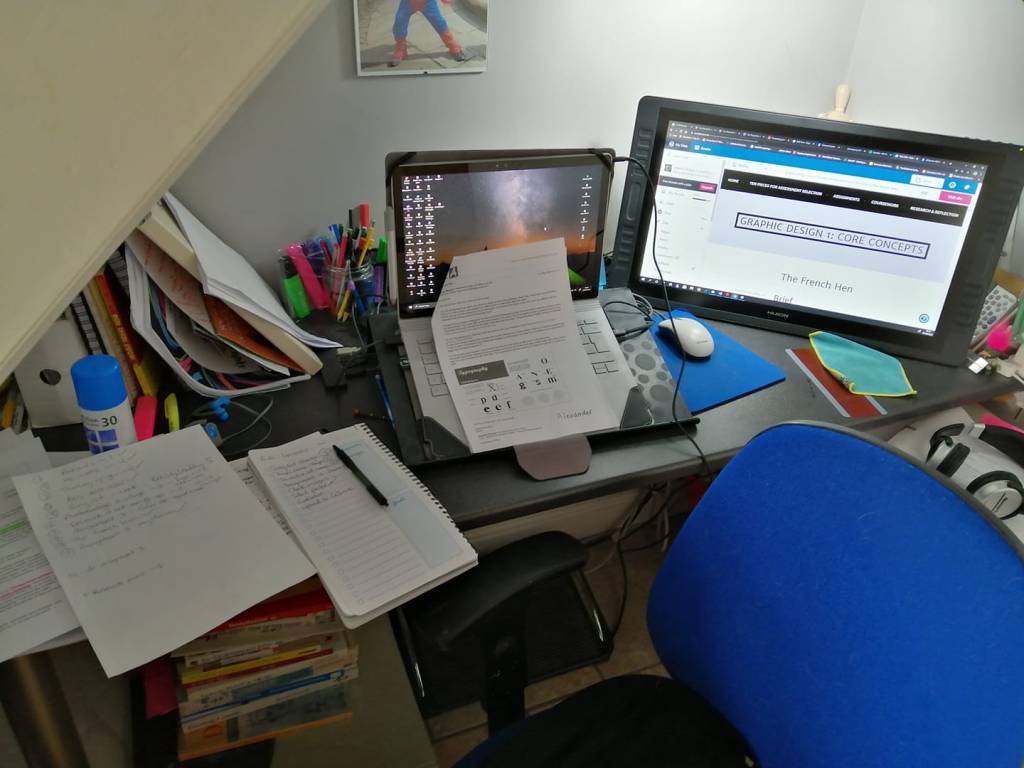
As stated in a previous research point, my creative space is currently under my stairs. I could work in my utility which is much larger but it isn’t insulated, so is freezing during the winter months. By working under the stairs, I can monitor my two children as I am in the centre of the house. However, during the pandemic, it was difficult to concentrate on my work with everyone at home, so I moved into my utility for a short time.
I felt at times like Harry Potter, but I have got through to the second year of the degree using this space so it can’t be too bad. When I need to paint, print or illustrate large pages, I will use the kitchen table to work from.
I am excited to say in the next couple of months my husband and I are transforming our children’s playroom into a studio as the children have outgrown the playroom now.
Below is my current working space.
What do you need to succeed?
Reading the handbook, I considered areas that I have found difficult in the past and what I can do to prevent any struggles with my studies.
Areas I have struggled with in the past that have affected my studies are:
Children being off school because they are unwell.
My ill health.
Bereavements.
These events did unfortunately take time out of my studies and made working difficult. However, at the moment life is okay, and it has made me determined to work extra hard and I think it is important to make sure I keep in touch with my tutor about how I am doing and to make sure I plan my studies around school term times.
 Visual Skills 2