Take a blank piece of paper, ideally A2 size, and an ordinary HB or 2B pencil and begin to make marks in the top left-hand corner of the paper. At first make small, short marks, but as you begin to work across the paper start to make them larger, stronger, and more varied. Continue to work across the paper and begin to fill it with these gestural marks. Vary the length, density, and shape of the marks as much as possible as you draw across the sheet of paper. Perhaps small ‘zones’ of the paper will consist of short, vertical marks, while another area might be formed of curling doodles or small circles. Fill the whole sheet of paper with marks, lines, and shapes, although you may need to sharpen the pencil as you go. It might take some time, maybe a few hours or even a day or two, to completely fill the paper. Don’t try to fill the sheet of paper in one go, you can take breaks and return to the paper over a period of time. The intention of this exercise is to reach the point where you are not thinking about the next mark, but simply enjoy letting the pencil and the marks you have made guide you along with no conscious effort.
When you have finished, and the sheet of paper is filled with detail and variation, take two ‘L’ shaped pieces of card and frame five sections of the paper, about 12-15cm square. Think about the variation of marks, density and visual content of each of the five selected squares. Take photographs of them and give them one-word titles that relate to the emotional or sensational affect you think they have.
OCA Text book, Visual Skills 2, Assignment one, option 1.
Keywords from the brief
A2 paper
Make marks top left corner
Small short marks
Then make marks larger stronger and varied.
Very length, density, and shape of marks
take two ‘L’ shaped pieces of card and frame five sections of the paper
Take photographs of them and give them one-word titles that relate to the emotional or sensational affect you think they have.
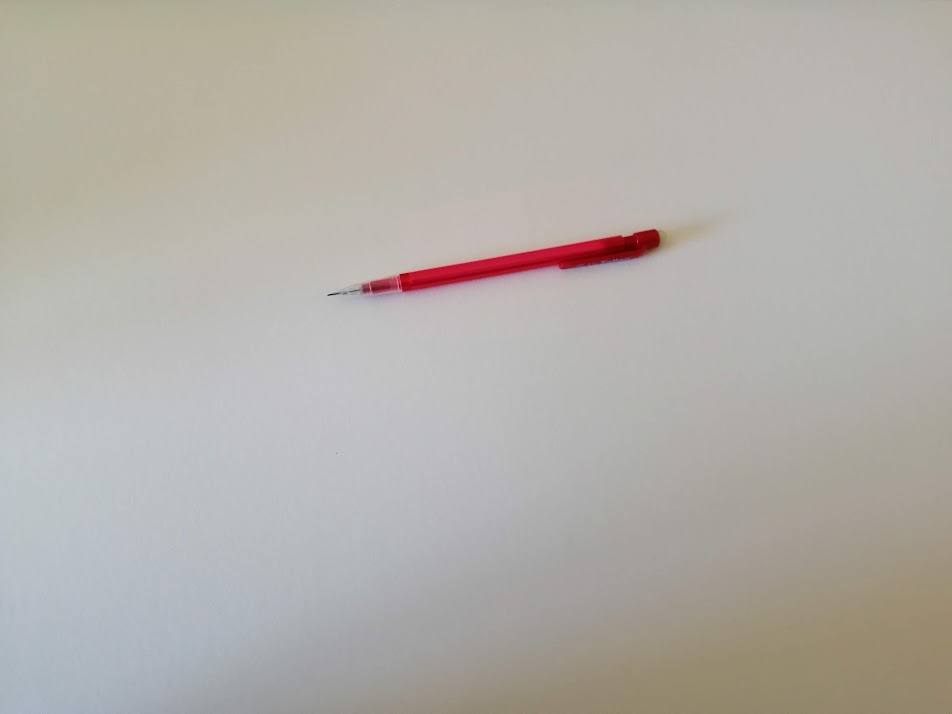
Despite the fact that the brief stated that this task should be completed with a pencil. I did not want to because that is my safety net, something I am used to and find simple to use. Pencils are also my safety net because they allow me to erase any mistakes. As a result, I wanted to test myself by making marks that I could not erase.
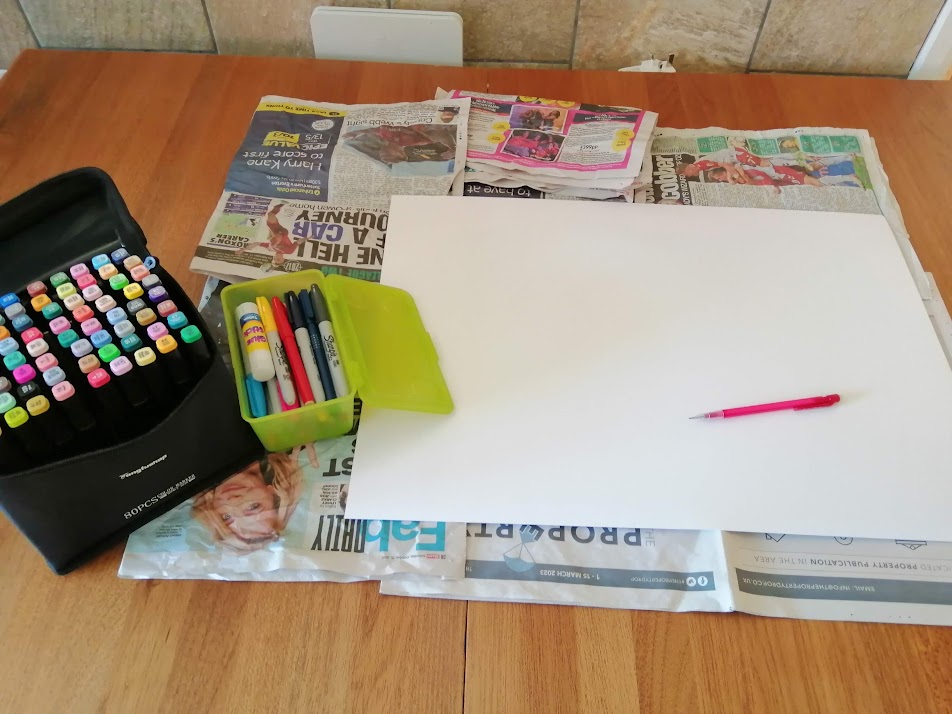
Looking around, I picked up some coloured markers and sat down in front of the card.
As you can see in the photo below, it was quite intimidating.
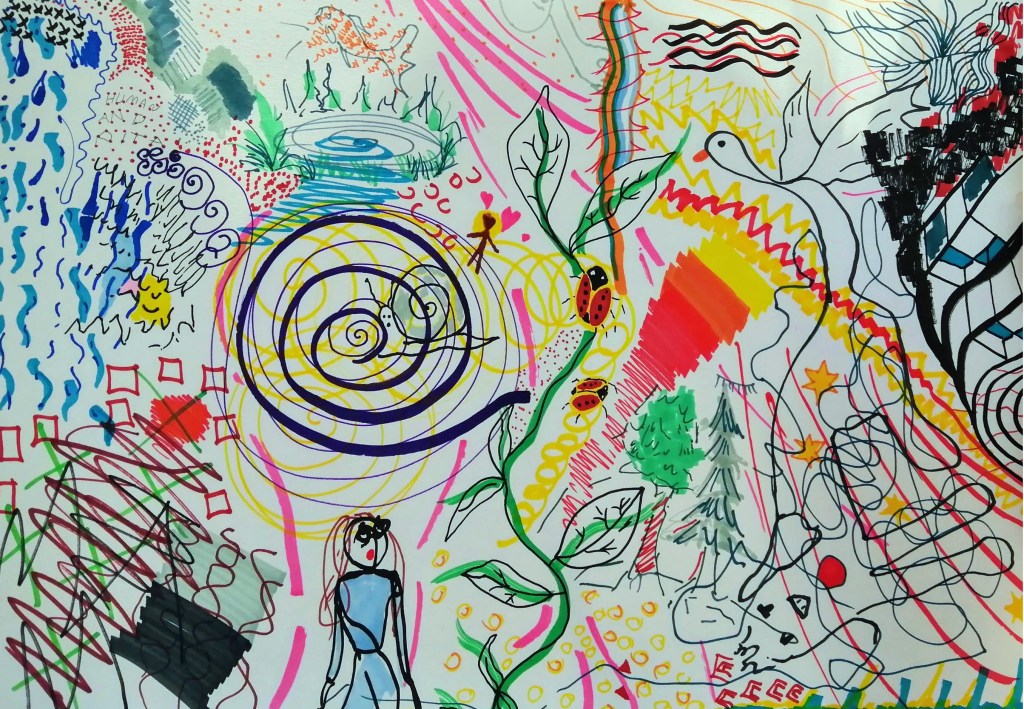
However, when I reread the brief, it stated to begin in the upper left corner and make small marks. I did this by making small dots, and as I did so, I became more daring to try different strokes, patterns, and shapes. I also listened to music and occasionally made marks in relation to the song’s beat. Below is a photo of the filled-up card.
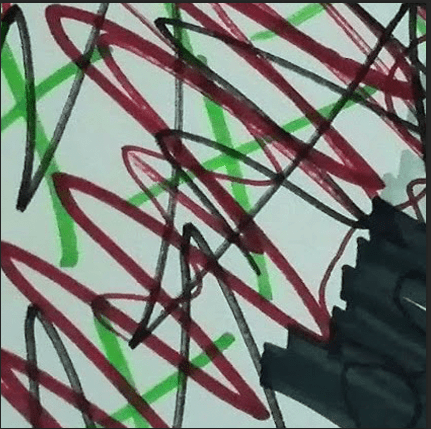
I then scanned in the drawing and cropped five sections of the image in Photoshop. I used Photoshop to measure and rotate the canvas because it was easier.
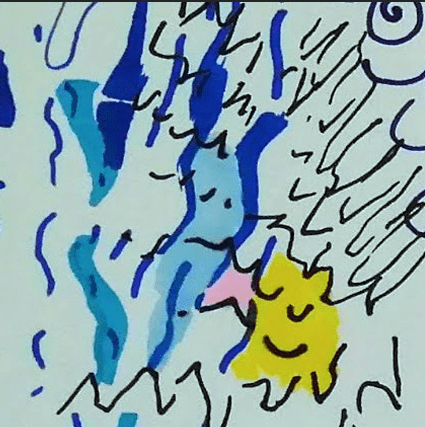
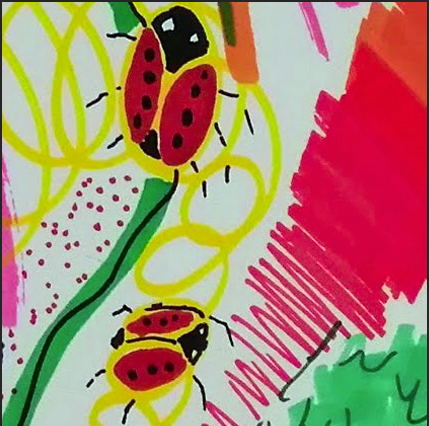
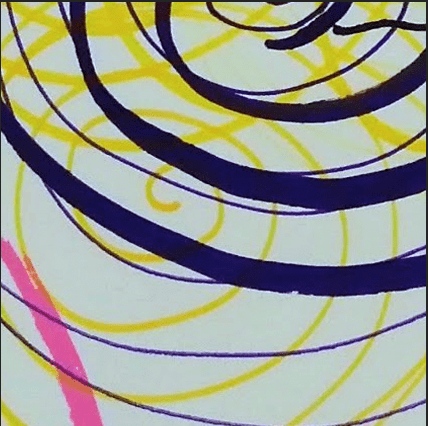
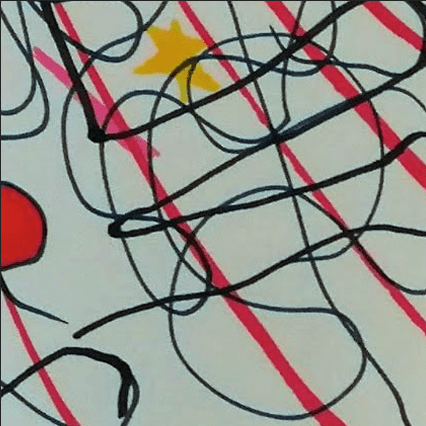
The selected five images and one-word titles I have given them are listed below.
Anger
Depression
Happiness
Dizzy
Stress
Reflection
While drawing, I kept thinking about the artists I had previously researched and tried to remember that this was a playful exercise, not a beautiful drawing.
As previously stated, I purposefully used pens to challenge myself not to be afraid of making mistakes. This was a significant challenge for me. However, once I put pen to paper, I realised it was not as bad as I had imagined, and it did not matter what mark I made anyway.
What I liked about this work was that it took what I thought was a lot of scribble and turned it into some interesting. Smaller images were made that now show deep emotion. These smaller images could be developed further in the future, for example, the image of Dizzy could be used on a mug that says Don’t worry, it is almost Friday. Alternatively, the happiness image could be printed on children’s tops.
It would be interesting to compare it using different mediums if I did it again.
I have learned from this assignment that being playful can open my mind to innovative ideas and creativity, as well as help me not be afraid to start a project. This is something I will keep doing when I am stuck for ideas.
It was fascinating to see how, when I created new images from one drawing, there could be an emotional response to the image that had not previously existed.
The purpose of this task is to find artists who use “flow and “play” theory in their work and I hope to eventually apply what I have learnt to my work.
Firstly, I looked at the recommended essay entitled Memory, Instinct, and Design: Beyond Paul Rand’s “Play Principle” Michael Golec
The essay was incredibly detailed, and I found it to be quite difficult to read so I hope I have understood it. I believe it to be a critical examination of the famous graphic designer Paul Rand’s design philosophies “Memory, Instinct, and Design Beyond Paul Rand’s “Play Principle.” The essay specifically criticises Rand’s emphasis on the “play principle” in design, which he claimed was essential for producing work that was both visually appealing and useful.
Analysing the quote above and from my understanding of the essay, the author of the essay is arguing that, while the play principle can be useful as a starting point for designers, it is insufficient to produce magnificent work. Instead, to push the boundaries of what is possible and create designs that truly resonate with spectators, designers must be willing to draw on a variety of different cognitive resources such as instinct and memory.
Next, I looked at some of the recommended artists and I researched first Hilma af Klint.
Hilma af Klint
Hilma af Klint was a Swedish painter best known for her abstract works. Originally, she began as a botanical and landscape artist. Her later works were created in the late nineteenth and early twentieth centuries, long before abstract art as we know it today. Her paintings were notable for their use of bright colours and geometric shapes, as well as spiritual and mystical themes.
Many of Hilma’s paintings were part of a series titled “The Paintings for the Temple.” She explored various spiritual ideas through these paintings. What fascinating was that she began holding seances, during which she said the spirits would send her images, which she would then paint. I am not religious, but could she have seen something from the spirit world? Surprisingly, these artworks included a total of 193 pieces. The paintings frequently feature complex geometric patterns and abstract forms that are meant to represent spiritual ideas and concepts. Her paintings frequently feature bold and vibrant colours that radiate energy. Her paintings also use a variety of textures and patterns, with some using intricate lines and others using large, sweeping brushstrokes.
Below are some examples of the works.
When discussing a painting she created in 1907, Hilma af Klint said:
“The pictures were painted directly through me, without any preliminary drawings and with great force. I had no idea what the paintings were supposed to depict; nevertheless, I worked swiftly and surely, without changing a single brushstroke.” (Paintings for the Temple | The Guggenheim Museums and Foundation, no date, para. 2)
Above describes the act of play and flow extremely well.
Joan Miró
Following that, I looked at Joan Miró (1893-1983), a Spanish surrealist painter, sculptor, and printmaker. His work drew me in because of its playful and childlike style, which employs simple forms and bright colours to create dreamlike compositions. The colour palette and style reminded me a little of some of my previous work, which can be seen here.
The Surrealist movement, which emphasised the subconscious and unconscious mind, had a strong influence on Miró. He frequently used biomorphic shapes, abstract forms inspired by living organisms, to create works that evoked a sense of mystery.
Miró began to experiment with varied materials and techniques later in his career, creating sculptures and ceramics in addition to his paintings. He kept using bright colours and playful imagery.
Overall, Miró’s work is characterised by a sense of freedom and experimentation, as well as a deep connection to the unconscious mind.
Bob Cobbing
I then looked at Bob Cobbing (1920-2002). I was interested in learning more about him for several reasons: one, I liked his artwork; two, I struggle with typography and thought I could learn something from his work; and three, I enjoy poetry.
He was a British poet and artist known for his work in concrete poetry, I discovered. Concrete poetry is a type of visual poetry in which the design and layout of the words on the page are as important as the words themselves. Cobbing was a key figure in the British concrete poetry movement, and his writing, performance, and publishing activities helped to popularise the genre. Cobbing’s work often featured experimental typography. He used a range of techniques to create his concrete poetry, including cut-up and collage methods, as well as hand-drawn lettering and experimental printing techniques.
Cobbing’s work, in general, pushed the boundaries of traditional poetry and helped to broaden the definition of what poetry could be.
Conclusion
From this research I have discovered that playing (meaning drawing without purpose) and drawing are both important activities that can stimulate creativity and imagination, but they serve different purposes and can have different benefits.
Drawing and playing (drawing without a purpose) are both important activities that can stimulate creativity and imagination, according to my research, but they serve different purposes and have different benefits.
Playing is important because it allows us to experiment and explore without feeling pressured to achieve a specific result or goal. We can try new things, make mistakes, and learn from them. Aside from that, it can assist us in relaxing and improving our mood. As a result, many people enjoy mindful colouring books, which have the same effect.
Drawing, on the other hand, is a more focused and deliberate activity that requires a result, which can be stressful at times. However, drawing can be a useful tool for capturing our thoughts and observing people and objects.
While drawing is important, it can also be structured and rigid at times. Simply playing would allow me to break free from my usual habits and thought patterns. It would motivate me to take risks and explore new opportunities. It would also be useful to ‘play’ if I were stuck for ideas or starting a project and was intimidated by the blank page. To summarise, both playing and drawing have distinct advantages.
For this question, I had to read and answer the following questions.
What do you need to be creative?
I have always had a strong will to be creative. I used to create clay sculptures, Fimo jewellery, write stories, create games, and make pottery on my kick wheel potter’s wheel that my dad and I had restored when I was a young child. Combined with continual painting, drawing, and reading. Yet, I had little skill or interest in anything academic, especially maths. Therefore a good imagination, which I inherited from my love of reading, is important to help be creative. Yet, it also demands perseverance and endurance. I can think of numerous occasions when a project I was creating failed. For instance, a pot I made on my potter’s wheel that was crooked. Or a painting where the paint merged in the wrong place.
I think what I am trying to convey is that to be creative; we need to be willing to attempt new things and explore new possibilities. A gorgeous sunset, a stroll through the woods, a recent artist piece, or something that happened throughout the day can all serve as inspiration for me to get started on my work.
Are there certain factors that are important for you to develop your work?
During this degree I have learnt a lot and have realised many factors that help me to develop. I have gained a lot of knowledge and have realised a lot of things that help me improve my work effectively. I wish I had known these things earlier, but that is progress all by itself.
Below is a list of the factors I have realised help me to develop my work.
Experimenting
The secret to discovering anything that works is experimentation. Regrettably, I do not do enough of this. Usually, this is because I did not allow enough time to include this into my practise.
Time management
This leads me to my next topic, which is time management. It is imperative I ensure that I provide enough time for study, blogging, experimenting, and creating. To allow myself time to take a break from my work. This is crucial because occasionally, after a break, when I return to my work, I can find fresh perspectives or a method to advance the project.
Research
I always undertake extensive study before starting any work, and it helps me to produce fresh ideas.
Environment
I need a comfortable workspace because I find it difficult to produce ideas while my kids are yelling and frequently fighting behind me. In addition, with my pets demanding my attention. This is the reason I am currently converting my children’s old playroom into a studio. It will improve my progress by having a room set up with inspiration boards, relaxing music, a creative workplace, and a peaceful environment to work in.
Collaboration
I was quite shy at the start of the course and did not want to share any of my artistic attempts. I thought I was not good enough and was afraid of other people’s judgements. Now, I no longer think in this way. It is crucial to share my work, and I frequently do this by uploading images of my projects to the Discord chat site. I also send pictures to my loved ones and friends. My peers’ feedback is extremely helpful to me. Yes, it is a little intimidating when I first upload my work because I obviously want people to appreciate it. However, they may spot something in the creative piece that does not work. It might be the composition, alignment, or typeface, and by showing my work to others, they get a different viewpoint and can provide their ideas. I may incorporate their ideas into my work and develop it accordingly.
When, where, and how do you work? How might you develop this approach further?
I work primarily under my stairs as was previously mentioned. Here, I conduct research, write blogs, and create computer-generated designs. I will, however, utilise the kitchen table or an art table that is in my children’s playroom when I need to be creative. I work primarily during my children’s school hours, but I also try to squeeze it in whenever and whenever I have free time.
Given your creative process, how do you best document your work? What kinds of questions do you use to reflect on your work?
Any time I finish a piece of creative work, I will take photos of it and post it to my WordPress blog. I will describe what I did followed by a reflection on what worked and what did not during the creative process. I have a lot of questions for myself when I consider my work, some of which might be as follows:
What inspired me in the project, and how did that influence me?
What method did I use, what techniques did I use?
What were the biggest challenges I faced during the project and how did I overcome them?
What about this work do I like the most, and how could I make it better if I were to do it again or work on something similar in the future?
What did I learn while creating this piece, and how can I apply what I have learnt to future work?
What do I want to explore or experiment with in future works, based on what I learned from this piece?
How can I challenge myself creatively in my next project, and what new techniques or approaches do I want to try?
Does the work contain a message or meaning and what impact do I hope it will have on others? (Depending on what the artwork is)
How important is reflection to your process?
In my process, reflection is important. But when I first started the degree, I did not understand why it was so helpful; instead, I just thought it was a hassle. However, I now realise that it helps in my ability to comprehend my own artistic process. It makes me aware of my weaknesses and strengths, which help me produce new strategies to use in future projects. Also, it reveals to my tutor where I am having trouble, so they may offer me advice. It is helpful to reflect on my work so I can explain to people why I did what I did and what the meaning was. Overall, it helps me grow my skills and artistic expression.
Can you develop new questions or prompts?
One question I realised I forgot to include above is, did I achieve what I set out to do? And if not why? This question then leads to, has my plan shifted or changed since starting, and if so, how?
What feedback have I received from people? Did this assist me in the development of the project?
How does this reflection help feed back into your making? How would you describe your creative process?
I am a little confused by this question because I feel like I have already answered it, but to sum up, the reflection process is helpful because it gives me a way to move forward. I can strengthen my weaknesses and develop skills that I might not have known I had if I had not thought about the project in detail.
What sort of stages do you go through to initiate and develop your ideas and work?
Understanding the brief
To start a project, I will read the brief, then create a list of keywords from the brief. This helps me to understand what the problem is and how to find the solution.
Collect information
Next, I will collect relevant information. These could be books, photographs or anything that will give me inspiration.
Research
I will research the topic first, but along the way sometimes my ideas shift and develop in a way I didn’t imagine. Therefore, I will need to continue to research throughout the project.
How important are restrictions to the process?
It is crucial to have limitations during the project. It is easy to get distracted by something and run out of time to do the remaining tasks on the project. For instance, as said above I spend a lot of time researching, which helps me produce ideas, but because I do it for too long, I frequently run out of time to experiment and explore.
Do you start with an idea or proposal, start making and see where it takes you, or work in a different way?
I would say yes, that is how I work. I do start with an idea and see what happens, but sometimes I wish I would explore more avenues.
Do you have any strategies to deal with creative blocks or obstacles? What does experimentation look like to you?
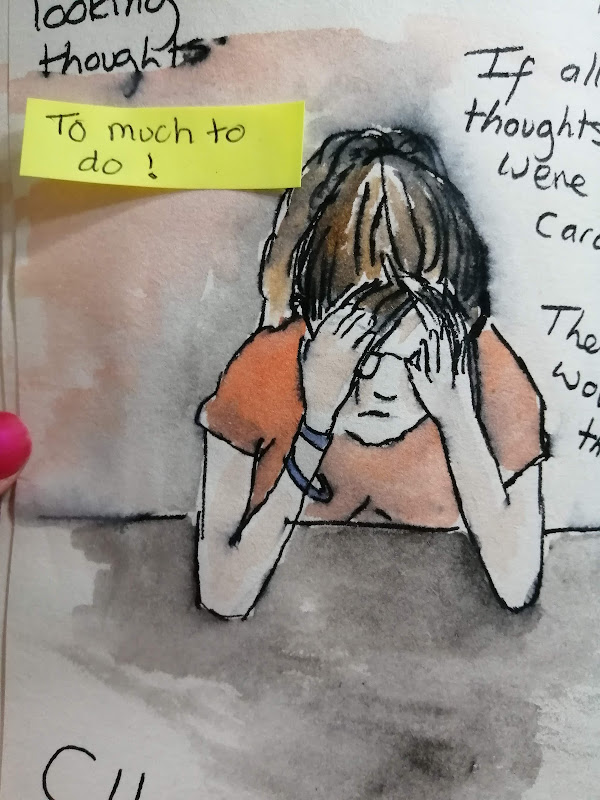
I need some help with this. I frequently get creativity blocks, at the start of a project. I do not handle it very well. I get discouraged and put off dealing with the obstacle. I am aware that this is not helping me.
Where do you work, what kind of physical spaces do you need? When do you work, and how best can you structure your time?
As said before, I am in the process of setting up a studio and work when my children are at school.
How do you draw on inspiration to feed your creativity?
I currently get inspiration from books, the internet, and Pinterest. I am aware, though, that I need to widen the places I find inspiration, such as museums and art galleries. Nevertheless, I have a tough time scheduling time for this because I squeeze study time into the week around collecting the children from school. Plus, I do not live close to any art galleries and the children’s activities fill the weekends. I could do with some tips on this from my tutor.
For this research task, I had to look at a range of artist and designers that have developed projects over-time.
Bryan Eccleshall
The first person I researched is Bryan Eccleshall. I started by watching a short video of Bryan Eccleshall talking about his challenge that he set himself which was to create a drawing a day for a year.
After years of employment, it was great news to discover Bryan has returned to his artistic pursuits and is now a renowned artist and tutor at OCA.
Whilst watching the video, I discovered he created drawings that he purposefully did not want to be too showy or dramatic but a catalogue of illustrations as part of his self-challenge, and when they are viewed all together, they become a work of art.
Below is a quote from his video:
“If I just do something, and keep doing it, something will happen.” (Parry, 2013)
This quote has been a source of inspiration for me as I am often scared to begin something and will put it off. As he said, I just need to act and keep at it, and hopefully something will happen in my creative process. Through his challenge, he has noticed an improvement in his drawing ability, a quickening of his workflow, the addition of new techniques, and the creation of a catalogue of illustrations.
Christian Marclay
I then did research on the movie “The Clock” by Christian Marclay and I watched a portion of the movie on the internet, which in full is a 24-hour-long montage of motion picture and television clips.
We can see part of the film below.
Each clip reflects or refers to a certain time of day. The movie keeps pace with real time, and each clip appears at the same moment it depicts, creating a captivating experience for the viewer.
The movie contains snippets from a variety of genres and eras. He and his team have arranged the footage to give the feeling of a continuous story. His group of six assistants spent years looking through film footage to discover the ideal snippets to use in this movie.
As I watched part of the movie, I noticed that Marclay and his team put clips from different films together in a clever way, making the audience think about the past, present, and future. This lead me and possibly other people too feeling anxious about our lives. Are we utilising our time in the best way possible? It made me think how many times I look at a clock each day? I think about making sure to get my children to school and to their after-school clubs, cook dinner, and start the bedtime routine, all according to a timely schedule. I am always aware of time in many other circumstances as well. What would life be like when not conforming to the clock? The film most importantly underlines the importance of the present.
Overall, the movie experience is very intriguing and is a clever work of art which will cause viewers to think about how they spend their time.
On Kawara
On Kawara was a Japanese conceptual artist that explored time, language, and human existence. He was born in 1933 in Kariya, Japan, and lived and worked in various cities around the world until his death in 2014.
Below is an interesting video I watched where three art curators discuss Kawara’s artwork. The artwork was exhibited at the Guggenheim Museum.
The “Date Paintings,” which Kawara started in 1966 and lasted up until his death in 2014, are what make him most famous, according to the film. Each painting is based on the passage of time, is painted in monochrome and have the creation dates on top of the canvas for each work. The dates are painted by hand in either white or black letters. The paintings frequently represent their place and culture by being made in many time zones and languages.
It was pleasing to see that the exhibition was held at the Guggenheim Museum, as this was a particularly significant venue for On Kawara’s work, as he had long admired the building’s architecture and believed that its spiral design and open interior space emphasised the passage of time.
Kawara’s other notable works include the “I Got Up” series, in which he sent postcards to friends and colleagues every day for two years, each one stamped with the time he woke up that day. He also created the “One Million Years” project, which consists of two sets of bound volumes, each containing pages upon pages of printed years and dates. The first set lists the years from one million years ago to the present day, while the second set lists the years from the present day to one million years in the future.
Douglas Gordo
Douglas Gordon, like On Kawara, is an artist known for conceptual works that explore time. His other works explore memory, identity, and perception.
One of Gordon’s most famous works is, “24 Hour Psycho,” a video presentation of Alfred Hitchcock’s classic film “Psycho.” It was first shown at the Tramway gallery in south Glasgow in 1993. The film was played in slow motion for twenty-four hours. By stretching the film’s duration, it encourages viewers to consider the emotional as well as psychological impacts of time and memory, Gordon has created a sensation of paused time.
Overall, Gordon’s work frequently uses perception, repetition, and distortion to question traditional ways of seeing. By doing this, he is encouraging viewers to question their own perceptions and assumptions.
Tatsuo Miyajima
Japanese modern artist Tatsuo Miyajima is known for his use of digital technology and his exploration of time, space, and life cycles. He enjoys creating performance artworks to create interactive experiences for his audiences.
His work is motivated by three ideas: “keep Evolving,” “connect with everything,” and “continue forever.” He has produced many long-term projects one which he is most famous for is “Counter Void”: This project features a room filled with LED counters that count down from nine to one. The subject and purpose of this project is to question “life and death.”
Below is a video where Tatsuo takes you through one of his sketch books and explains the meaning behind his work.
Alfredo Jaar
Alfredo Jaar is a Chilean-born artist who is known for his socially and political works of art. He has created numerous projects throughout his career, but one of his most famous and influential projects is “The Rwanda Project” which he began in 1994.
When I investigated this project more, I learned that it was a project in response to the 1994 genocide in Rwanda. I did some further study because I was unfamiliar with the history of the genocide and the reasons it occurred and thought this would help me to better understand Alfredo’s thought process.
I started by doing some research on Google, then I watched some films about the genocide in Rwanda.
One video of such is displayed below.
I was shocked and saddened to learn what had occurred. I learned that the Rwandan genocide claimed the lives of about a million innocent individuals in just 100 days. Two ethnic groups, the Hutus, and the Tutsis, were battling over the land they shared for many years. Many Tutsis fled the nation after the Hutu community overthrew the Tutsi monarchy in 1959. Later, to help the Tutsis community with their return to their homeland, they established the RPF and signed a peace treaty with the Hutus in the 1980s. Yet, on April 6, 1994, a Hutu president was killed along with everyone else on board the aircraft that had been shot down.
Extreme Hutu groups in revenge planned to massacre the Tutsis people in large numbers after blaming them for the crash. Women and girls were seized as sex slaves and many Tutsis were killed with machetes. Three months were spent with their bloodshed.
After the genocide, Jaar visited Rwanda to record the destruction and produce a body of work that would bring attention to the catastrophe. The project had several parts, including a collection of images, a video display, and a public engagement.
The video below displays a portion of Alfredo’s creation. I teared up a little when I read about what happened in Rwanda and when I saw Alfredo’s response in his artwork.
The film mentioned above shows a record of 17 front covers from Newsweek issues published between April and August into Alfredo’s exhibition. None of the front covers, save for the last, refer to the genocides taking place in Rwanda. At the base of each cover, Alfredo writes a brief caption outlining the events in Rwanda. The last cover of The Seventeen honours individuals who have perished in genocides. This serves as an emotional ending to his artwork.
His work is quite straightforward but incredibly moving and thought-provoking as a tribute to the Rwandan victims. Together, the covers demonstrate how art can be used to speak out against political and social injustices as well as to bring attention to human rights crimes. It also serves as an example of what journalists should not do.
“I don’t like, and I do not except the term political artists. We are all artists and we all critically engage with the world because we act in the world so everything, we do represent a conception of the world in that sense we’re all political. When it is not critical, when there is no conception of the world, that is not art, that is decoration.”
(Louisiana Channel, 2013b)
This remark spoke to me since, after finishing college, I battled for years to rediscover my love of art. The purpose of drawing seemed pointless since a camera could capture every detail. After thinking about it I realised and understood that I wanted to produce work that had a purpose and a meaning rather than merely a drawing.
With all the artists I have looked at, his is my favourite and most inspirational body of work.
Next, I answered the following questions from the OCA textbook
How might you produce a similar daily project?
As Alfredo inspired me the most out of all the artists, I have thought about how I could produce a similar project to his but based upon a different topic.
First, I would need to identify the issue that my project will address. It could be a social issue, an environmental issue, something based upon current news. I would then need to research the subject to understand the problem better and think about potential solutions. I would need to think about what I wanted to achieve from creating this artwork. I would start with a mind map of ideas and then develop selected ideas further into a detailed plan.
What could the subject or content be?
As said above the subject content could be based on social issue, an environmental issue, something based upon current news. Having a quick look at what is happening in the world today I realised sadly there will always be something I could create. For instance, as a starting point the subject could be about any of the following below.
Poverty
Knife crime
Racism
Ukraine War
Think of things that happen regularly but might change slightly, like going to the shops, or reading a newspaper, or a domestic routine.
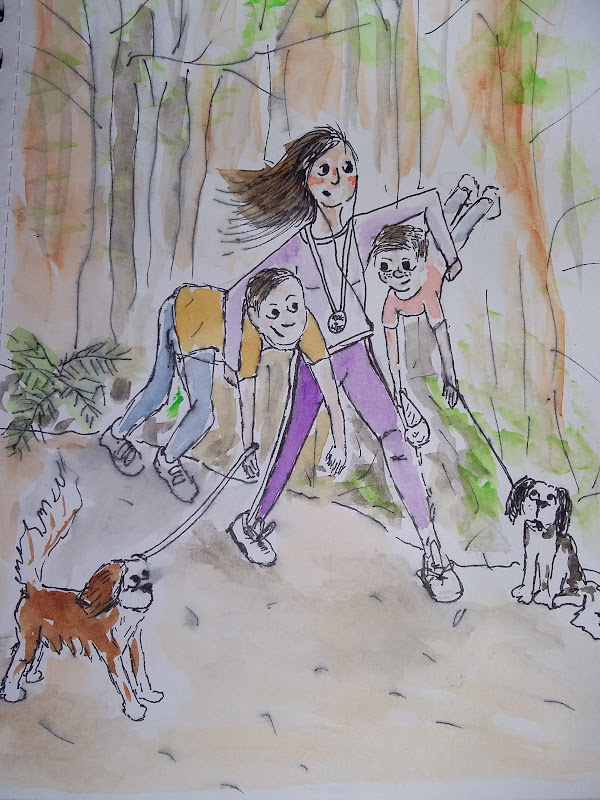
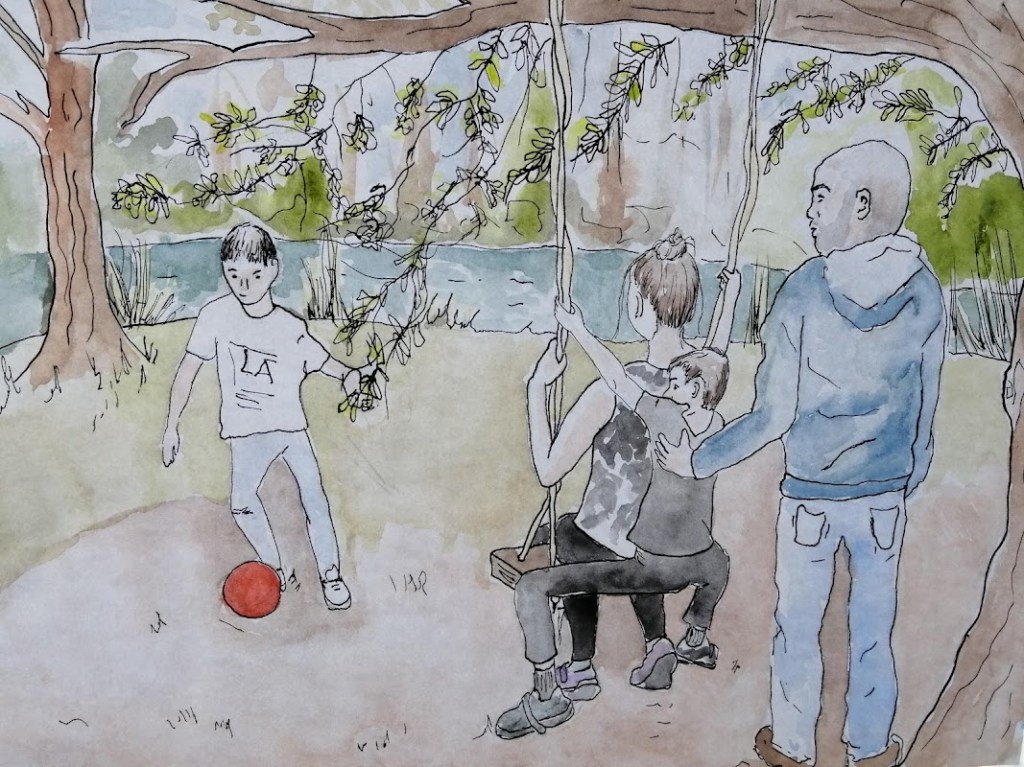
I have always wanted to make a daily diary of what has happened in my day using illustrations, this is thinking very differently from the ideas above. I often consider how bizarre something was and how my life would make an excellent comic book. For instance, one time when I was walking through the woods near my house, a middle-aged woman dressed all in red came skipping towards me singing before she vanished into the distance. This kind of thing is unusual, therefore would be an interesting starting point.
Here is an illustration I created while I thought back on a walk I took with my children. As you can see, it was not as relaxing as I had hoped and is the sort of thing that I would put into the diary.
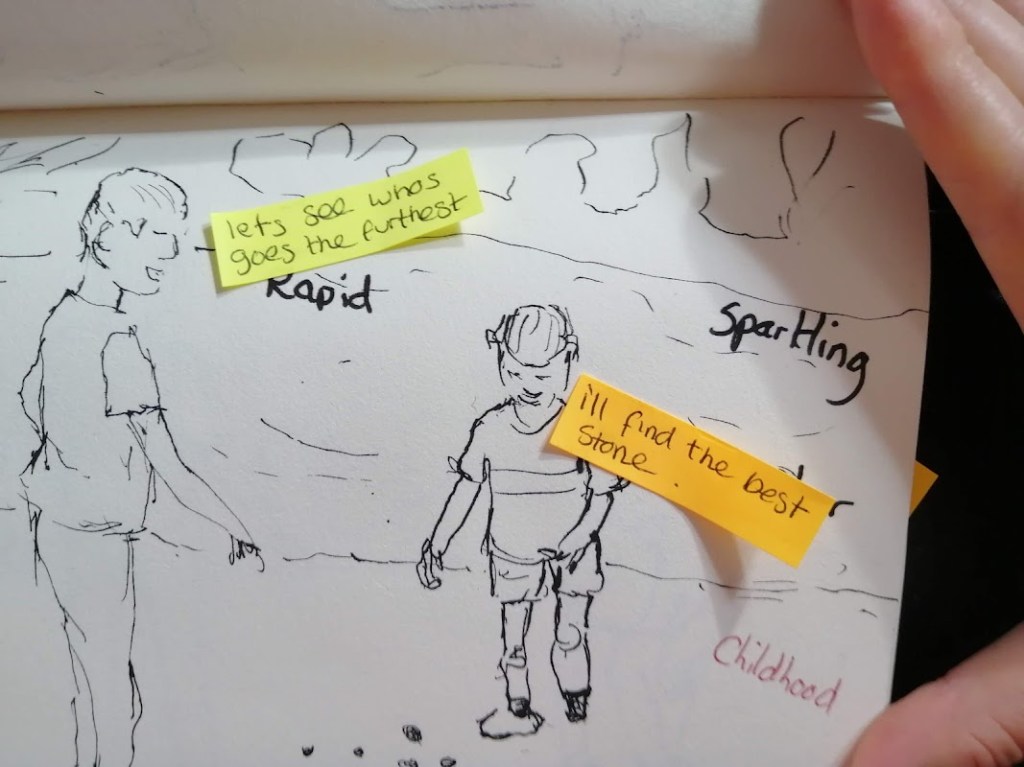
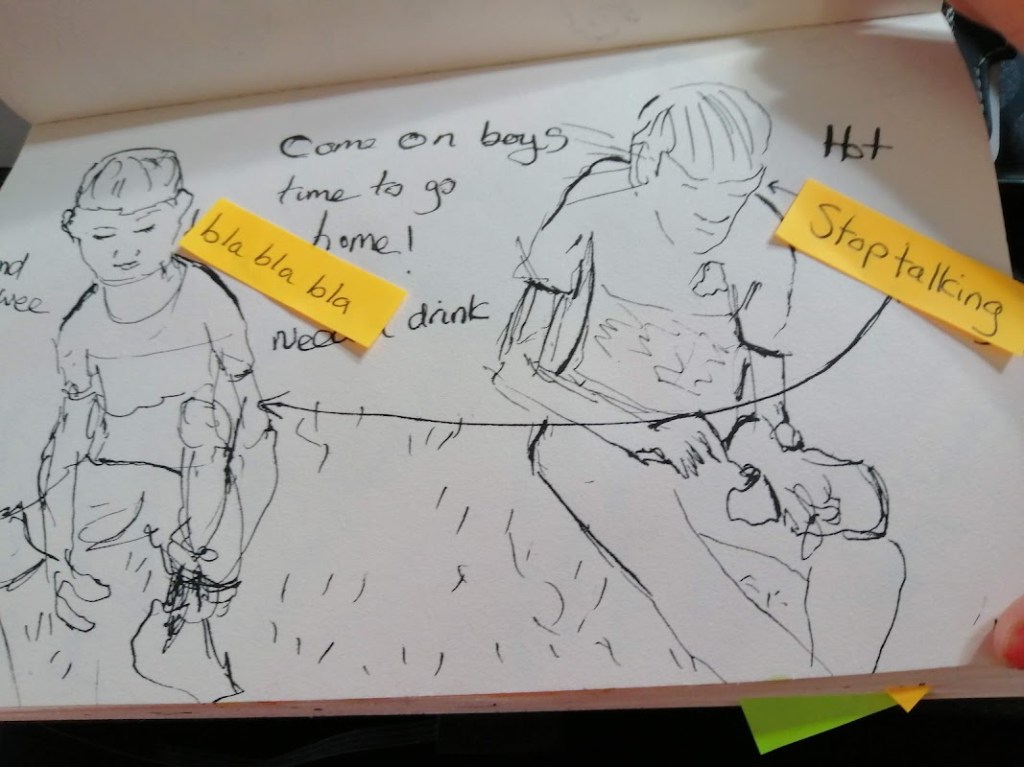
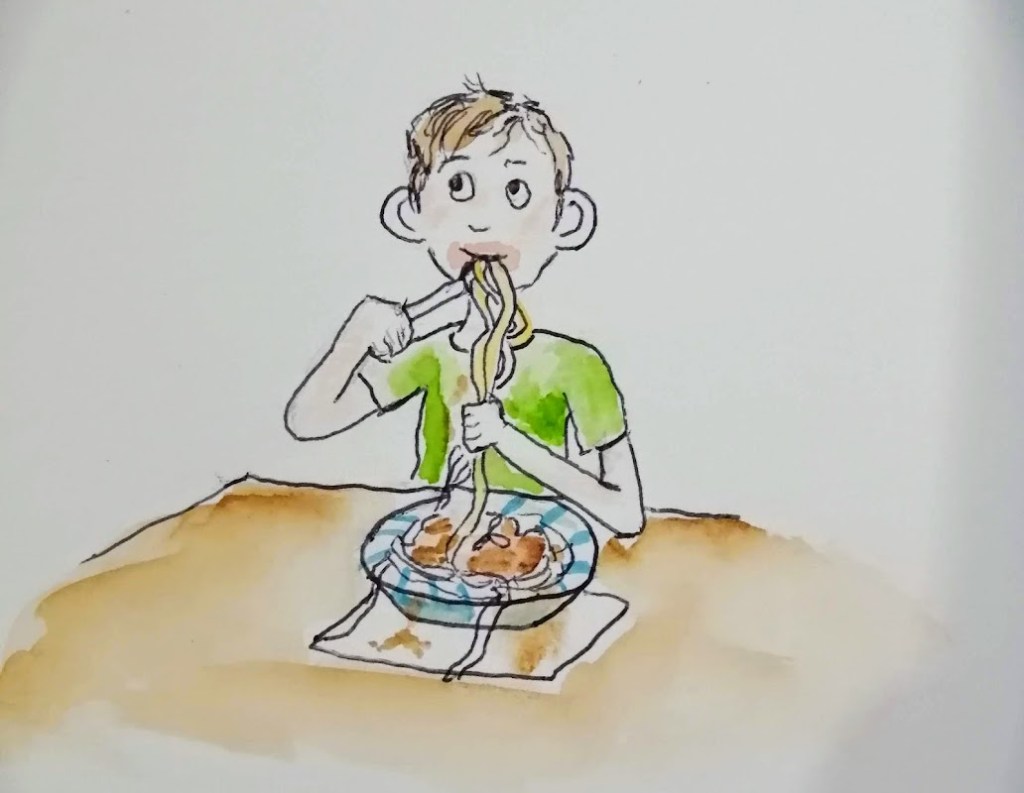
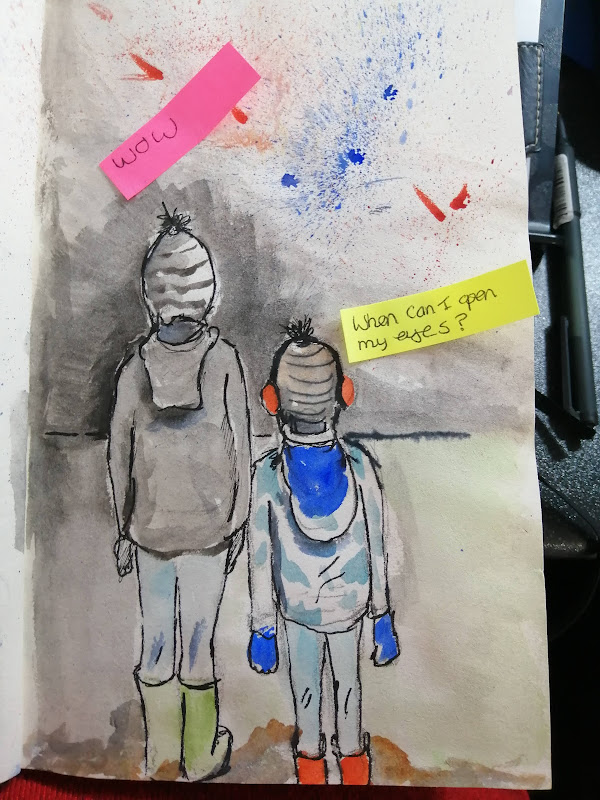
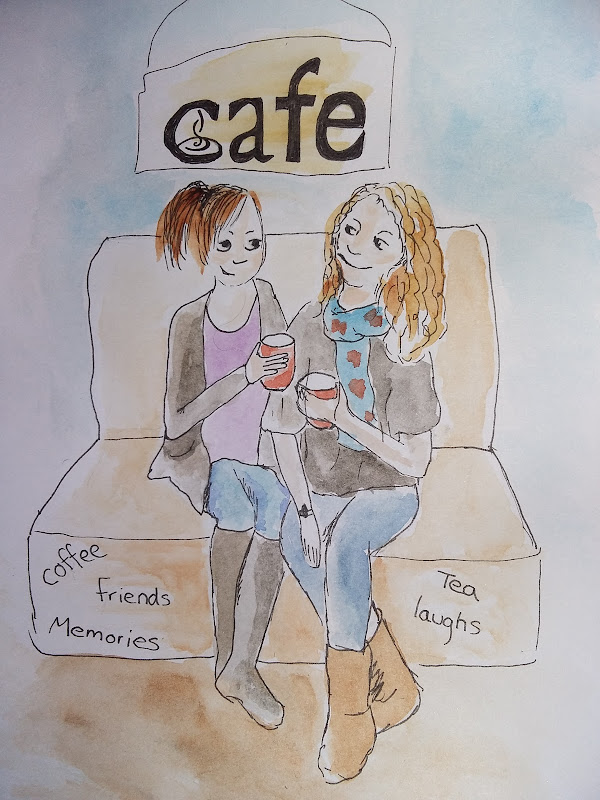
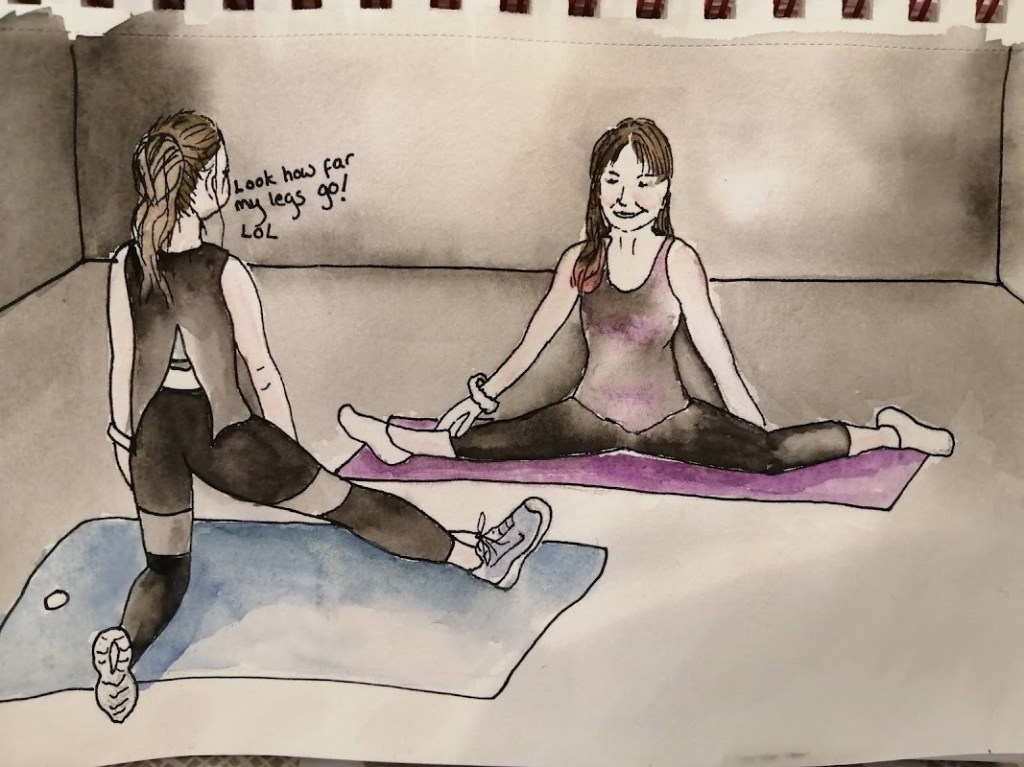
Below are some other examples of the type of illustrations I could include.
How could the way you record it vary, or what form might your record of it take? Could it be drawn in a diary, or as a calendar? Could it be 365 photographs of the view outside your window, or a series of collages from the daily newspaper?
As previously said, I intended to compile a diary of incidents that happen in my daily life. This diary may be illustrated in the way shown above using watercolours, but it could also contain photographs and handwritten notes. A few collages from my daily newspaper might also be added so I could refer to the day and other events that were occurring on that day.
I like the concept of keeping a diary since it serves a purpose. I can use it to reflect on what has happened over the year, see how my children have changed over time, practise sketching, and create a special memory to pass down to my children.
For this exercise, the OCA asked me to think about my creative workspace and answer the following questions.
Do you already have a studio or a space where you can creatively experiment and make your artwork?
At the moment, my creative space is under my stair case. This is where I produce all my blogging and any computer generated designs. For other more practical creative works such as painting or drawing, I use a drawing board that is in my children’s playroom or sometimes at the kitchen table. However, in the next few weeks I will be converting the children’s playroom in to a studio.
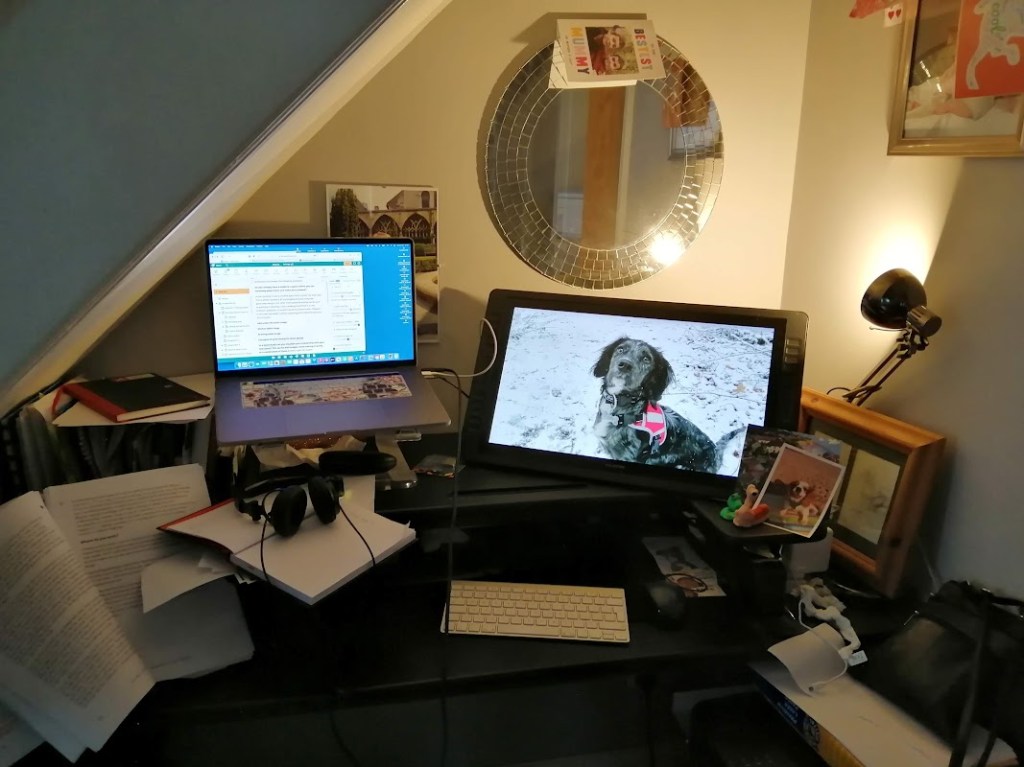
Below is an image of my studio-space that I use most of the time. This is under my staircase and although it is small it fits my laptop, Huion drawing tablet, some reading books, sketchbooks, a daylight lamp and note-pads.
Under the stairs office
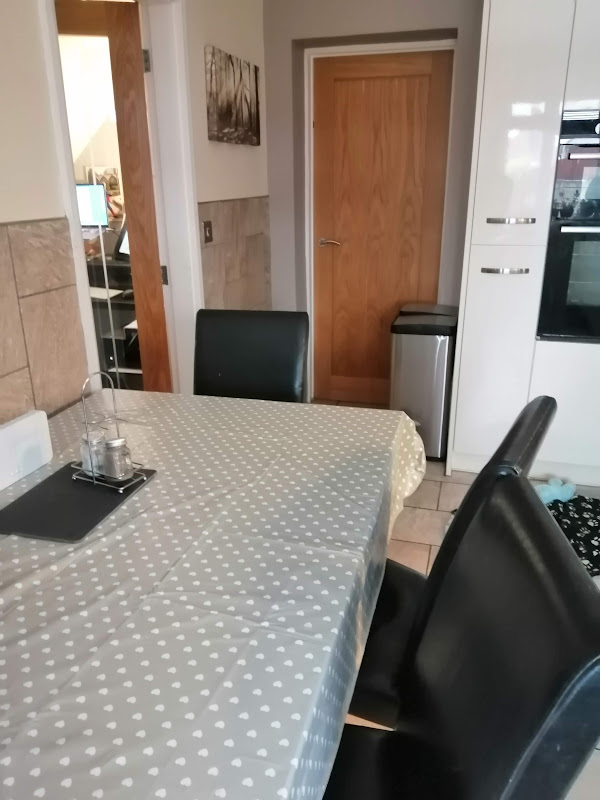
When I need to have a creative space to draw or paint, I either will set up my drawing table or work at the kitchen table.
Kitchen table
Drawing table
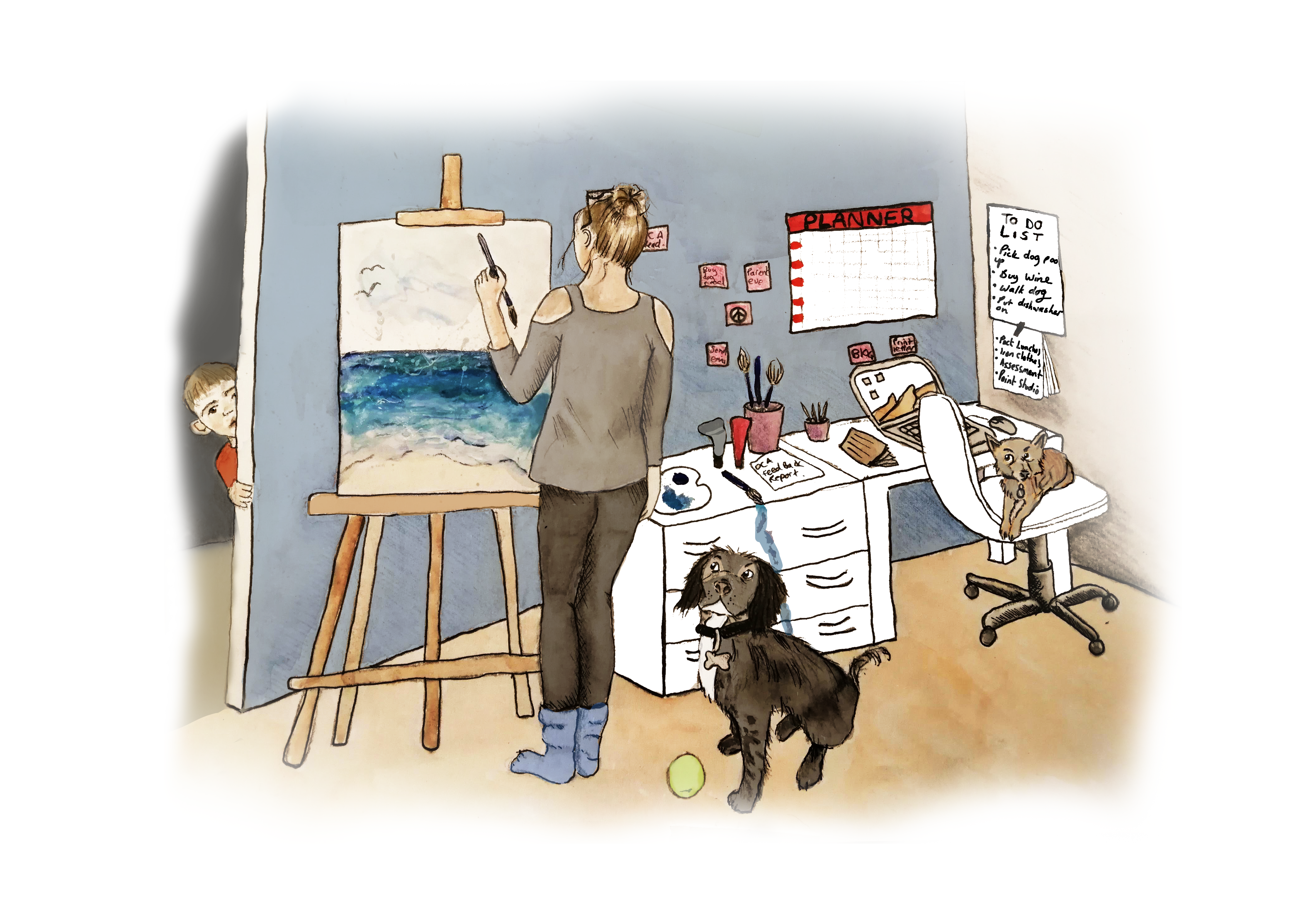
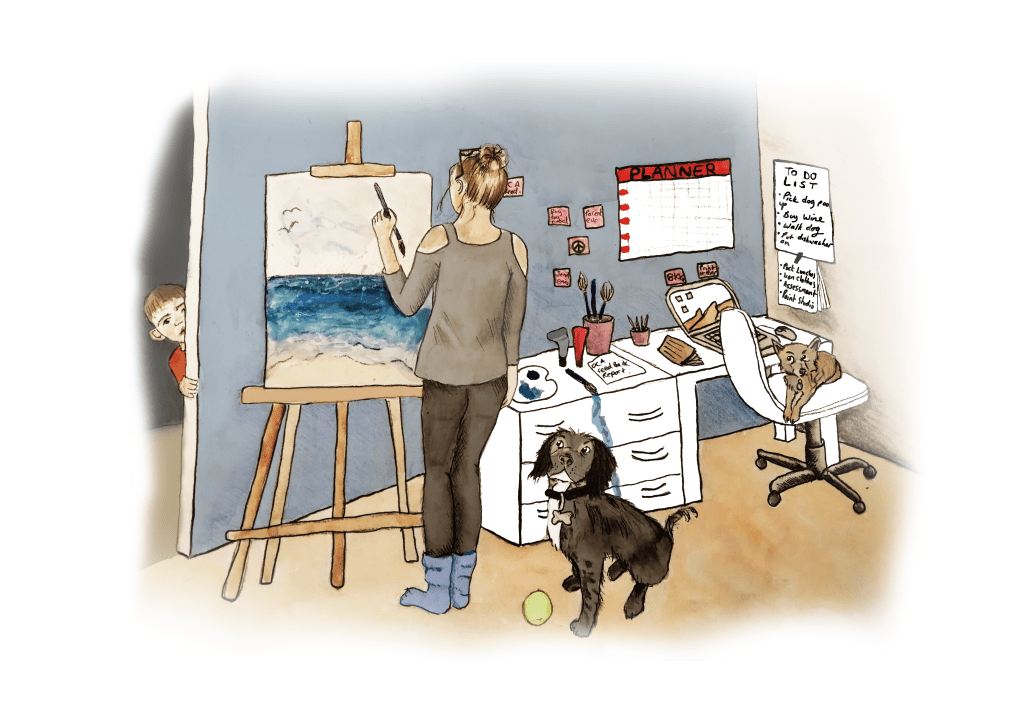
Below is a sketch I drew to show what my typical day working in my studio can be like.
I then developed the sketch further with water colour and pen and changed a few things such as the scale and positioning of my dogs and added my youngest son who is never far from me.
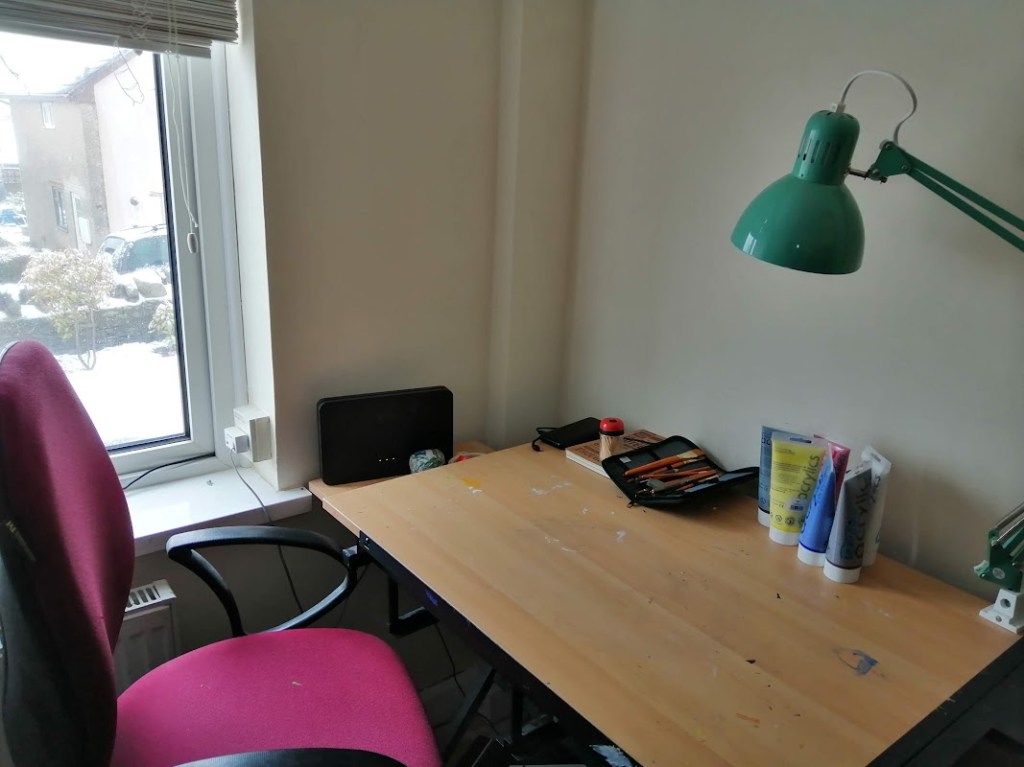
I have been thinking about what type of art I’ll produce in my new studio and the items I’ll need to make a comfortable workspace. Below is a list of things I have considered for the new room.
Good Lighting. I have blinds which I can open to allow natural light in but it can get quite dark so will need to think about alternative artificial lighting too. A bright light that won’t create shadows in my workspace.
Comfortable Seating: I have an office chair which is adjustable, but I would also like to get an adjustable stool to support me while I work at an easel.
Storage: Currently I have a kallax unit from Ikea but it is old and needs replacing. I will probably will get the same as it has lots of storage to organise my art supplies and tools. Around the room, I’ll also be adding lots of shelves. I would like to get a drying rack too, as I have found it difficult to find places for prints to dry.
Inspiration Board: Around the room I am going to hang artist’s work that inspire me and put up a corkboard to display my ideas, sketches, and images that inspire me.
Sink and water: Thankfully, I have a utility with an old sink where I wash all my pallettes and brushes.
For this research, I needed to read some OCA student quotations about their creative process. Then view a Stephen Johnson film that explains the source of good ideas and recognize any statements I agreed with.
“I generally start with an idea and a plan. But the plan usually changes during the process.”
Ros, OCA Textiles, Level 1.
I am in full agreement with the previous statement. I start with a concept and develop a plan from there. As I work on the first idea, the plan can change, and a completely different idea can come out of it.
“I have not been making art for very long yet and only just started to reflect on the process. For OCA exercises, I tend to start with realistic pencil drawings in order to get to know my subject. I then gradually leave that by changes in media and bolder interpretations. It is at this stage I feel creativity kicking in. I try to do many different versions because the doing sets in motion a chain of thoughts, ideas and things to explore. I stop when the ideas cease or I have a picture I am happy with.”
For my own work I go a similar path if I start with an idea of what I want to do. If I haven’t I mess around with water and water soluble media until I see something emerge. I then use that as a starting point. This makes for very surprising subjects and often abstract ones.
Ideas pop up at unexpected times and I have started to jot them down. When I am not able to develop them visually I use words. I think I should combine the two – visual and verbal – as they lead to different things. Verbal is faster and so allows for a train of thought to flow more freely. Visual development takes hold of a first idea and develops that out of the processes involved.”
Sibylle, OCA Drawing, Level 1.
I agree with the above statement. In my work, I usually begin with a pencil sketch and then when I am sure of what I am attempting to accomplish, I become more at ease with the question. This then gives me more motivation to try more mediums.
“I often start out with an intention but the work finds its own way somewhere else and that’s ok. Sometimes work that I’ve done for an exercise will offer itself up for development into something else and that’s fine. Once the work’s started it often feels as if I’m chasing after it rather than guiding the work.”
Kate, OCA Photography, Level 1.
The above statement is sometimes the way I work. I can have an initial idea, but as I work on it, it can lead to something different.
Next, I watched the recommended video ‘Where Good Ideas Come From’ by Steven Johnson. Then answered the following questions in response to the video.
Do you agree with Johnson that ideas take time to develop?
I agree with Steven Johnson’s idea that good ideas take time to develop. In his video, Johnson argues that many of the world’s greatest innovations and inventions were not the result of a sudden “Eureka!” moment but emerged slowly over time, through a process of trial and error, collaboration, and sharing of ideas.
Johnson points out that many of the most significant breakthroughs in the world have resulted from “slow hunches”. Each idea often gradually developed over weeks, months, or even years. He suggests that this process of gradual idea development is critical to creating truly innovative ideas.
In my opinion, this is an accurate description of how ideas often develop. It’s rare for a brilliant idea to appear fully formed out of nowhere. More often, it’s the result of a long process of experimentation and refinement.
Are his ideas equally applicable to creative disciplines?
Steven Johnson’s ideas about idea generation and creativity are equally applicable to creative disciplines.
In his video “Where Good Ideas Come From,” Johnson argues that creativity and innovation often emerge from a collaborative, networked environment. He uses examples from a range of fields, including science and technology, to illustrate this point.
This idea of collaboration is equally important in creative disciplines. For example, many successful artists often collaborate with others to create new and innovative works. Such as Andy Warhol and Jean-Michel Basquiat, who successfully worked together. From 1980 to 1986, they created many pieces of art together. A popular example of their collaboration together would be the painting of the Olympic rings. (2023)
Furthermore, Johnson’s emphasis on the importance of slow hunches and the gradual development of ideas is also relevant to creative disciplines. A long process of development is used to refine and improve ideas, resulting in many successful creative works. An example where an artist has done this is Graham Rawle with his book ‘Woman’s World a graphic novel’. In his quote below, it explains this long process of development.
“The book took five years to create. I first drafted the novel in outline, then searched through hundreds of women’s magazines, cutting out anything that seemed relevant to the scenes I’d written: sentences, phrases and words that when joined together might be rearranged to approximate what I wanted to say. These pieces were transcribed, filed and stored, and from them I began to assemble my story as a Word document. Little by little, my original words were discarded and replaced by those I’d found. Once the text was finalized, I pasted up each page from the organised snippets. The method was primitive: scissors and glue. Apart from a little post-production tweaking, everything was done by hand.” (WOMAN’S WORLD BOOK, n.d.)
Overall, while Johnson’s examples in his video focus on innovation, his ideas are equally applicable to creative disciplines, where collaboration and the gradual development of ideas are all critical to success.
Do you think collaboration is important to creativity?
Collaboration is an important aspect of creativity. As shown in the video, collaborating with others can bring new perspectives, fresh ideas, and diverse skills to a creative project. Which can lead to more innovative outcomes.
Collaboration also allows for the sharing of knowledge and expertise, which can help to overcome creative roadblocks and generate new ideas. For example, the collaboration between Andy Warhol and Jean-Michel Basquiat shows working with others can result in new techniques and approaches to art-making.
Furthermore, collaboration can provide a support network for creatives. I often will contact my peers using Discord chat. This allows me to bounce ideas off others and receive feedback on my work. This can help to refine and improve ideas and hopefully lead to better and more successful outcomes.
However, it’s worth noting that collaboration is not always necessary or appropriate for every creative project. Some projects may be better suited to a solo approach. Ultimately, the decision to collaborate or not should be based on the specific needs and goals of each creative project.
Given the opportunity, who would you collaborate with from another field or discipline? A scientist, for example, or a writer, or painter?
If I had the opportunity, I would love to work with Quentin Blake. Below are the following reasons:
To start, it would be an amazing experience due to his renowned status as an artist and illustrator.
He has made great strides in children’s literature thus has great experience.
He is best known for his illustrations of Roald Dahl’s books. These were my favourite growing up, especially “The BFG “and “Charlie and the Chocolate Factory”.
Working with Quentin Blake would give me the opportunity to learn from a master and gain insight into his creative process.
I could observe how he approaches illustrating a story, how he brings characters to life through his art, and how he uses colour and composition to create a cohesive visual narrative.
Additionally, working with Quentin Blake would likely be a fun and rewarding experience.
By collaborating with him, I could contribute to a project that inspires and delights readers around the world.
References
W. (2023, February 15). Famous Art Collaborations – AGI Fine Art – Advice Blog. Advice for Artists – AGI Fine Art – Advice Blog. https://agifineart.com/advice/famous-art-collaborations/
For this last exercise of the chapter, Getting Started, OCA wanted me to arrange a 15-20 minute conversation with my new tutor. This is for us to discuss how best to schedule my time, document my work, and share it.
Unfortunately, I had not read the OCA text book or started any of the questions when I first spoke to my tutor. We had already scheduled a date to talk via google meet. As I have already completed many units, I knew what sort of questions I wanted to ask. Yet, it will be interesting to show my tutor all my reflections on these questions and research tasks to get her opinion on what I have written.
For this exercise, the OCA advised me to get in touch with other students. Recommending I share something about my practice. This is because it can provide a social support for my studies.
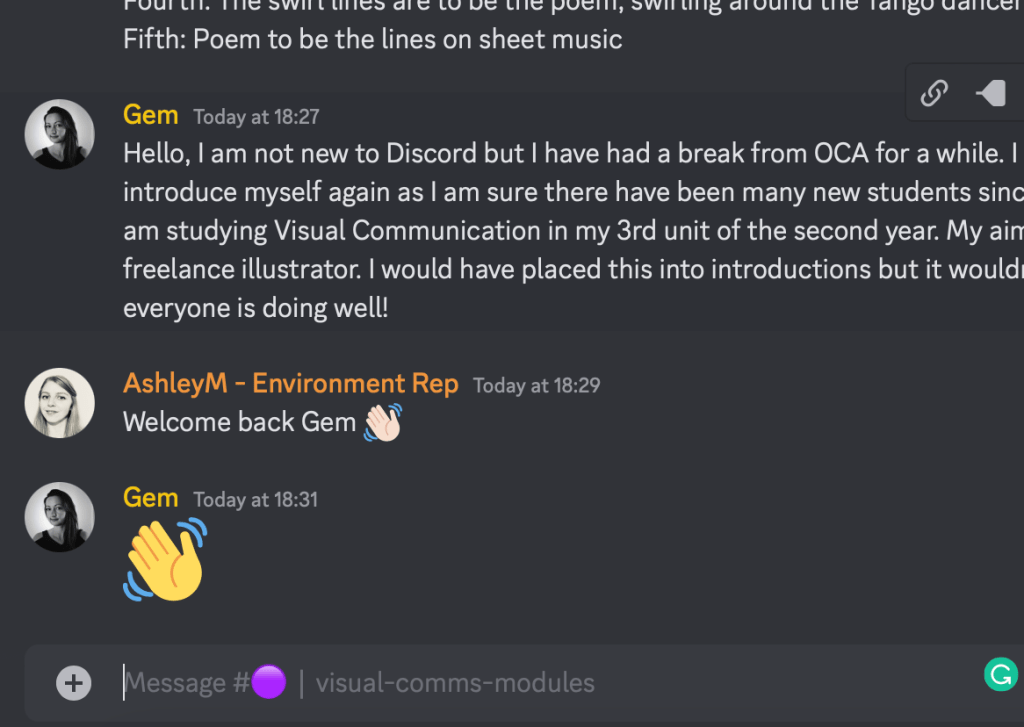
For the first three units, I kept in constant contact with fellow OCA students through Discord chat. It was great because I felt part of a community and could share my work for critique and see other student’s work. However, during the last unit, there were a lot of upsetting and personal circumstances that prevented me from completing the coursework, and I was a little embarrassed at how far I had fallen behind.
Yet, I have decided this is a silly attitude and I still need the support that these students gave me and I hope I helped others, too. Therefore, I am about to introduce myself back to the group.
For this research task, I had to find out what OCASA (OCA’s Student Association) is and what it can offer me in order to support my coursework.
The student Association is something I have not paid much attention to, but I wish I had. Researching the webpage I realised there are many study events that I could have taken advantage of. They can be attended in person and virtually.
Looking at the upcoming events, there are a few I would like to attend, such as:
Lunch & Learn: Study Skills: Managing Stress and Anxiety15 Mar, 13:00 – 14:00Online workshop
Life Drawing with 2bornot2b Collective15 Mar, 19:00 – 21:00Online workshopDevelop your understanding of how mindfulness can enhance your teaching and learning practices, while helping manage stress and anxiety.
Lunch & Learn: Study Skills: Focus, Attention and Concentration22 Mar, 13:00 – 14:00
Lunch & Learn: Study Skills: Time Perception and Organisation29 Mar, 13:00 – 14:00Online workshopThis session will give you an understanding of what solutions are out and how they can work best for your learning working style and course dynamic.

 Visual Skills 2