Brief
Take an A1 (59 x 84cm) sheet of paper and draw a circle about 30cm in the middle of the sheet. Write inside the circle a list of things you like, experiences you enjoy or feel comfortable with. For example, these could be ‘sunshine’, ‘cities’, ‘lying in bed’ or ‘green salads’. Now draw two larger circles 40cm and 50cm diameter around the first circle, as if you are drawing a dartboard. Now in the large circle write things you don’t like and that stress you. These might be the opposites (or ‘antonyms’) of the things in the centre like ‘moonlight’, ‘the countryside’, ‘exercise’ or ‘bacon sandwiches’, but they also might be completely different things. Try to be as expansive as possible, so name experiences, objects, cultural phenomena, etc. Do you dislike all the things in the outer circle, or are they simply the opposites of the things in the centre?
After you have completed this exercise, reflect on your current creative practice and begin to identify what new things you’d like to develop through this course. Below are a series of prompts to help you, feel free to select which questions are most useful or add new questions of your own:
● What do you feel comfortable doing?
● What do you feel uncomfortable doing?
● What areas would you like to develop further?
● What thoughts do you have about your work and where it might develop?
● Where would you like to begin?
● How can you develop ways of working that allows for the new to emerge?
● How are you going to document and reflect on your progress?
Write your responses to these questions and upload them to your learning log.
Keywords from the brief
- Draw a circle about 30cm in the middle of the sheet. Write inside the circle a list of things you like, experiences you enjoy or feel comfortable with.
- Draw two larger circles 40cm and 50cm diameter around the first circle, as if you are drawing a dartboard.
- In the large circle, write things you don’t like and that stress you.
- Be as expansive as possible,
- Reflect on your current creative practice and begin to identify what new things you’d like to develop through this course.
I began by drawing three circles in pencil on an A1 sheet of paper. After that, I coloured each circle a different colour. My danger zone is represented in red, my maximum performance zone in green, and my comfort zone in yellow. I know it wasn’t essential, but colouring them helped me visualise my ideas better.
I began writing everything I am happy and comfortable doing on another piece of paper. Then I wrote down anything that makes me nervous, caused me concern, or caused me stress. After that, I cut up all the text and put them in the appropriate circles.
As the green circle became empty, I began to consider what I had written in both the comfort and risk zone. While reflecting, I recognised areas in my working practises that, if maintained, will allow me to perform better. So I wrote these ideas down and put them in the green zone.
Below is a photo of the finished work.
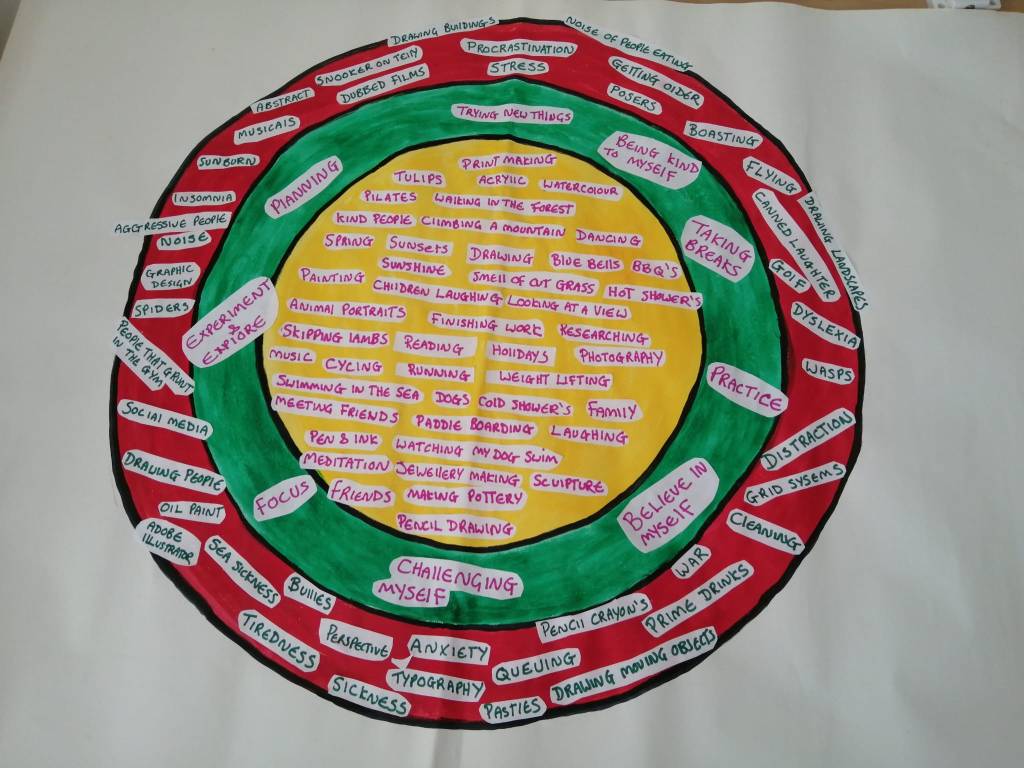
Fig 1: Comfort zone (2023)
Prior to beginning this exercise, there was some information in the OCA textbook that described flow and play, as well as a psychologist named Mihaly Csikszentmihalyi, who explains ‘flow’ as a mental state also known as getting into the zone. (Csikszentmihalyi, 1990). As a result, I did more study and viewed an amazing short film that illustrates the concept of flow. This is shown below. (Flow by Mihaly Csikszentmihalyi animated book, 2015)
Below is a screenshot from the video that helped me understand how I can get into a flow state.
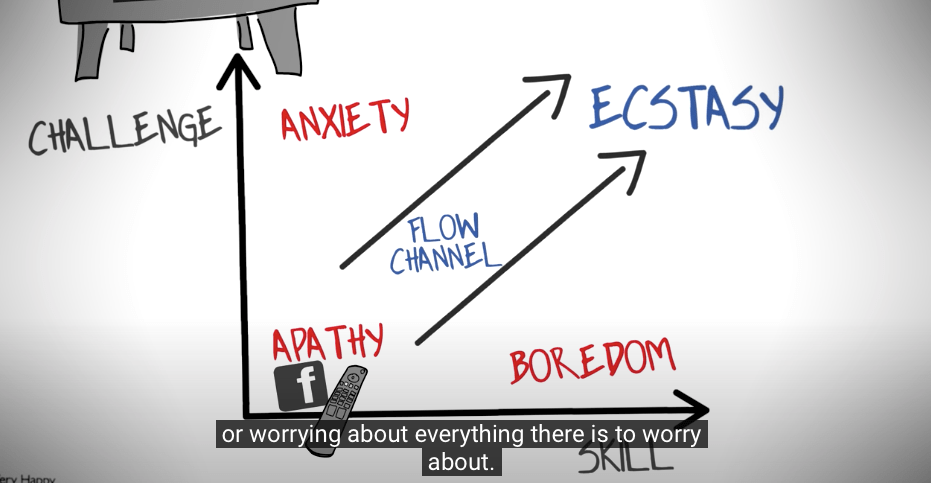
Fig 2 : Screenshot of a flow model (2015)
I then watched a TED Talk by Mihaly Csikszentmihalyi, which is presented here.
He explains what the state of mind can be during an activity and what causes our moods to change.(TED, 2008) The next diagram depicts this flow mode.

Fig 3: The FLOW Model (1997)
Reflecting on the comfort zone drawing I did I decided to see where some of my topics sit within a graph like the one above.
Flow / attention, enjoyment.
- Reading
- Running
- Lifting a new personal best at the gym
- Painting
- Sculpture
- Drawing
- Learning new Photoshop techniques
Control / enjoyment, confident.
- Printmaking
- Planning
- Pen and ink
- Sketching
- Thumbnail ideas
- Spider diagrams.
Relaxation / confident.
- Playing with my dogs
- Walking
- Cooking
- Taking a bath
- Meditation
- Matching a sunset
- Watching waves crash at the seaside.
Boredom / relaxed, depressed.
- Being confined to a grid system when designing
- Drawing detailed buildings
- Same daily routine
- Collage
- Contour drawing
- Studying a topic I am not interested in.
- Distraction
- Choosing the right typography
- Designing my own typography
Apathy / distracted, depressed.
- Watching television,
- Scrolling social media.
- Stoping my children arguing
Worry / stressed, distracted.
- Not being good enough
- Dyslexia
- Procrastination
- The white page
- Juggling study with family commitments
- Not experimenting enough
- Time management.
- Will I be a success or is this a waste of time?
- Am I too old to start this?
Anxiety / alert, stressed.
- Social situations
- Presentations
- Talking to a crowd
- Adobe Illustrator
- Pencil crayons
- Oil painting
- Abstract art
- Drawing movement
- Making mistakes
Arousal / Alert, focused.
- Blogging
- Researching
- Discussing ideas with family and fellow students.
Putting my topics into flow model titles has helped me understand my working mindset. It has shown me I spend too much time worrying about doing the work and trying to create perfection. However, if I spent more time in the areas of control, arousal, and flow, it would help me produce more work and most likely work that is of a higher standard. I need to believe in myself more, which I can do if I push myself but not too hard.
Studying Csikszentmihalyi’s theory and completing the comfort zone diagram helped me identify what I’m comfortable with and areas I want to work on, like building confidence, trying new things, having fun, and enjoying the course. Checking in with the flow model to see if I’m directing myself in the right places is one of my future goals. An Adobe Illustrator course, a confidence-building course, and getting feedback on my work will all help me gain confidence in the near future.
By making sure I spend more time in the three areas of flow, arousal and control, I think I will see a new progression in the speed and quality of my work. This exercise has been an invaluable exercise for me and one that I will continue to use and reflect on with future work.
List of Illustration
Fig 1: Fowler, G. (2023) Comfort zone. [Painting] The author.
Fig 2: Flow model (2015) [YouTube, screenshot] At: https://www.youtube.com/watch?v=8h6IMYRoCZw (Accessed 28/06/2023).
Fig 3: Digital reproduction of Mihaly Csikszentmihalyi’s FLOW Model. The FLOW model (1997), https://www.mindtools.com/a3u4xut/the-flow-model. Accessed 28/06/2023.
Bibliography
Csikszentmihalyi, M. (1990) Flow: The Psychology of Optimal Experience. New York, NY, USA: Harper & Row.
FightMediocrity (2015) FLOW BY MIHALY CSIKSZENTMIHALYI | ANIMATED BOOK SUMMARY. YouTube. Available at: https://youtu.be/8h6IMYRoCZw.
Flow theory: A deeper dive into flow states (no date) Teuxdeux.com. Available at: https://teuxdeux.com/blog/flow-theory-a-deeper-dive-into-flow-states (Accessed: 28 June 2023).
MindTools (no date) Mindtools.com. Available at: https://www.mindtools.com/a3u4xut/the-flow-model (Accessed: 28 June 2023).
Oppland, M. (2016) 8 traits of flow according to Mihaly Csikszentmihalyi, Positivepsychology.com. Available at: https://positivepsychology.com/mihaly-csikszentmihalyi-father-of-flow/ (Accessed: 28 June 2023).
TED (2008) Mihaly Csikszentmihalyi: Flow, the secret to happiness. YouTube. Available at: https://www.youtube.com/watch?v=fXIeFJCqsPs&t=5s.
 Visual Skills 2