Brief
For this research task, I have been asked to look at a one-day conference called ‘The Embodied Experience of Drawing’, held in 2018, in Plymouth. After, I was asked to make some notes about the participants different drawing techniques and physical processes.
To do this, I watched a short video that observed the participants drawing and took screenshots of people’s different approaches.
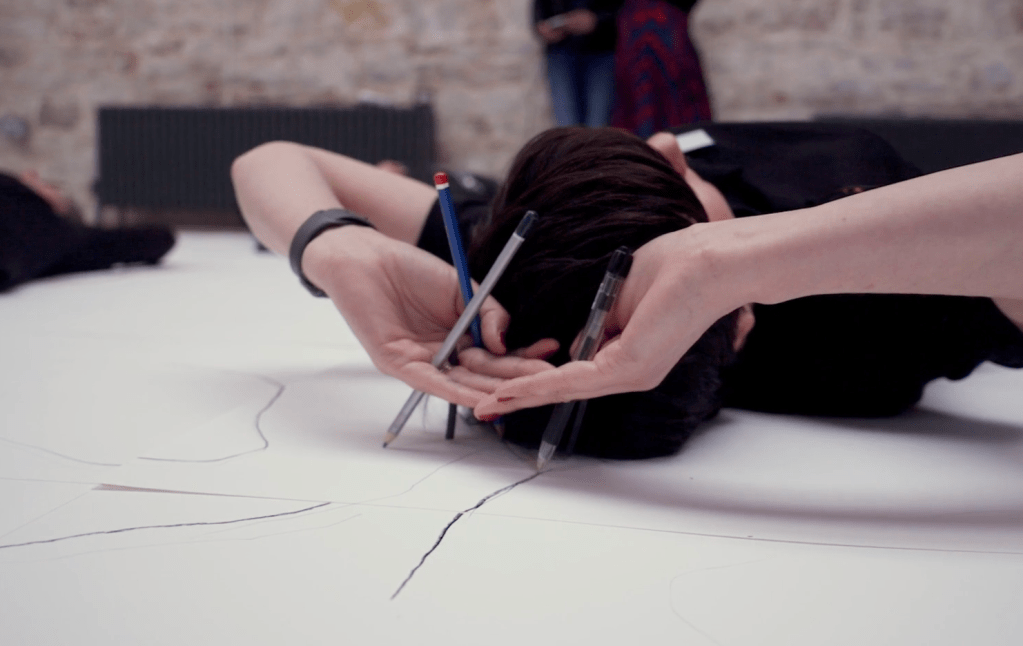
Here’s a picture of one of the conference women, lying on her back. Taking different pens and pencils and making marks on the page without looking at it. The marks made will be limited by the extension from her elbow upwards.
Approach one
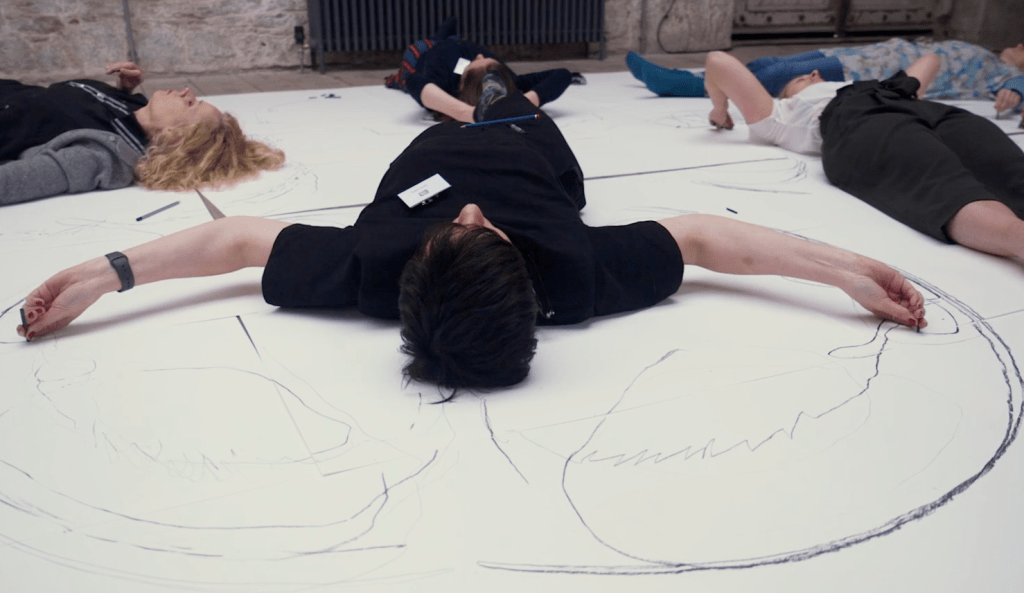
The next image, is the same approach as above but allows a full extension from the shoulders into both arms. This creates a more flowing line work, especially with the medium charcoal as it makes bold expressive lines.
Approach two
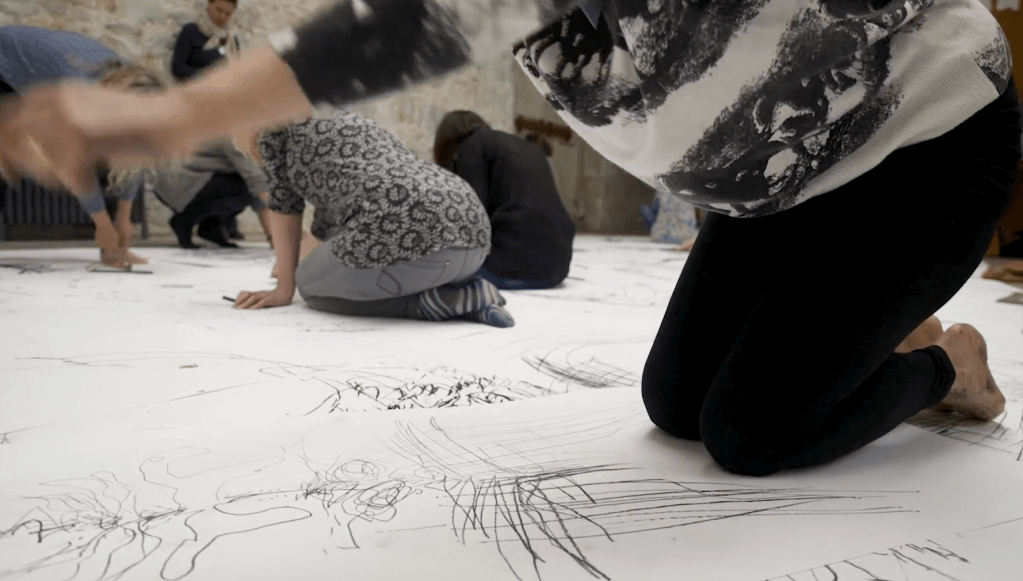
With the next approach, this lady is sitting looking at the paper on her knees. Again using charcoal but this time using the motion of her arms to swish back and forth in front and behind her.
Approach three
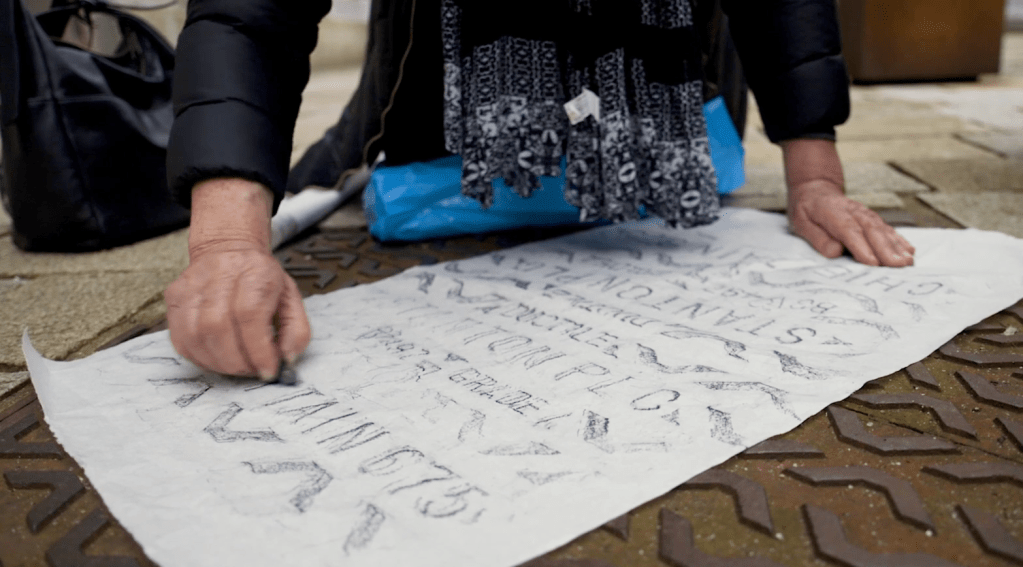
In the next image, the lady is making marks by creating rubbings from various surfaces.
Approach four
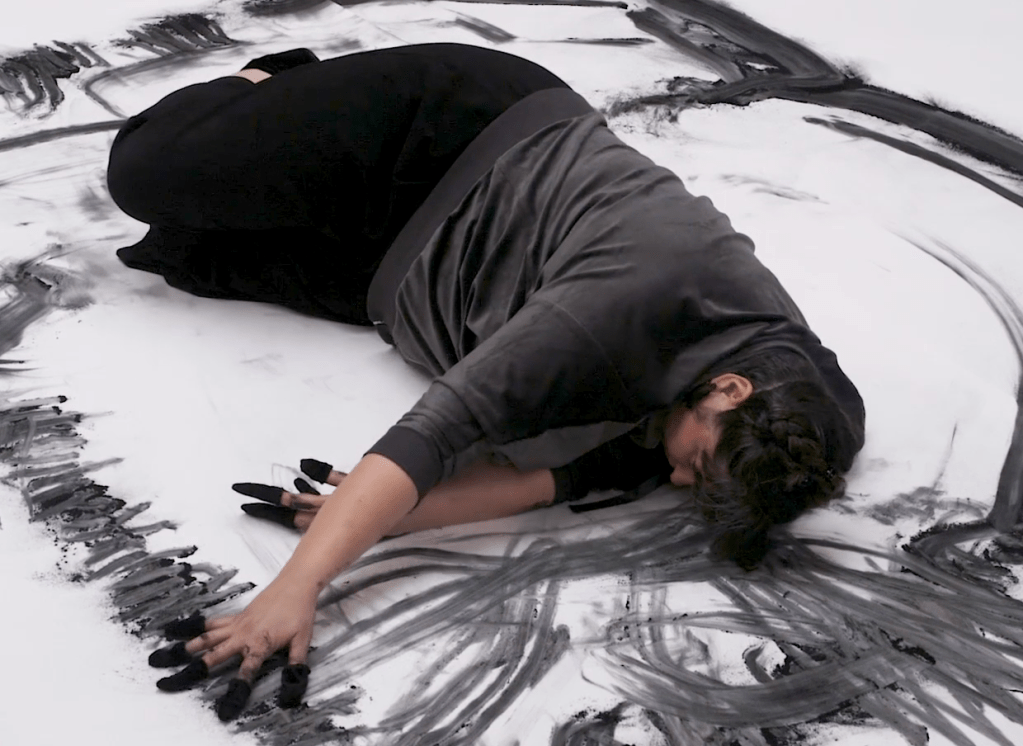
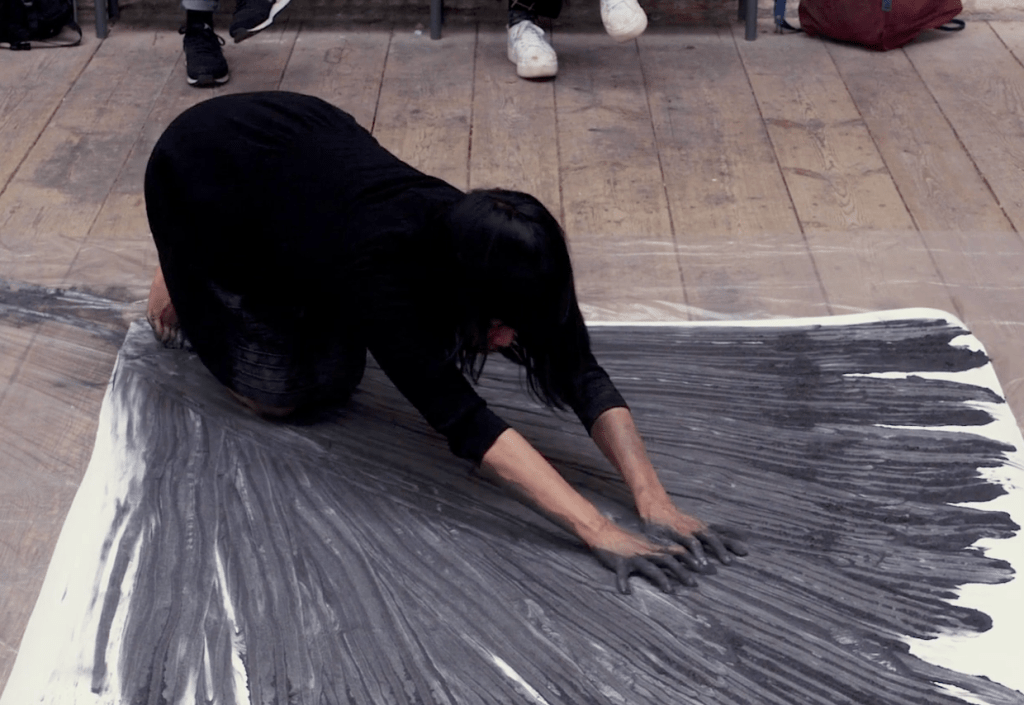
In the next two images, the participants are using their whole bodies to create marks with what I think is graphite powder. This is a more physical approach than the previous ones and will make the most expressive marks.
Approach five
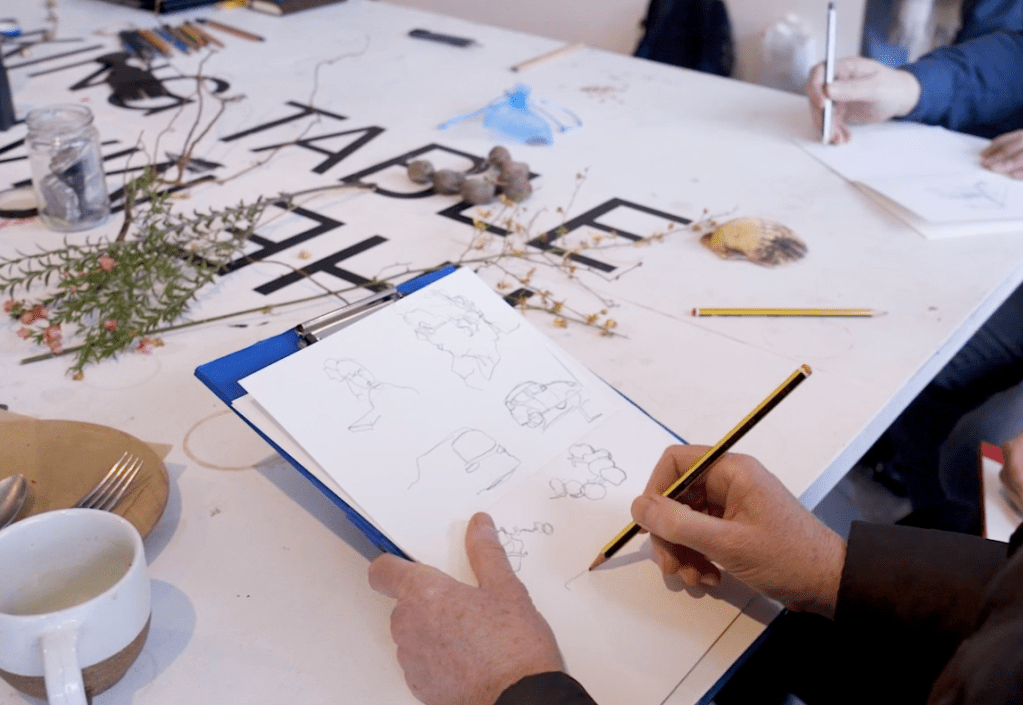
Finally, many artists were practising their observational skills by drawing still lifes.
From watching the video, I can see the purpose of the day was to explore the relationship between drawing and using various parts of the body or the whole body. It would be a beneficial exercise that will help to explore new ways of approaching drawing.
Next, I was asked to search for and record my thoughts on some of the listed artists in the OCA textbook who make large-scale images.
The following artists from the textbook appealed to me:
- Emma Stibbon
- John Vertue
- The Boyle Family
Emma Stibbon
Before starting the previous exercise, which was to create a large landscape scene, I began first, with this research task. One reason I selected Emma, is because Emma is a British artist known for her large-scale drawings and prints that often depict dramatic landscapes and environmental events. This is therefore an appropriate research task before embarking on the previous exercise and I thought I may find inspiration from Emma’s work.
Stibbon has visited remote and environmentally significant places all over the world, such as Antarctica, the Arctic, Iceland, and volcanic regions. Emma creates reference sketches of these natural landscapes, glaciers, volcanoes and polar regions while on location, which she then refers to when creating her finished pieces in her studio. The drawings and prints serve as visual records of her observations and encounters whilst on her expeditions. As she states on her website,
“Many of the environments and landscapes I depict are changing rapidly. As an artist, I feel committed to representing the impact of these changes, be they natural or human. My impulse is to draw, in an effort to act as a witness.” (Stibbon, n.d.)
Stibbon’s drawings and prints are full of detail and powerful compositions. She often works in monochrome, using charcoal, graphite, ink, and other media to create intricate pictures.
Her creations evoke awe; they make me feel as though I’m there, experiencing the moment she has captured.
John Vertue
John Virtue, is a contemporary British artist, known for his distinctive monochromatic landscape paintings, primarily in black and white. Many of his large-scale works consist of dramatic landscapes, often depicting urban scenes, coastal views, and rural landscapes.
Researching online, I found a very interesting documentary where Virtue discusses the makings of his artworks.
He explains his work consists of abstract compositions from the way he perceives the world. In order to do this he is very experimental with the materials he choses to use, such as many different types of brushes, rags, his own hand, black ink mixed with shellac and titanium acrylic. (Virtue, J, 2012)
His artworks consist of bold brushwork, strong contrasts, and are full of movement and energy. What I find interesting about his work is there is a powerful sense of atmosphere and mood even without the use of colour.
Below are some examples of his work.
The Boyle family
The Boyle Family is a group of artists consisting of Mark Boyle, Joan Hills, and their children Sebastian Boyle and Georgia Boyle. It began originally with the mother and father in the early 1960s, when they started to visit demolition sites in London and gathered materials to use in their artwork.
To get a better understanding of who the family are and their artistic approaches I watched the following documentary.
The documentary is very informative and is interesting to see the artist’s approach and visions for their works and the many different projects they have embarked upon. It was also interesting to hear the objective of the works, Mark said :
“The objective is to teach ourself to see“.
I found this statement quite thought provoking as an artist myself, this is what I constantly strive to do, to see exactly what is in front of me and portray it to the viewer as I would like them to see it.
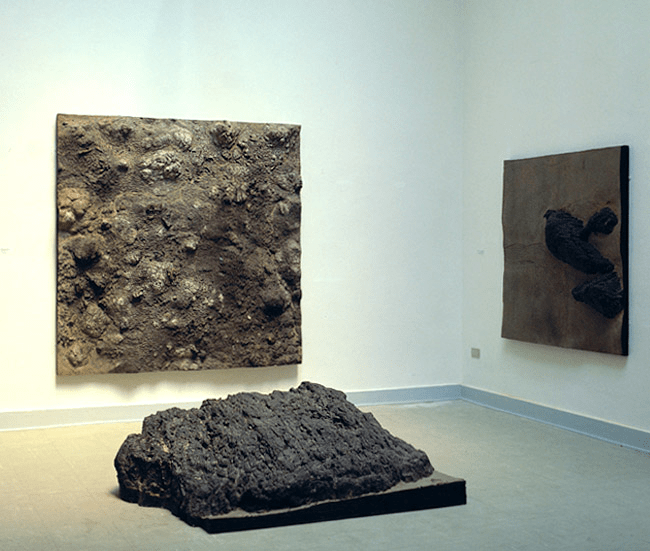
The Boyle Family, all have an innovative approach to art-making, which involves the replication of real-life surfaces and landscapes. They are particularly renowned for their “Earth Studies” series, where they recreate sections of the Earth’s surface in three-dimensional relief, capturing the texture, composition, and detail of specific locations.
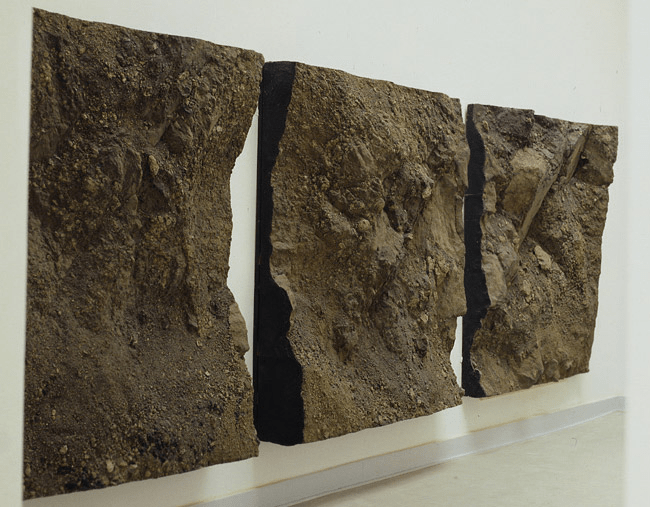
Another study which I found interesting is called “The Multi Human Being series”. Which was the study of different parts of the body. Mark himself took top layers of skin from different parts of his body and then created images from them using a projector.


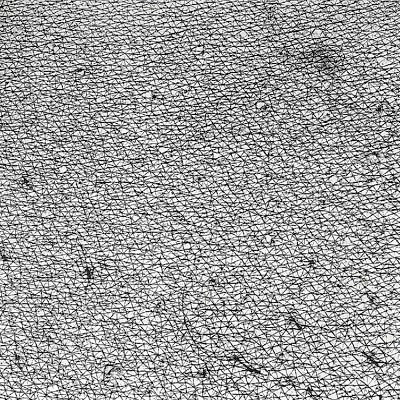
Overall, I find their work challenges traditional notions of what constitutes art and encourages viewers to reconsider their perception of the world around them. I also think, there is a fine line with some of their work. Is it art? or a contribution to science? Is it the study of our planet and everything that resides within it?
After researching these artists I chose Emma Stibbon to ask myself the following questions about her artwork:
How do they choose their subjects?
Emma has a strong desire to document the impact of both natural and human-caused events either on large-scale canvas or via printing methods. In her work, she captures the stunning scenery of the places she visits, but she also records the environmental changes that are taking place. For example, glaciers have broken down before her very eyes as she watched from her moving boat.
How do their creative and material approaches differ?
Emma’s creative approach differs from working in the field to working in her studio. Whilst in the field she often collaborates with scientists and geologists that give her information on why something is happening and she has to work at speed to capture the information.
When back in the studio, Emma can use her sketches and digital photos she has taken as reference for her large-scale artworks, and she can be much more experimental and spend longer on fine details. Often, she will incorporate materials taken from the environment she was in. Such as volcanic ash, which she then mixes into ink and uses in some of her artworks.
Below is an example of one of these artworks, this particular one is from a volcanic scene.
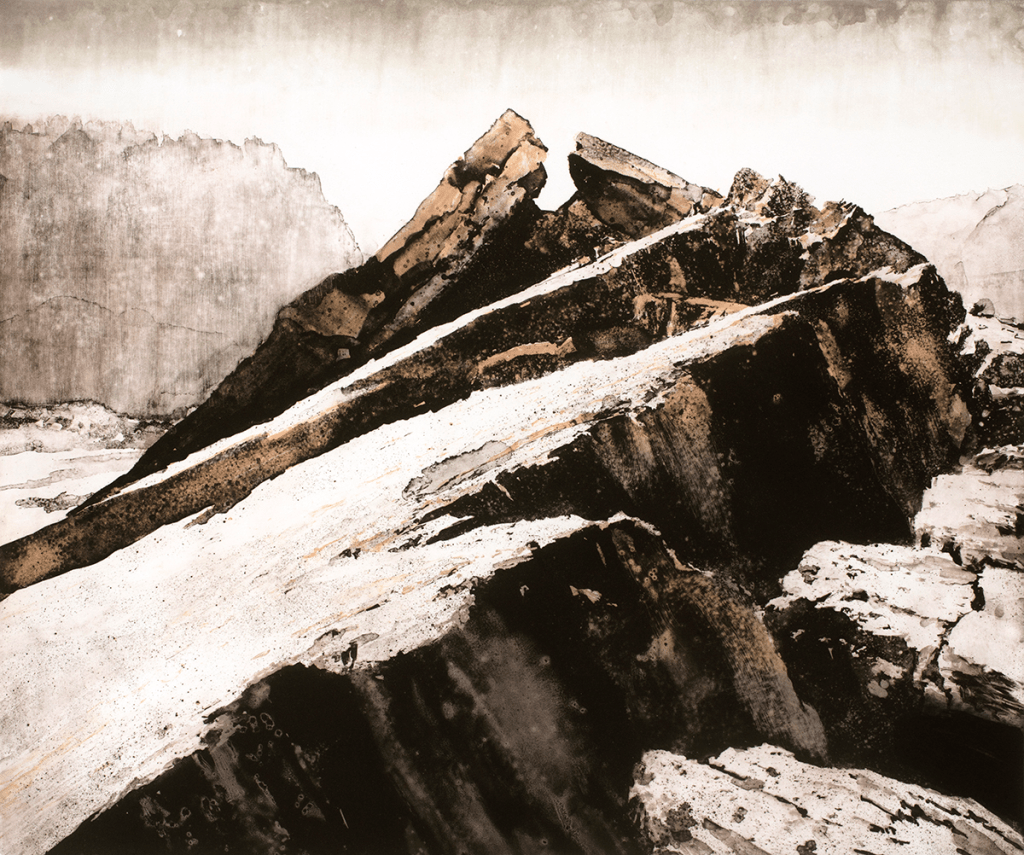
The reason Emma includes materials from the environment she study’s are to create a metaphor in her artworks. Another example where she has done this is in her work, “Tidewater Glacier chalk on Blackboard“.
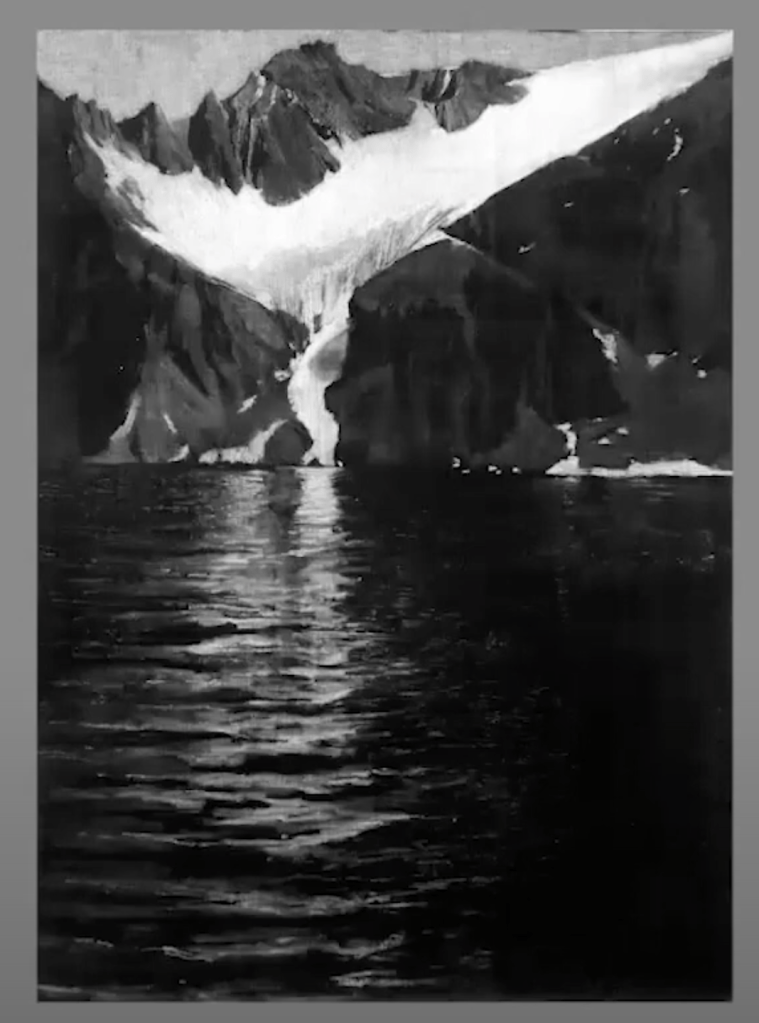
This image is created using chalk on a blackboard. The irony is in the possibility that the chalk could vanish in an instant, much like a glacier melting away.
There is something quite special about looking at Emma’s large-scale images. The places Emma chooses to draw are places that not many people will ever get to see in their lifetime and being able to look at these works allows each viewer to experience some of the magic that Emma must have witnessed whilst out in the field.
Why do they make their work at a large scale?
While watching the film below, Emma revealed why she does her art on such a massive scale. In the documentary, she stated:
“I sort of want the reason for the big scale is that sort of sense of encounter for the viewer. I really want the sort of sense about being immersed in something for an audience that might sort of see that in a space to give a sense of the physicality of being in front of it.” (Stibbon, E 2023)
It was nice to hear her say this. As I had previously mentioned, I felt the pieces were for the viewer to get a better understanding of the places she had been witness to. The vast scale allows the viewer to fully immerse themselves in the scene, which is similar to watching a film at the cinema.
What hurdles have they encountered or initiatives have they had to develop in order to produce their work?
Whilst in the field, Emma is faced with many obstacles that hinder her such as the cold, seasickness, the wind, the fear of a volcano eruption and the many other elements that the places she visits throughs at her. Therefore, she has to work fast using sheets of carriage paper, inks and watercolour. These mediums are chosen for there ease of use and they are good at capturing the characteristics of the environment at speed. Emma, also said in a documentary that “The paper is a witness of the weather, and it is embedded into the media” (Stibbon, E 2023) Additionally, she will use a digital camera to record information for later use.
Reflection
It has been interesting to see the different style and approaches that theses three artist have used whilst creating their large scale works. Out of all of them, I have to say my favourite is Emma’s work. The whole process from start to finish is quite fascinating. Being able to visit remote countries, recording information whilst there and then coming home and capturing the scenes at such a large scale but with such realism is remarkable.
References
“Boyle Family.” Www.boylefamily.co.uk, http://www.boylefamily.co.uk/boyle/works/index.html.
Davies, Patrick. “John Virtue (Paintings).” Patrick Davies Contemporary Art, http://www.patrickdaviesca.com/artists/46-john-virtue. Accessed 18 Mar. 2024.
“Emma Stibbon | Artist | Royal Academy of Arts.” Www.royalacademy.org.uk, http://www.royalacademy.org.uk/art-artists/name/emma-stibbon-ra.
Gallery, Rabley. “Emma Stibbon RA – Broken Terrain.” Rabley Gallery, 2 Aug. 2020, rableygallery.com/shop/artists/emma-stibbon/emma-stibbon-ra-broken-terrain/. Accessed 18 Mar. 2024.
Robbins, Andy. “The Culture Show: John Virtue.” Vimeo, 6 July 2012, vimeo.com/45322786. Accessed 18 Mar. 2024.
Roberts, Cristea. “Emma Stibbon.” Cristea Roberts Gallery, cristearoberts.com/artists/33-emma-stibbon. Accessed 18 Mar. 2024.
Spira, Freyda , and Robert l. “At Home: Artists in Conversation | Emma Stibbon.” Www.youtube.com, 16 June 2023, youtu.be/l3PtnhGeVyI. Accessed 18 Mar. 2024.
Stibbon, Emma. “About.” Emma Stibbon, http://www.emmastibbon.com/biography.
Illustration List
Fig. 1 Drawing approach one extension of elbows (2018) [vimeo, screenshot] At https://vimeo.com/267261033# (Accessed 13/03/2024).
Fig. 2 Drawing approach one, full extension of arms (2018) [vimeo, screenshot] At https://vimeo.com/267261033# (Accessed 13/03/2024).
Fig. 3 Drawing approach two, drawing kneeling (2018) [vimeo, screenshot] At https://vimeo.com/267261033# (Accessed 13/03/2024).
Fig. 4 Drawing approach three, rubbings (2018) [vimeo, screenshot] At https://vimeo.com/267261033# (Accessed 13/03/2024).
Fig. 5 Drawing approach four, whole body 1 (2018) [vimeo, screenshot] At https://vimeo.com/267261033# (Accessed 13/03/2024).
Fig. 6 Drawing approach four, whole body 2 (2018) [vimeo, screenshot] At https://vimeo.com/267261033# (Accessed 13/03/2024).
Fig. 7 Drawing approach five, observation (2018) [vimeo, screenshot] At https://vimeo.com/267261033# (Accessed 13/03/2024).
Fig.8 Boyle M, Hills J (1974 )Bergheim Mine Study [Resin and fibreglass impression] At:https://www.boylefamily.co.uk/boyle/works/index.html (Accessed 13/03/2024)
Fig. 9 Boyle M, Hills J (1977 ) Rock and Scree Series [Resin and fibreglass impression] At:https://www.boylefamily.co.uk/boyle/works/index.html (Accessed 13/03/2024)
Fig. 10 Boyle M, (1969 ) Skinchart for Body Work [Negative photograph] At:https://www.boylefamily.co.uk/boyle/works/index.html (Accessed 13/03/2024)
Fig. 11 Boyle M, (1969 ) Skin Series, Left Heel Study [Negative photograph] At:https://www.boylefamily.co.uk/boyle/works/index.html (Accessed 13/03/2024)
Fig. 12 Boyle M, (1973 ) Skin Series, Small Back Study [Negative photograph] At:https://www.boylefamily.co.uk/boyle/works/index.html (Accessed 13/03/2024)
Fig. 13 Stibbons E, (2017 ) Broken Terrain. [Intaglio] At:https://rableygallery.com/shop/artists/emma-stibbon/emma-stibbon-ra-broken-terrain/ (Accessed 13/03/2024)
Fig. 14 Tidewater glacier chalk on blackboard (n.d.) [YouTube, screenshot] At https://youtu.be/l3PtnhGeVyI (Accessed 13/03/2024).
 Visual Skills 2