When I finished Assignment 4, I was concerned about what my tutor would think of my work. For as long as I can remember, I’ve felt like my work isn’t good enough. However, after receiving feedback from my tutor, I understood that my concerns were unfounded because the tutor provided great feedback. This event led me to be more confident in my abilities. I’m more motivated to keep working hard on this course. It gave me a huge boost of confidence and assured me that I was on the right course with my studies.
The concept of imagination that I chose for the assignment is so broad that it encouraged me to think outside the box by employing mind maps and primary research. For the first time, this led my work to reflects my personal style.
Reflecting on my visual approach to the task, I would proceed in the same manner that I would with the research. Visiting Oxford helped me engage with the story on a different level. Throughout the journey, I imagined myself as Alice in a variety of settings, including visiting the river she would have taken boat rides on, seeing the fields she would have played in, and the inspiration around Oxford that led Lewis Carroll, all of which helped me channel those ideas into my artwork.
The final images’ strengths are that they demonstrate perspective, movement, attention to detail, and expression against a complex background. The illustrations’ flaws could be improved by working on more refined facial expressions with the sculptures I produced, as well as paying closer attention to detail with the sculptures. This might be accomplished by adding whiskers to the rabbit and more detail to the fur. This could be accomplished by researching human or animal facial anatomy to create more realistic depictions.
The work’s scale was suitable for assignment four, but going forward, I’ll need to make sure I set up the right size at the start of the project to prevent it from unintentionally becoming distorted in any way. For example, if I want my work to be used as book illustrations or merchandise.
Before beginning assignment four I reflected on the ways I have approached making throughout this unit and broke them down into categories so I could continue thinking about strategies to help me stay open minded and be creative.
Approaches
Identifying keywords
Brainstorming
Research
Methods
Thumbnail sketches
Generating ideas
Drawing ideas up
Choosing ideas
Creating visuals
Final artwork
Conceptual strategies
Word association
Word processing
Words to pictures
Considering viewpoint, composition, and content
Ways of making
Painting
Sculpture
Paper folding
Working small
Working big
Collage
Mixed media
Brief
For this assignment there are a choice of three assignment titles that I can develop for this themed project. The university has deliberately made the themes expansive and open so I can interpret them in many ways. These three theme titles are:
A Place
Imagination
The Word
Brainstorming
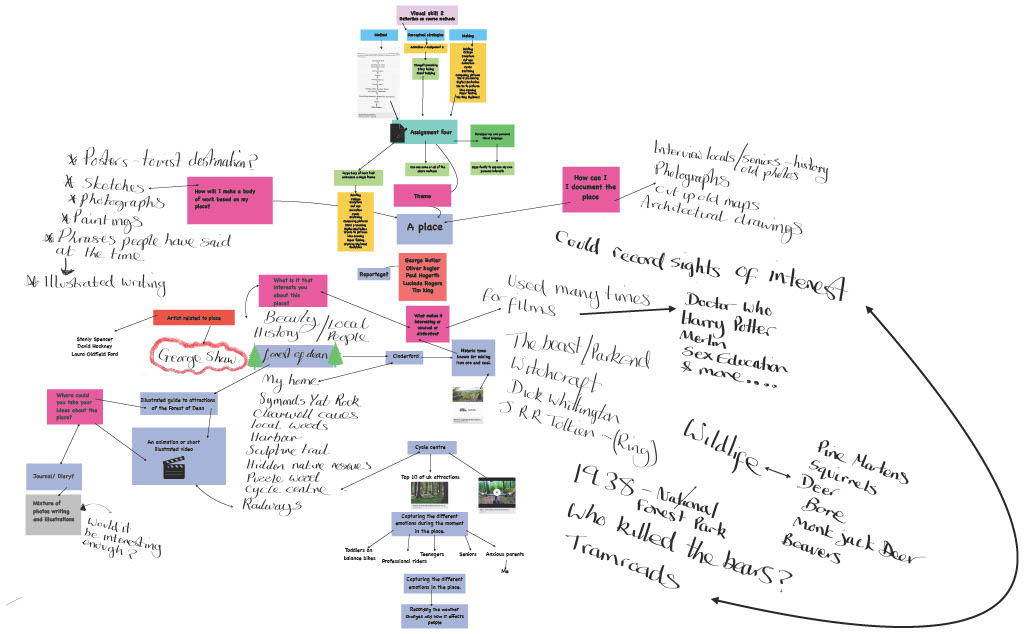
To begin I read the brief for each of the named projects and decided I didn’t want to do ‘The Word’ project as I felt it led me to a more graphical approach and this is not my speciality. Therefore, this left ‘A Place’ and ‘Imagination’ to decide between. To help me decide on the one that appealed most I created brainstorms for each topic. These can be seen below.
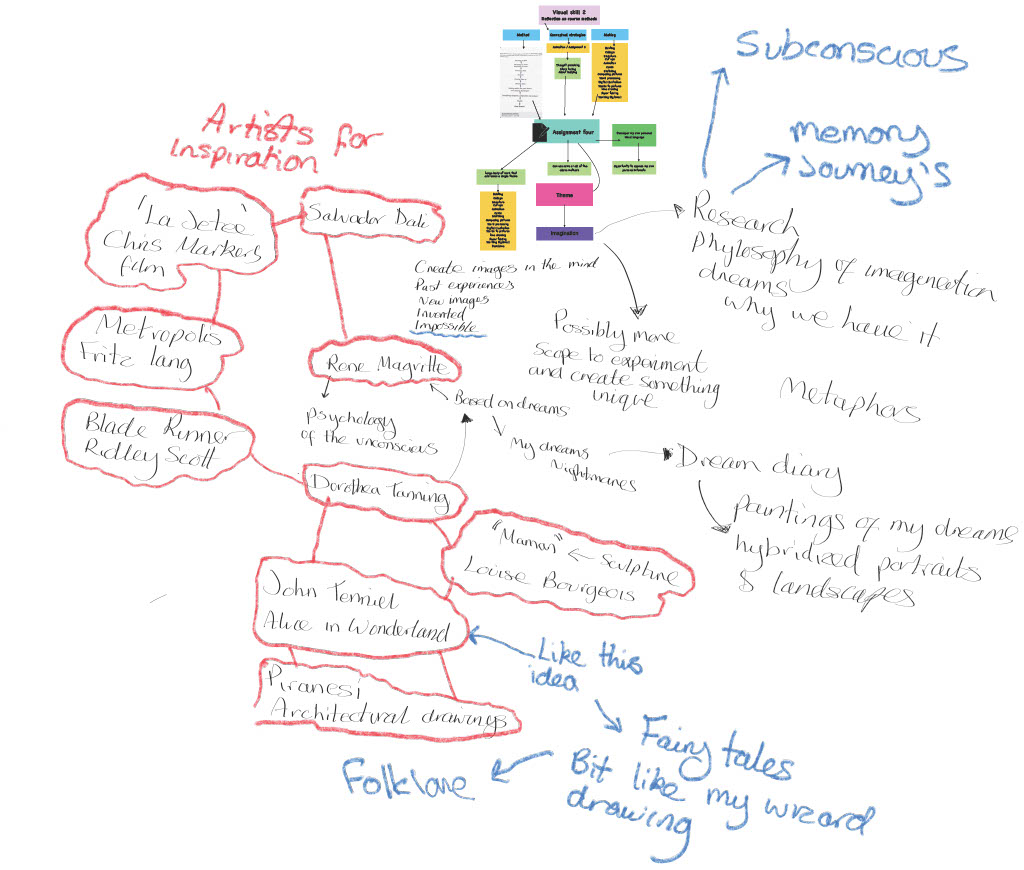
‘Imagination’ brainstorm
Fig. 1 Imagination Brainstorm (2024)
‘A place’ brainstorm
Fig. 2 A Place Brainstorm (2024)
Generating ideas, concepts and images.
After creating these maps, I reviewed my past work with my instructor and explored the possibilities shown in the maps. In the session, I realised that my true fascination lay with the concept of imagination. In my mind map, I had listed John Tenniel and I thought to myself what could be more inspiring than John Tenniel’s enchanting illustrations of “Alice in Wonderland” and the dreamlike story itself, penned by Lewis Carroll and first published in 1865?
Also, after some research, I discovered that all works produced during Lewis Carroll’s lifetime are copyright-free around the world. Although I had no intention of copying anyone’s artwork, I didn’t want to incur any legal problems by using their works as inspiration.
Reflecting on some of my work, I recognised that part of it may have been influenced by Alice in Wonderland. Here are some of these pieces.
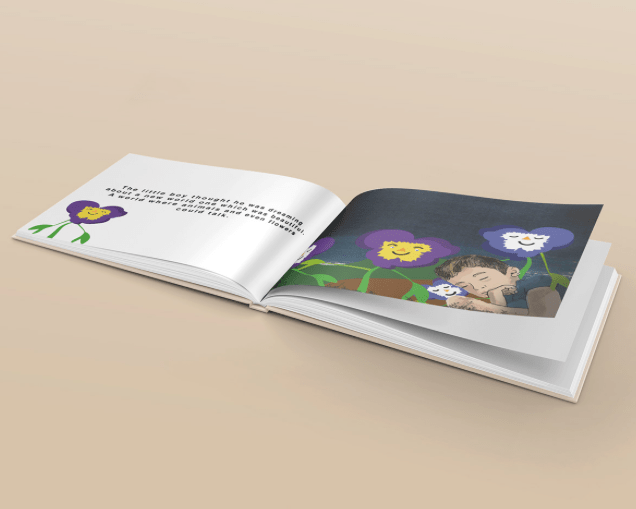
Below is an exercise where I created illustrations based on Pareidolia.
Fig. 3 Flower characters (2023)
Below is a an illustration I created for an exercise in Illustration Sketchbooks called Interpretation and communication.
Below is a video of a zine I created made for a previous assignment in the unit Illustration Sketchbooks.
Desk research
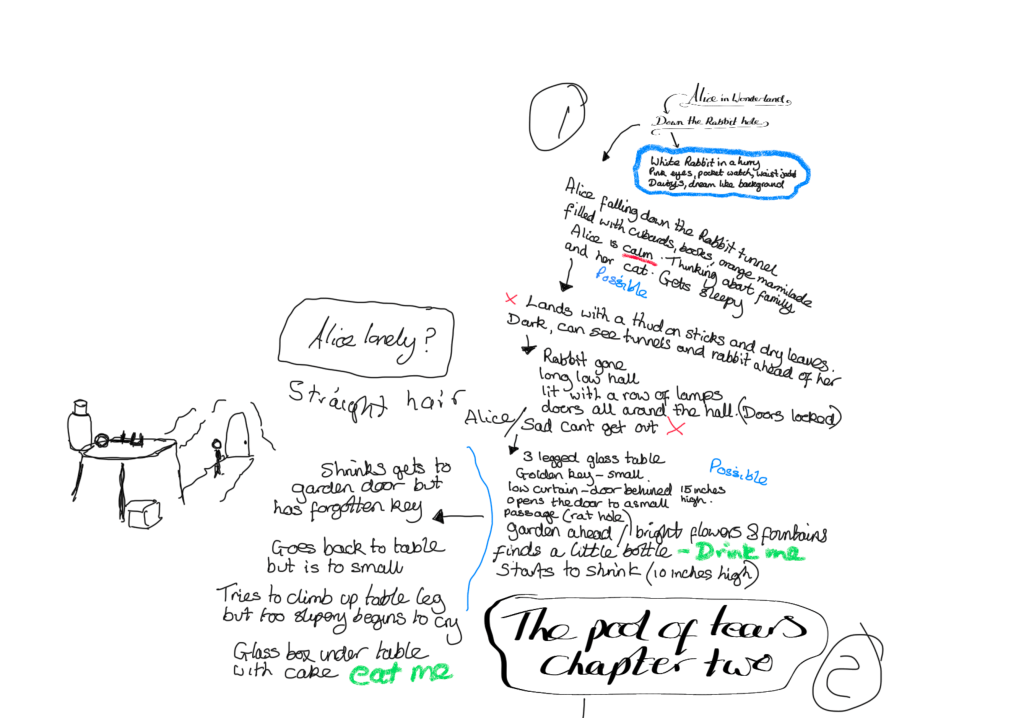
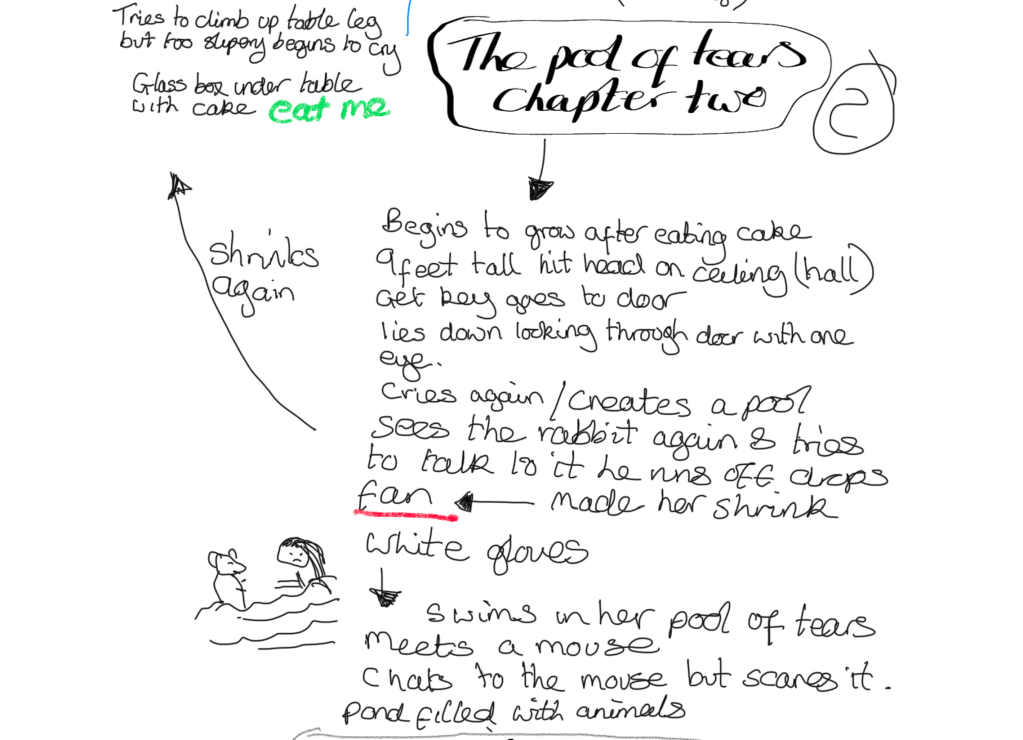
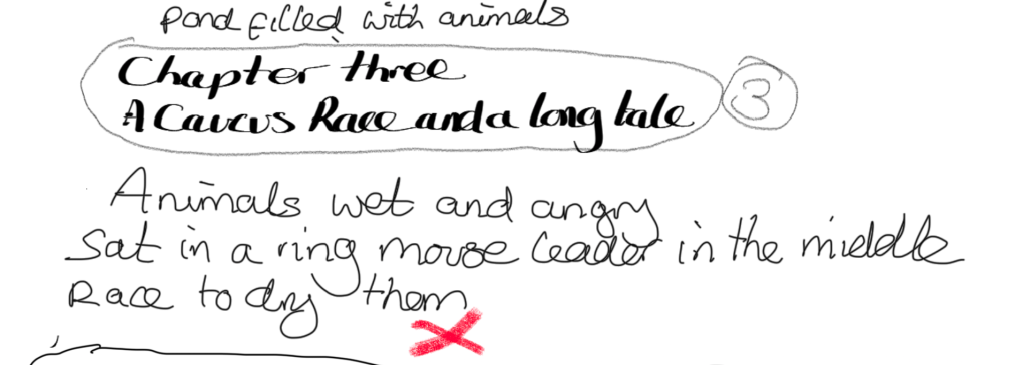
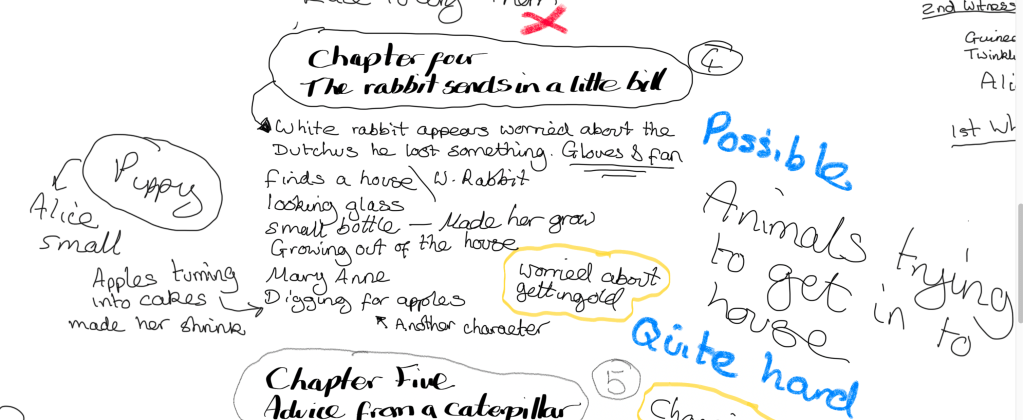
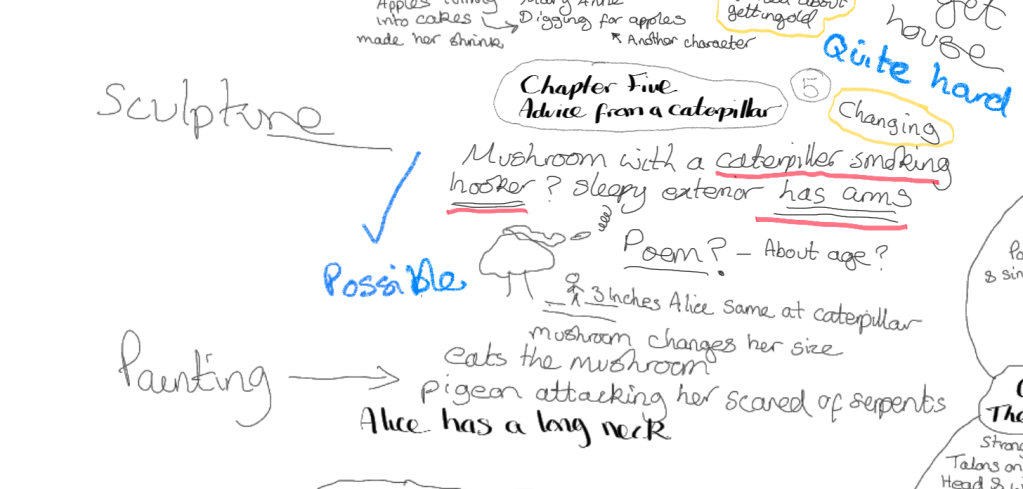
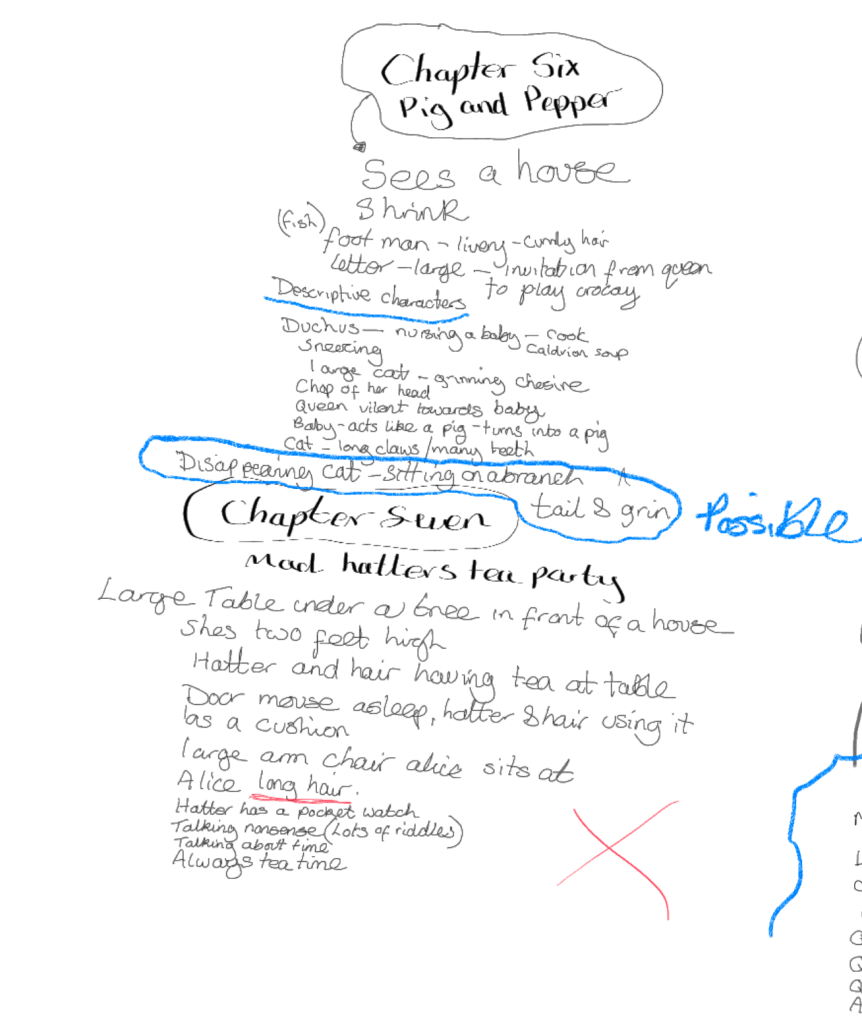
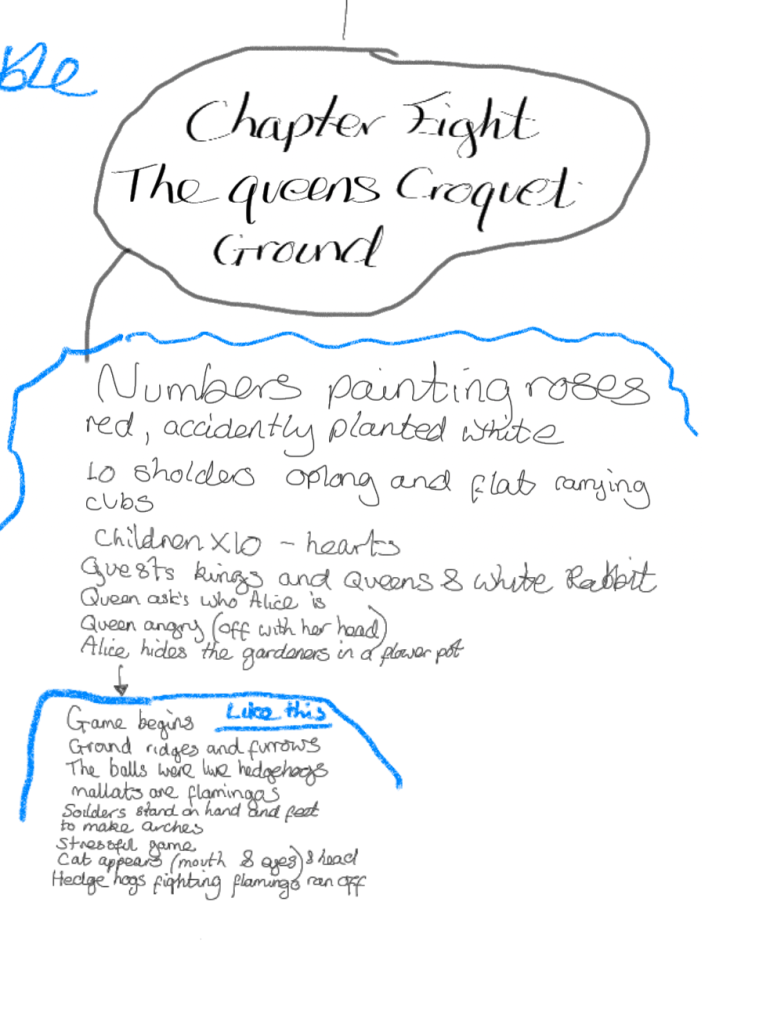
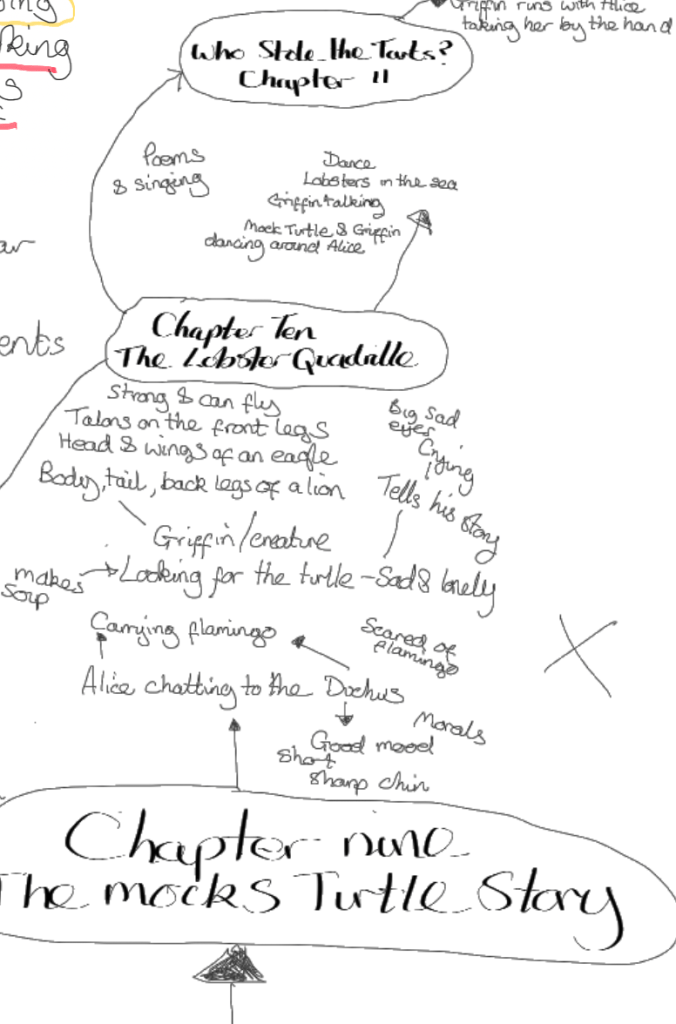
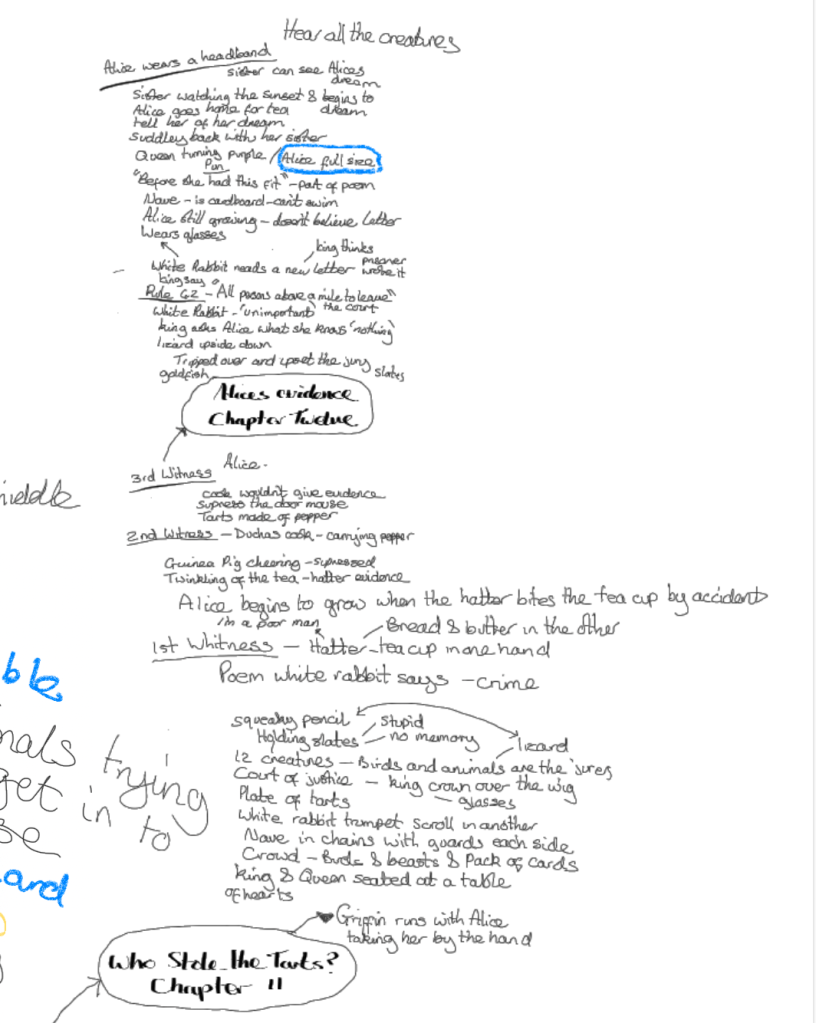
To begin with I decided it would be best to read the book before looking at any previous artists works as I wanted to use my own imagination to picture each character. To do this I listened to the following audiobook and made notes while listening to it.
Notes
Fig. 7 Notes (2024)
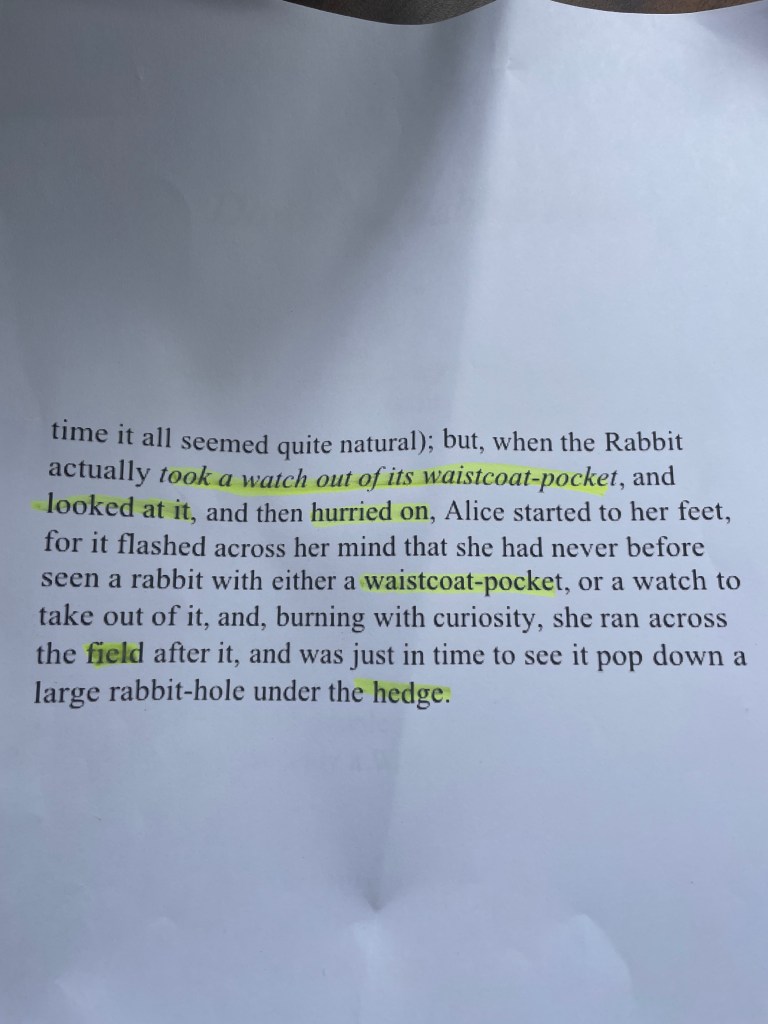
Chapter One really appealed to me because I felt it set the scene for the whole story and established the atmosphere. It felt quite magical and surreal. When reading the chapter again, I highlighted parts that I thought would make for an interesting illustration.
Fig. 8 Down the Rabbit hole page 4 (2024)Fig. 9 Down the Rabbit hole page 5 (2024)
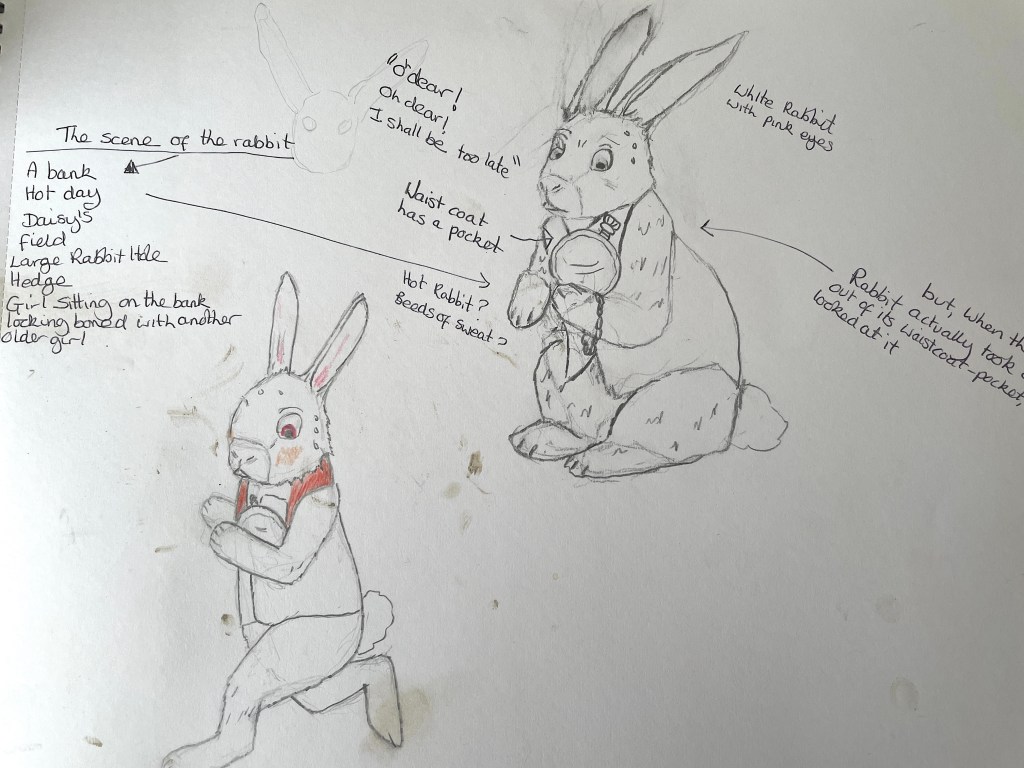
Next, I got out my sketchbook and began sketching out what I thought the white rabbit looked like in my imagination.
Fig. 10 Sketch of white rabbit (2024)
Before continuing I thought it was time to look at other artists work for inspiration.
Multiple artists have created illustrations for Alice in Wonderland, each with their own unique artistic expression. However, I wanted to create something distinctive. Researching, I was inspired by the following artists: Annie Montgomerie, Mary Rose Young, Tenniel, and Rackham.
Annie Montgomerie’s anthropomorphic animal figures are particularly unusual and lifelike. Each figure has its own intriguing story and particular appeal, conveying a sense of nostalgia, uniqueness, and cuteness. Each doll is constructed from vintage items such as broaches, children’s shoes, jewellery, and buttons. Below are some examples. My personal favourites are the chimpanzees as they are my favourite animal.
Fig. 11 anthropomorphic animal figures (2024)
Fig. 12 anthropomorphic sheep (2024)
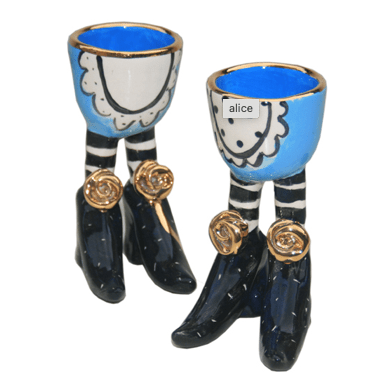
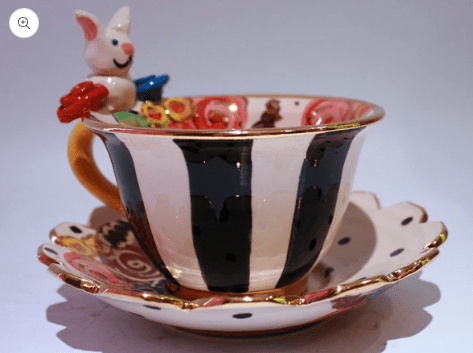
Mary Rose Young is a local artist in the Forest of Dean that I once worked for when I was sixteen, employed to paint designs onto her pottery. However, researching her lately, I discovered she has since made some new designs that are inspired by Alice in Wonderland. What I like about them is their bold colours and whimsical patterns that capture the imagination.
Below are some examples.
Fig. 13 Mary Rose egg cups (2024)
Fig.14 Mary Rose Alice Teacup (2024)Fig. 15 Mary Rose Alice teapot (2024)
Last but not least, I could not leave out the old illustration masters such as Tenniel and Rackham. Their illustrations continue to be timeless and influential in the world of art and literature. Their work has inspired countless artists and continues to captivate audiences of all ages.
Below are some examples.
John Tenniel
Arthur Rackham
Visual research in the world
Through my research, I discovered that the character Alice is based on a real person named Alice Pleasance Liddell.
Wanting to learn more about what inspired the story, I did more research and discovered that the author of Alice in Wonderland, Charles Lutwidge Dodson (pen name Lewis Carroll), moved to Oxford and enrolled at Christ Church College, where he studied mathematics while also living in the city. Lewis Carroll became friends with Henry Liddell, the Dean of Christ Church College, and all three of his daughters when he was studying there. Lewis entertained the girls with stories, and Alice Liddell encouraged Lewis to write down one of them, resulting in the well-known story Alice in Wonderland.
After researching online and reading the story, I wanted to discover what inspired Lewis Carroll. Therefore, I planned a day trip to Oxford with my husband to see the sights that inspired his magical story. As I went over the college grounds and toured the city, I could almost envision the author himself telling wonderful stories to the Liddell sisters. It was a fantastic day that brought the famous narrative to life in a completely new way.
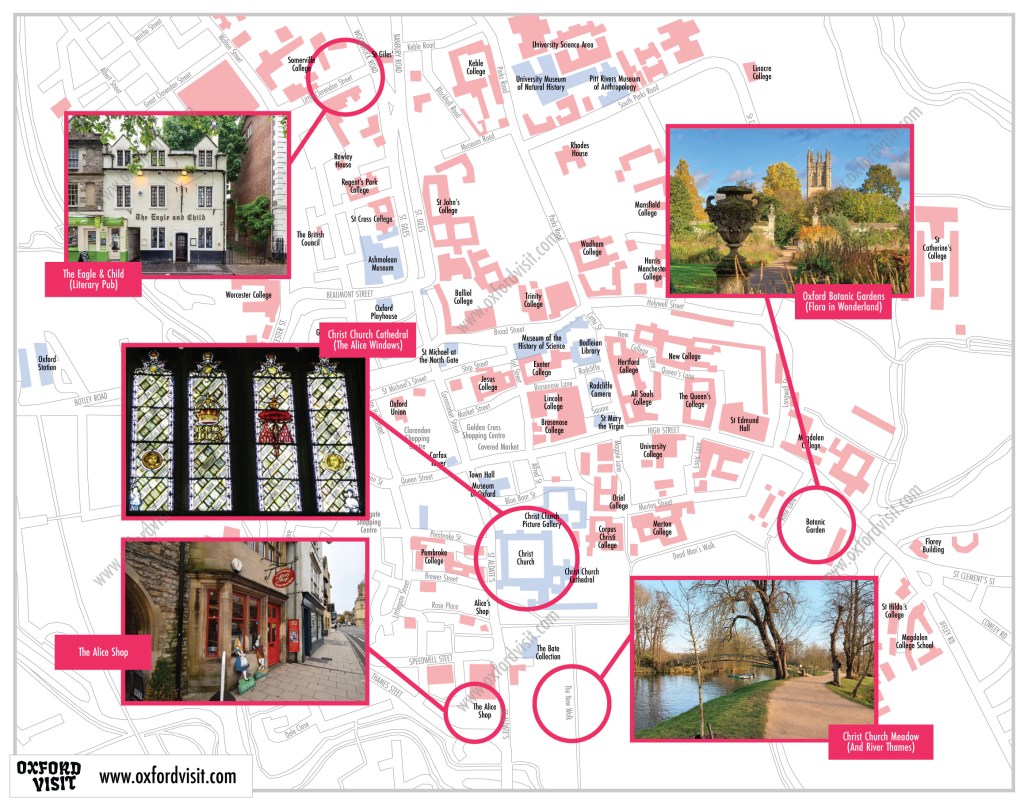
Below is a map I downloaded from the internet to follow on the excursion.
Fig. 16 OxfordMap (2024)
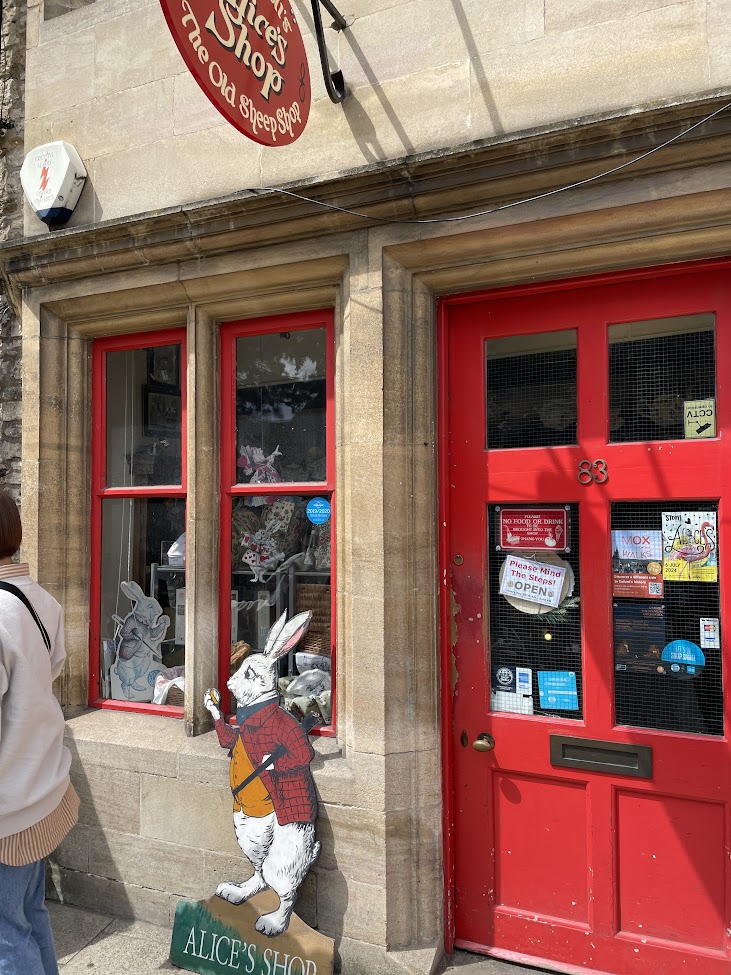
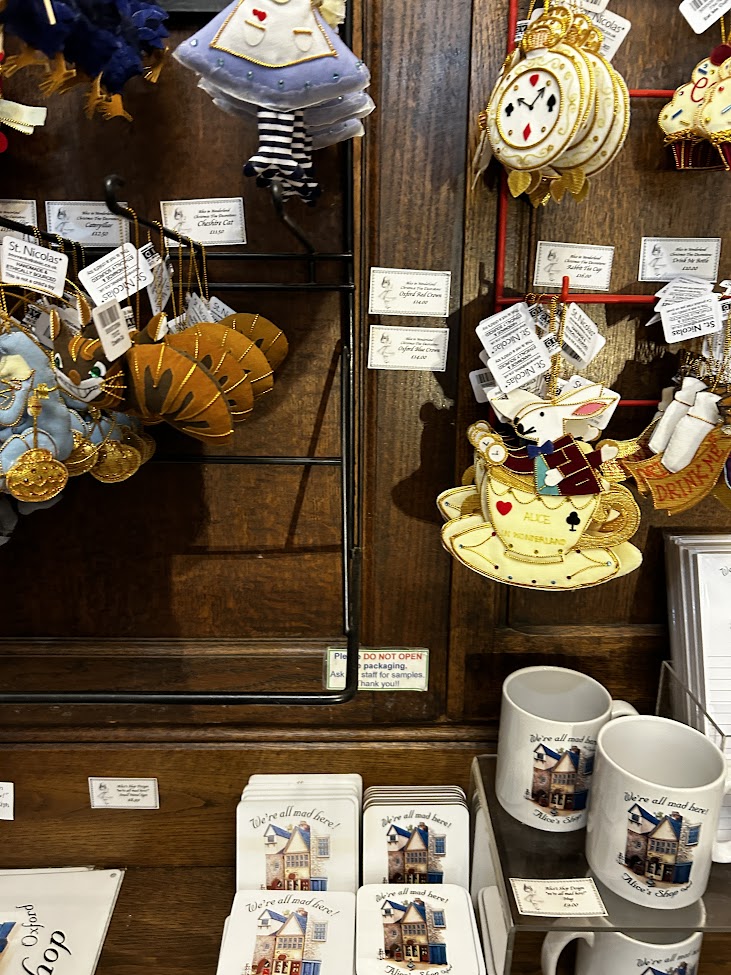
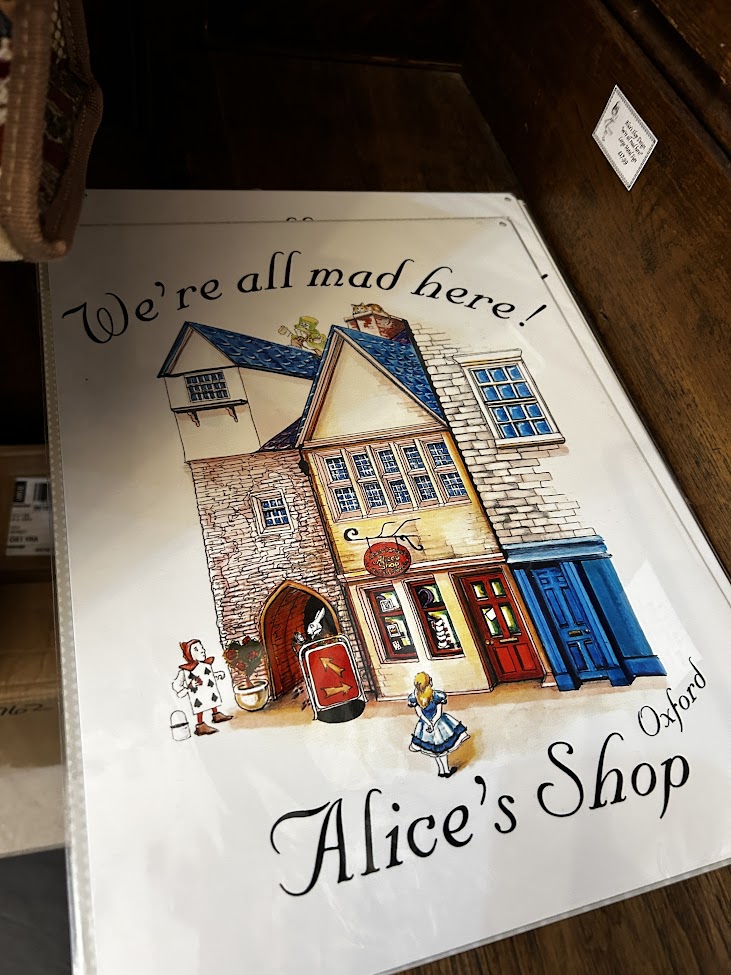
To start the strip we visited Alices shop this used to be Alice Liddell’s local sweet shop.
Fig. 17 Alices shop (2024)
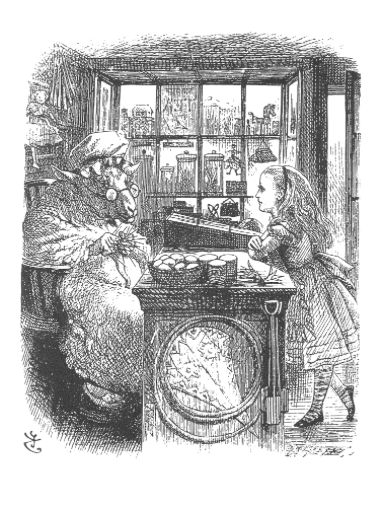
Illustrations of the interior of the shop also appeared in the book Through the looking glass.
Fig. 18 Pencil sketch of Alices shop (1871)
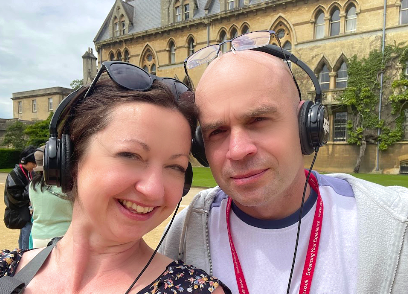
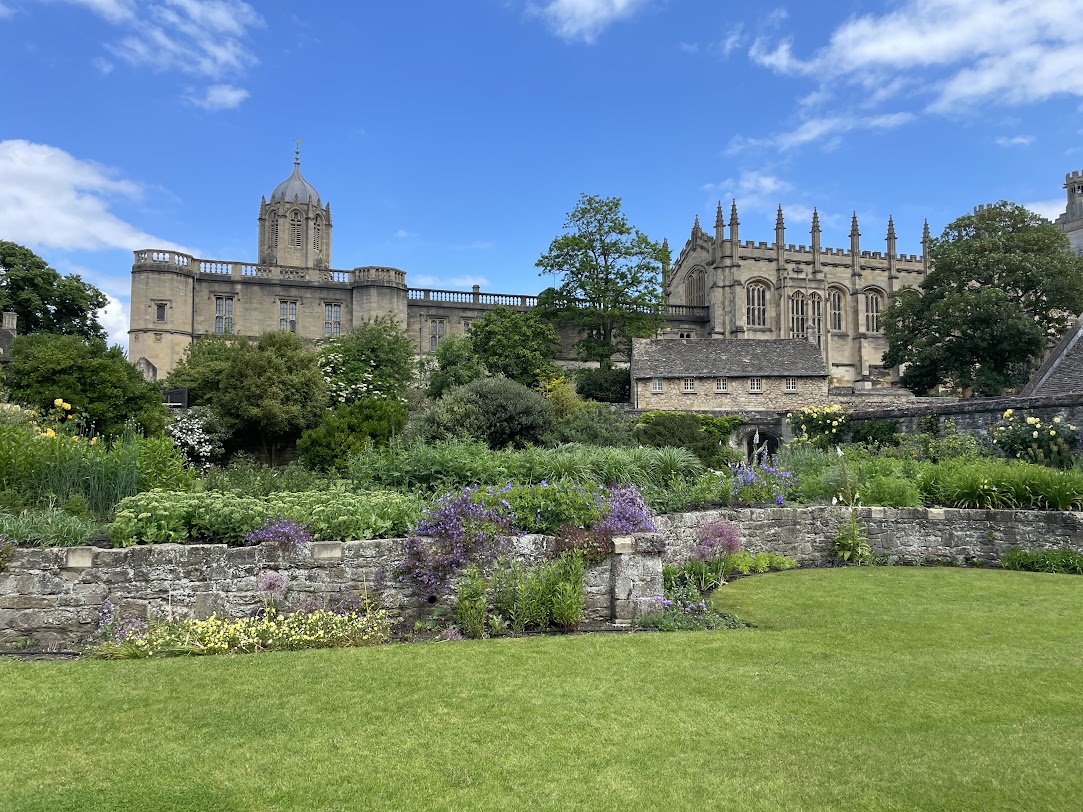
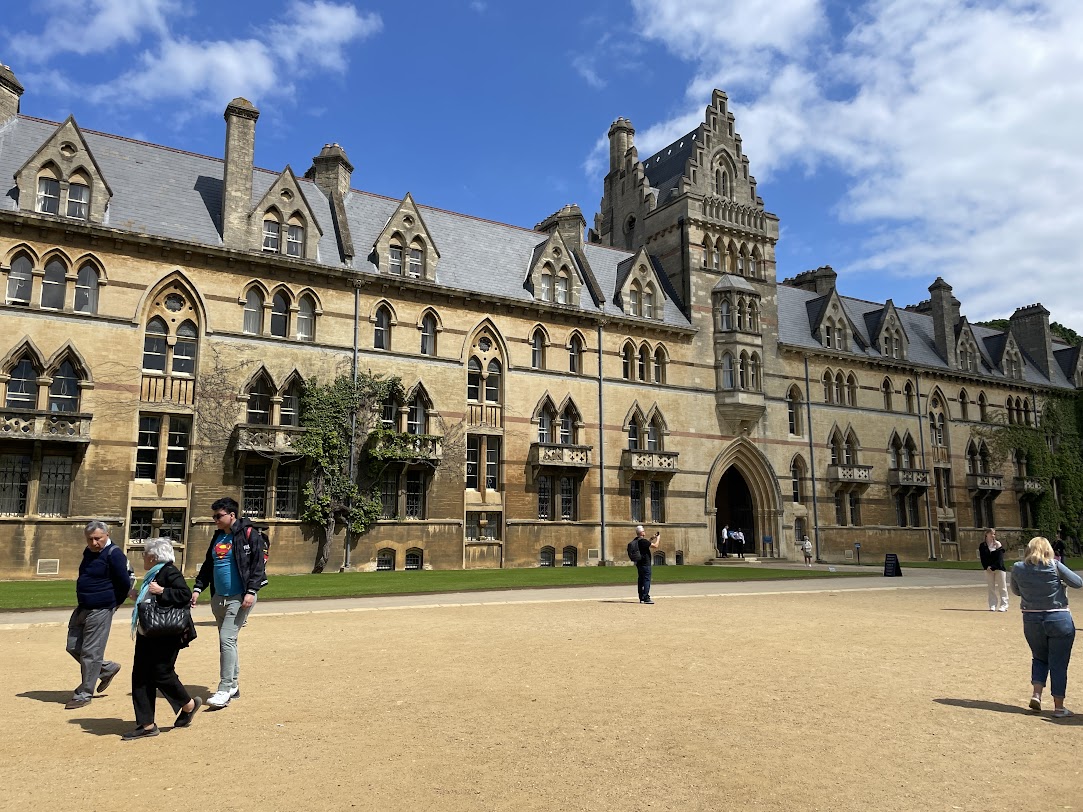
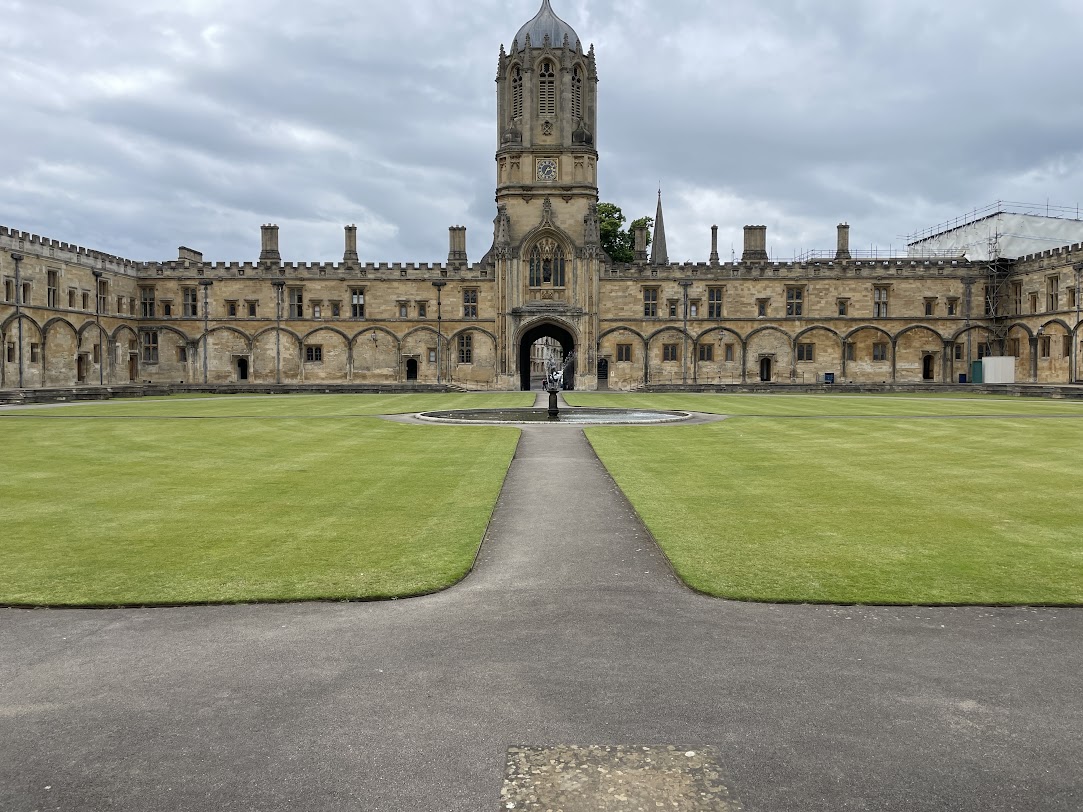
Opposite the shop is Christ Church College which we entered and paid to do an audible tour.
Fig.19 My Husband and I (2024)
Below are exterior photographs of Christ Church College.
Fig. 20 Exterior photos of Christ Church (2024)
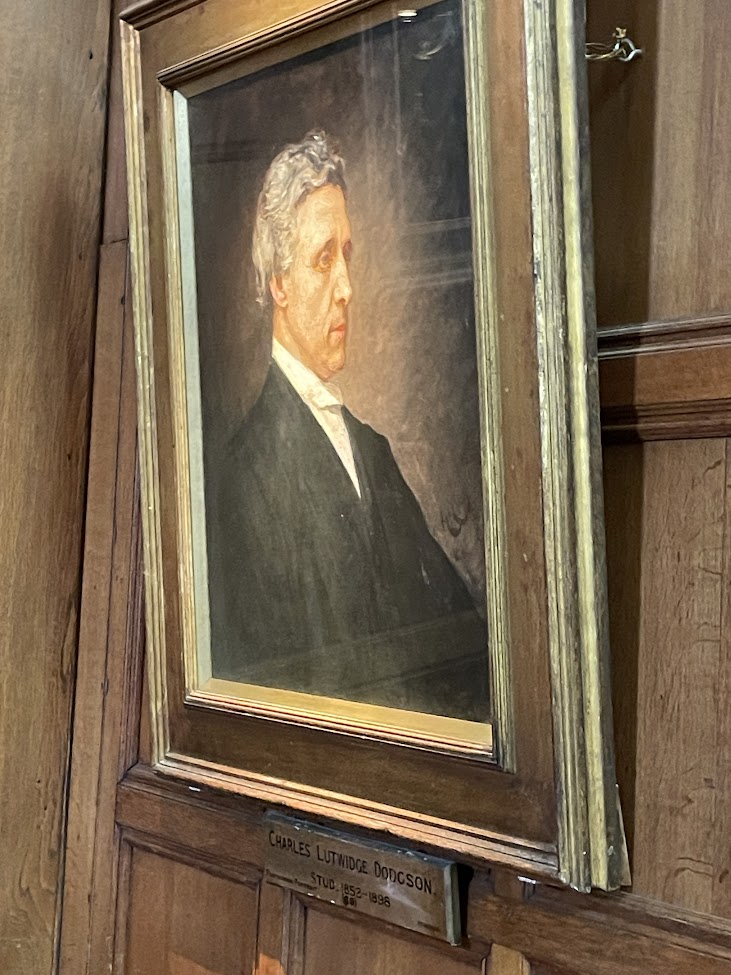
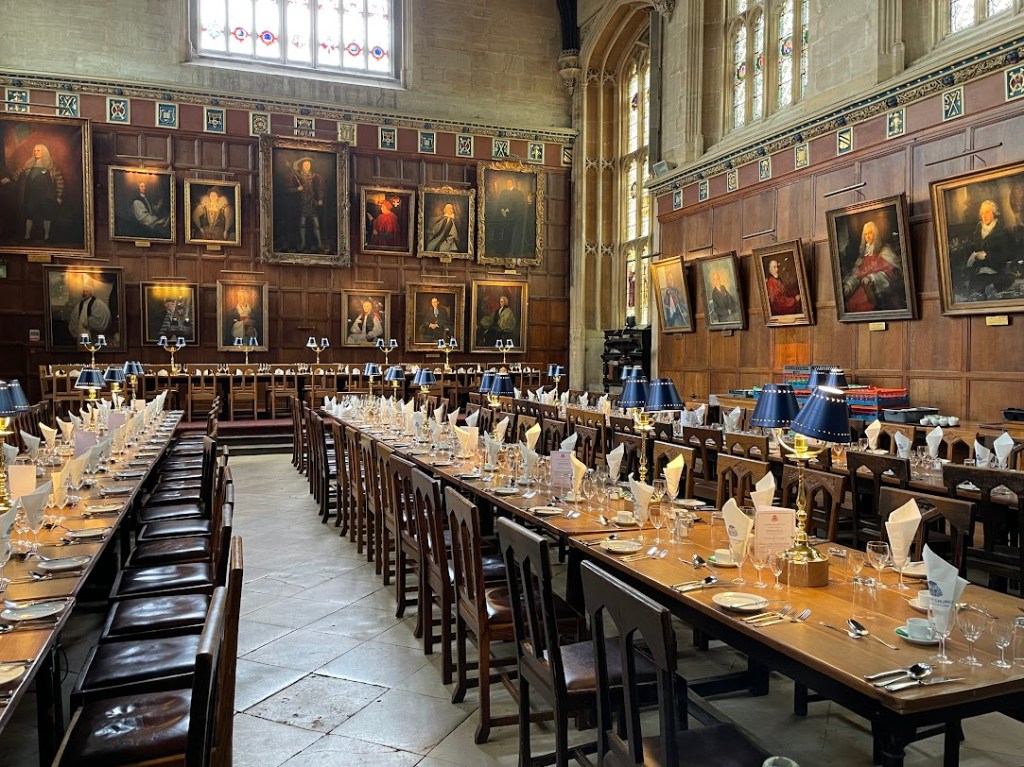
We then entered the interior of the building and visited the Great Hall, which is still used today by students for the meals. Hanging near the entrance to the hall was a painting of Lewis Carroll.
Fig. 21 Charles Lutwidge Dodgson (1899)
Whilst in the hall I pondered if the great hall with its long magnificent tables may have influenced Lewis’s imagination with the Mad Hatters Tea party?
Fig. 22 The Great Hall (2024)
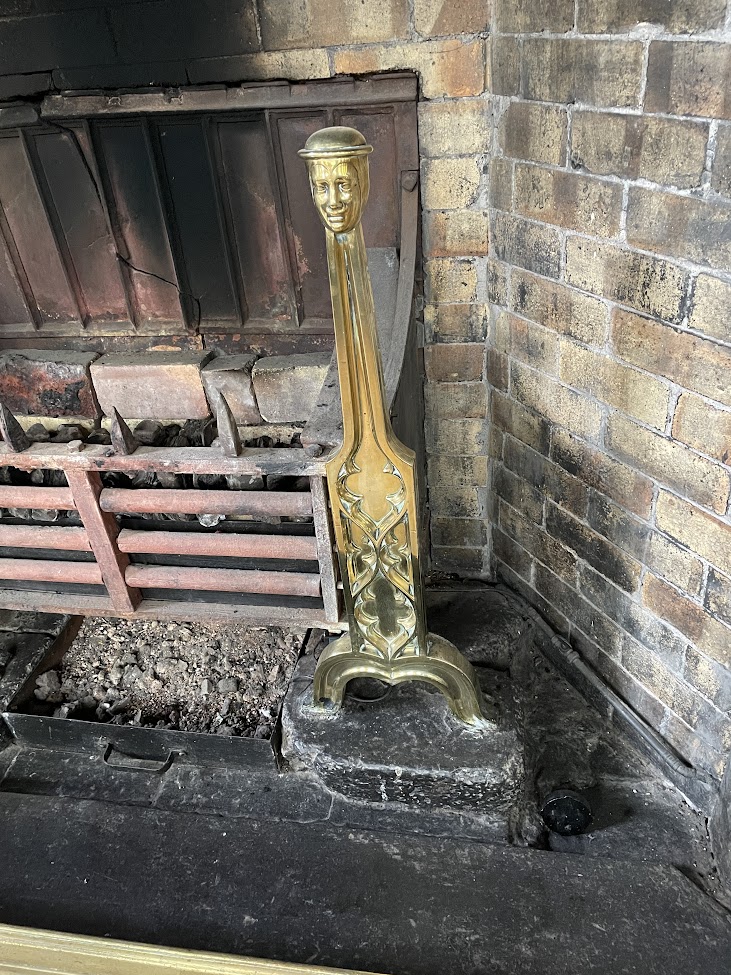
Halfway into the hall on the left hand-side was a fireplace, next to it sat brass andirons shaped like two ladies with long necks. I would imagine this inspired Lewis’s writing when he wrote about Alice’s neck growing longer and longer when she eat the left part of a mushroom.
Fig. 23 andirons (2024)
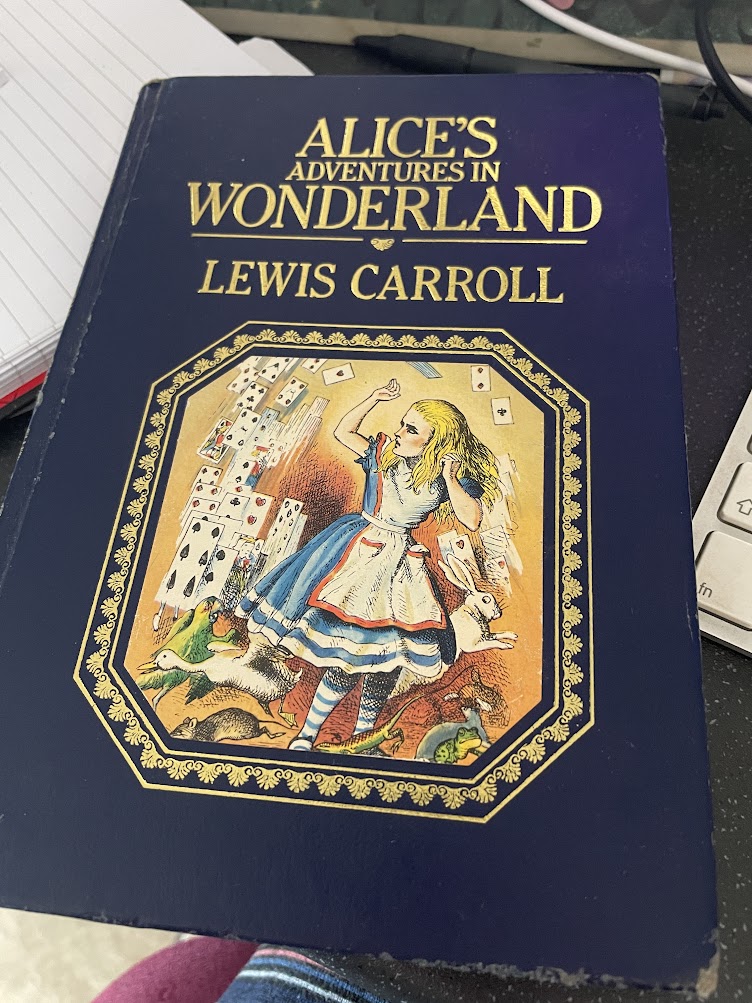
After visiting Oxford my son said “would you like to borrow my book?” I had forgotten I had given him Alice Adventures in Wonderland a few years ago. Pleasantly surprised the book contains both coloured and black and white illustrations by John Tenniel.
Fig. 23 The pool of tears (1982)Fig. 23 Front Cover(1982)
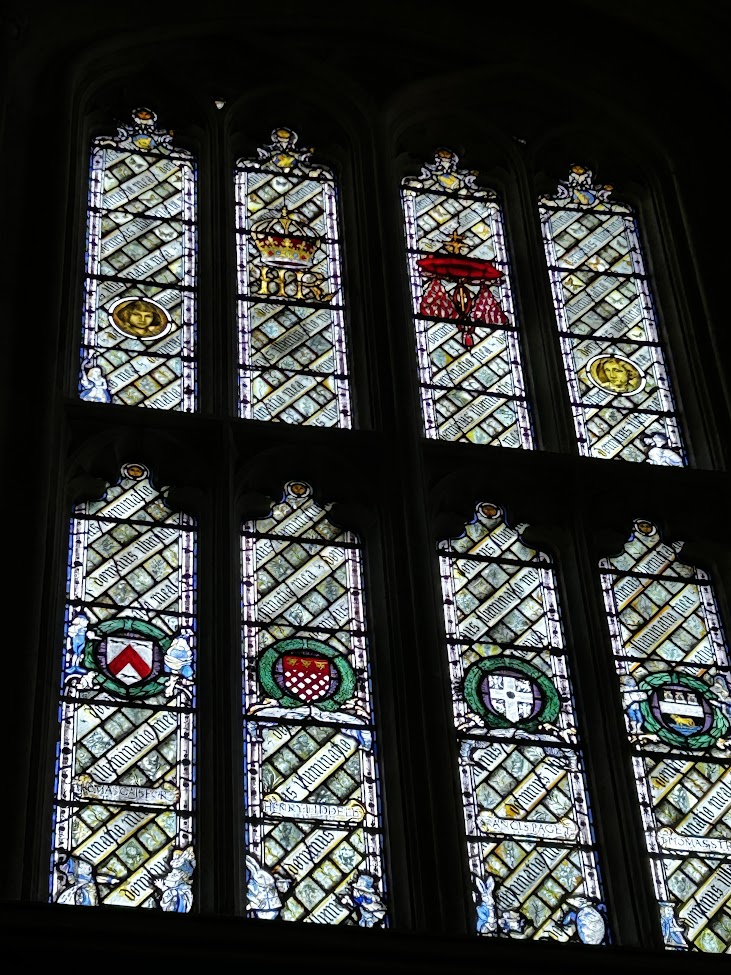
Above the fireplace in the Grand Hall is a stained glass window that features characters from the book including a portrait of the real Alice. You will have to look carefully to see each character. This window was added to the college in the 1920’s to celebrate Carroll.
Fig.24 Stained Glass Window (2024)
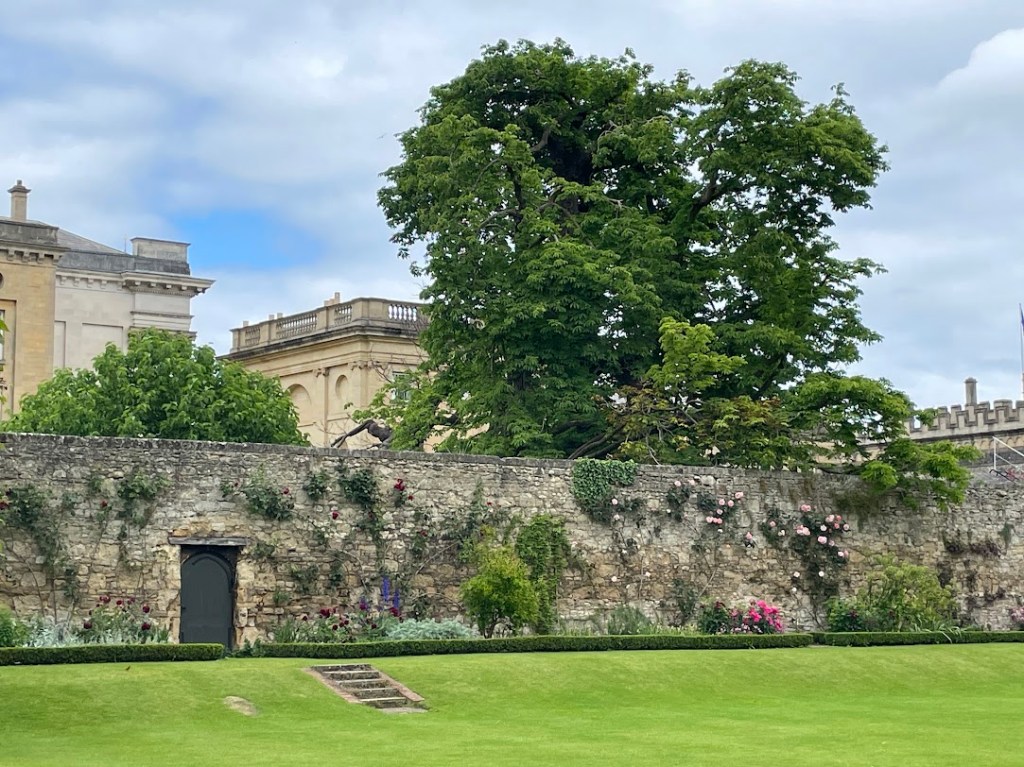
Next, we moved on to the adjacent cathedral and I asked a tour guide if the cathedral had any significant influence on the story. Pleasantly surprised the man showed me to the garden of which was a small door. This was the door that Lewis Carroll used as inspiration for in the book.
Fig. 25 Alice’s door (2024)
“A little door about fifteen inches high: she tried the little golden key in the lock, and to her great delight it fitted! … she knelt down and looked along the passage into the loveliest garden you ever saw.”
(Carroll, 1982)
The tree behind the wall is also considered to feature in the book when Alice meets the disappearing Cheshire Cat.
This Leeds me to my favourite inspiration that Lewis used and it is hidden well. Situated within the Cathedral high up on one of the pillars was an engraving which looks very familiar could this be the Cheshire Cat inspiration?
Fig. 25 Cat (2024)
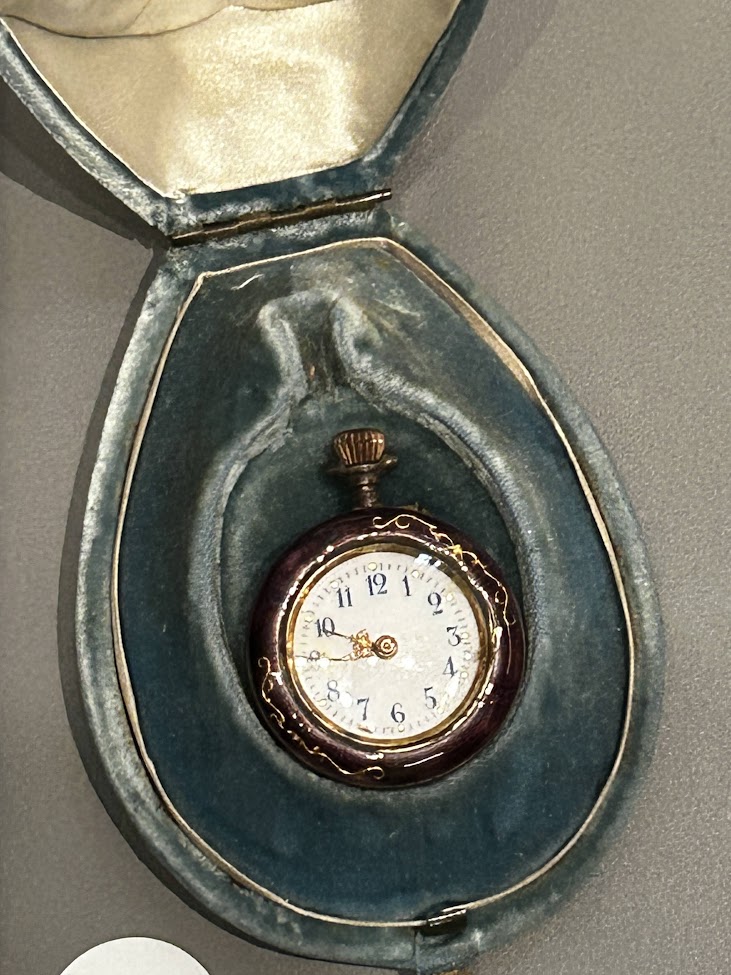
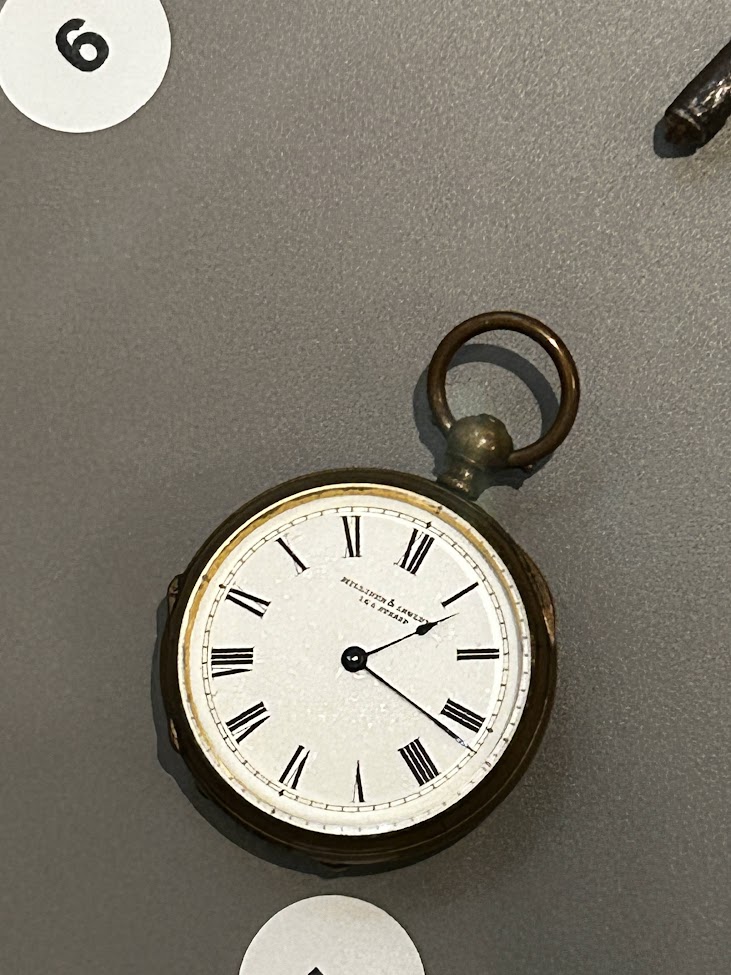
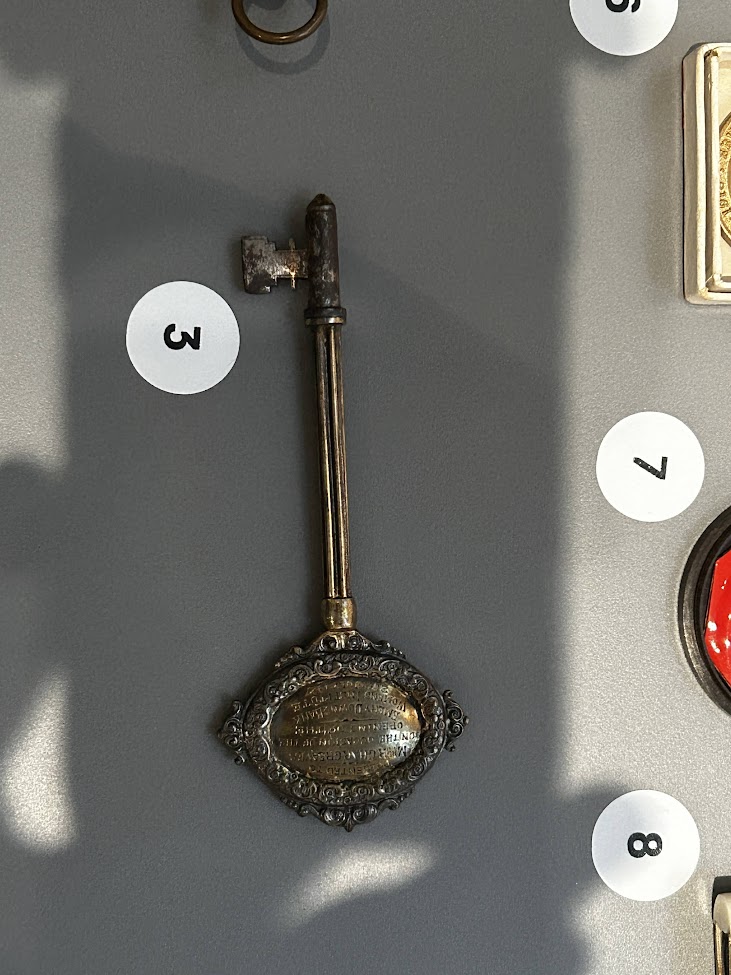
Next, we went to the Oxford Museum near Christ Church Cathedral and discovered artefacts belonging to Alice Liddell. These were a key presented to Alice at the opening of the Emery Down and Bank Women’s institute, Lewis Carroll’s pocket watch and Alice’s pocket watch.
Fig. 26 Pocket Watch (2024)
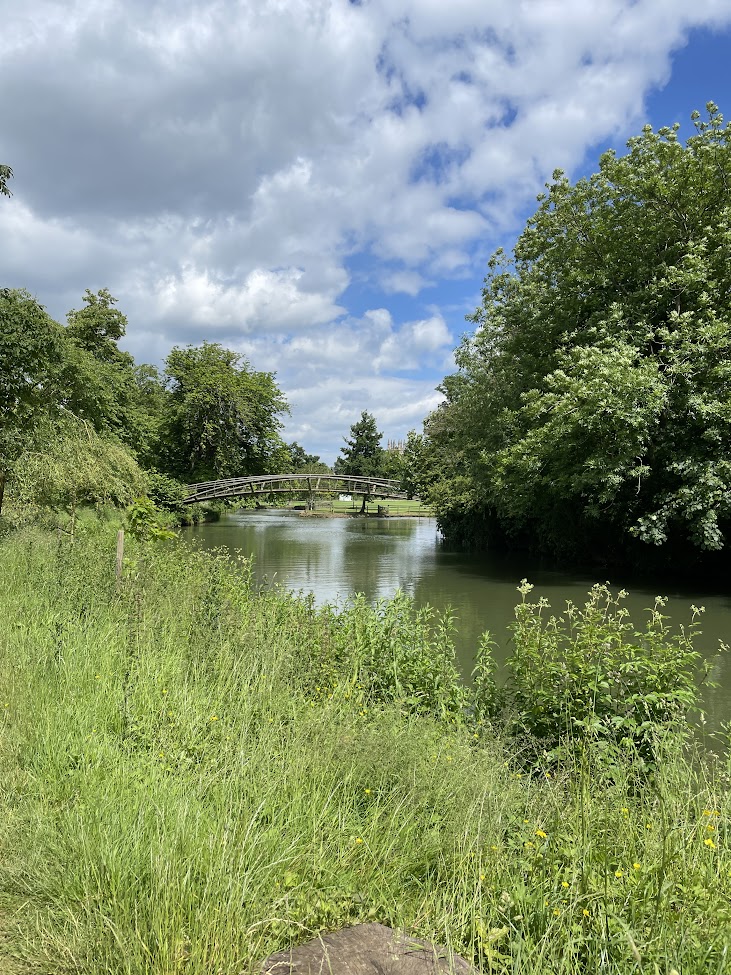
Finally, we attempted to visit the botanical gardens, which Lewis Carroll would frequently visit with Alice, but they were closed. However, we did walk along the river and see where Carroll used to take the three daughters on boat rides and tell them stories.
Fig. 27 Bridge (2024)
Visiting Oxford and seeing the influential elements that Lewis Carroll drew upon for his story have been worth seeing and have inspired my own imagination. I am eager to explore different visual interpretations of my own work and see how they compare to the original source material.
Making
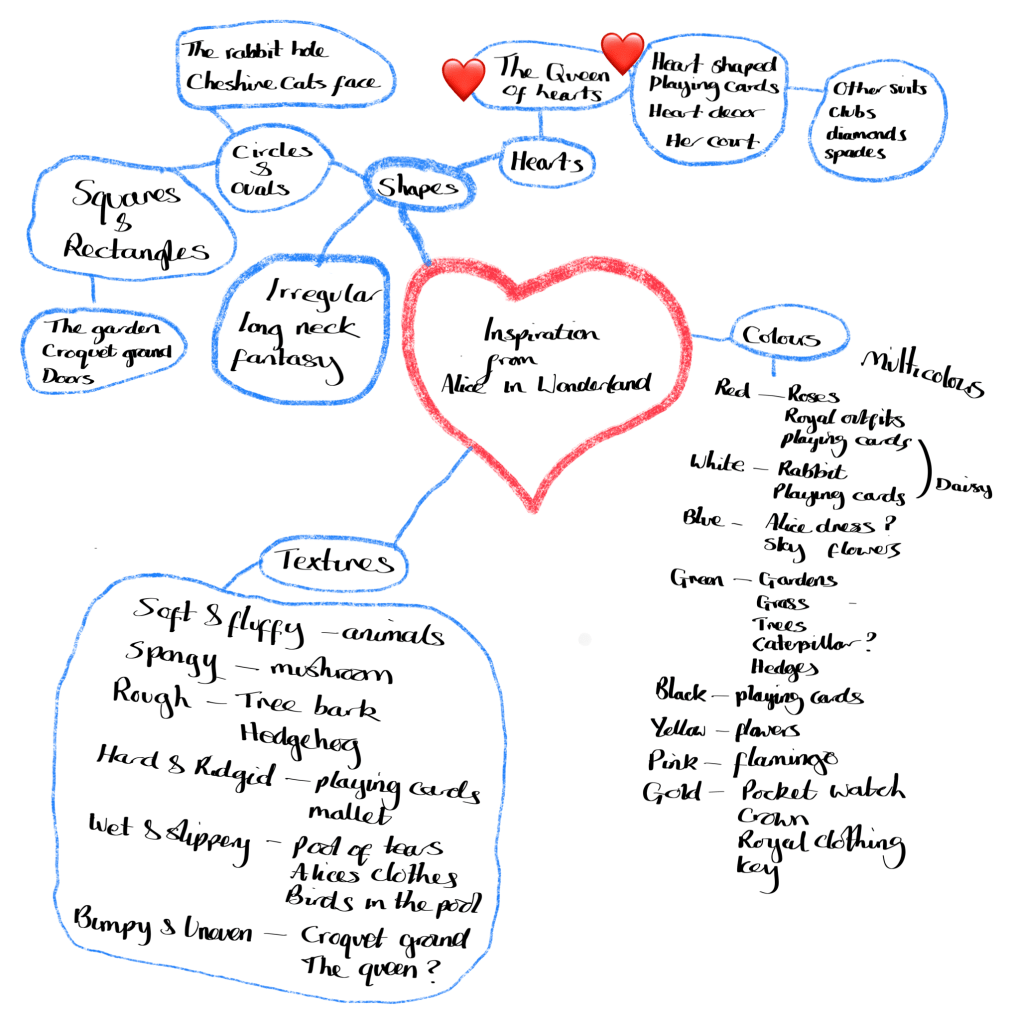
Looking back at my sketchbook of the rabbit I drew, and refreshing my recollection of the artists I had studied, I decided to try to create something unique. To do this, I began compiling a list of everything that had inspired me, from colours to shapes to textures, and considered how I could combine them in new and unique ways.
Fig. 28 Inspiration notes (2024)
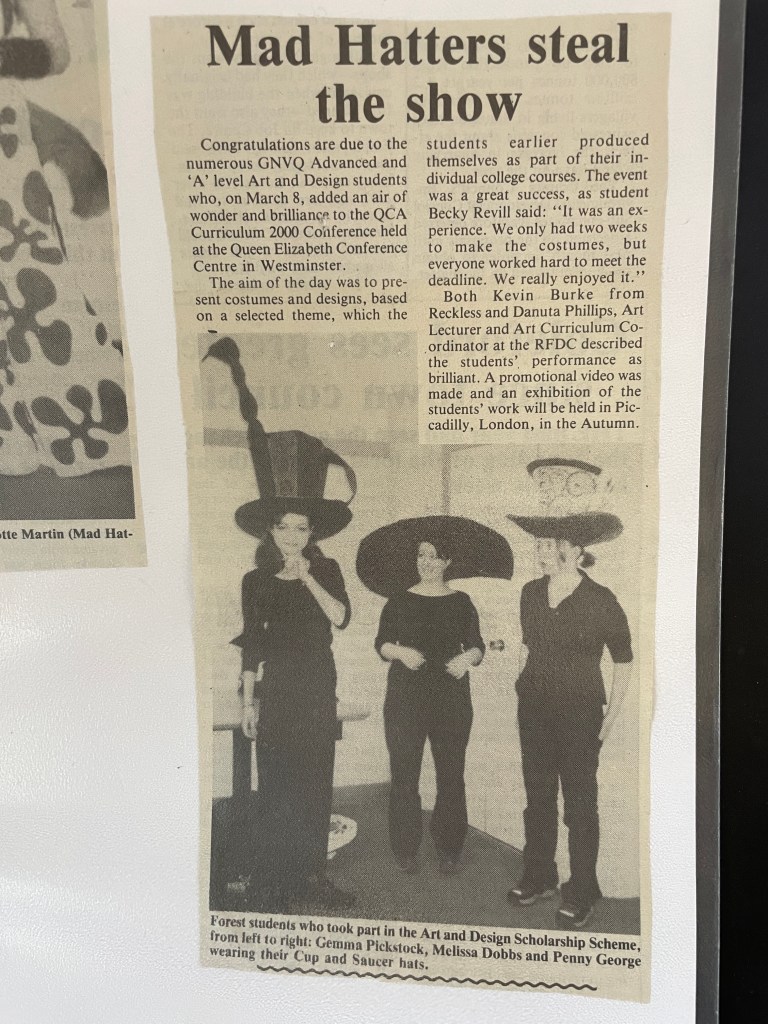
Looking back over my sketchbook at the rabbit I drew and refreshing my memory of the artists I had studied, I decided to try to create something new. To achieve this, I made a list of my inspirations, including colours, forms, and textures, and brainstormed ideas. After, I also thought about designs for the Mad Hatter’s hat, which reminded me of a project I worked on in college when I was sixteen. This was to make a hat for the Mad Hatter’s Tea Party.
Fig. 29 Newspaper clipping (2000)
Could I expand on this notion now? Other ideas were the Cheshire Cat’s fading smile and tail, the Queen of Hearts’ fondness of red flowers, the talking caterpillar, the card soldiers, and Alice frequently changing sizes.
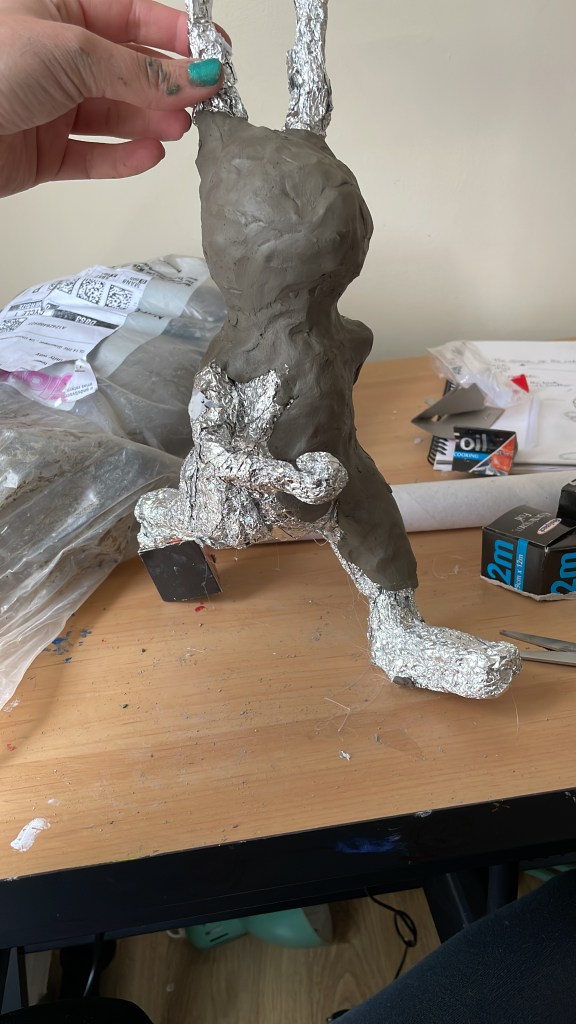
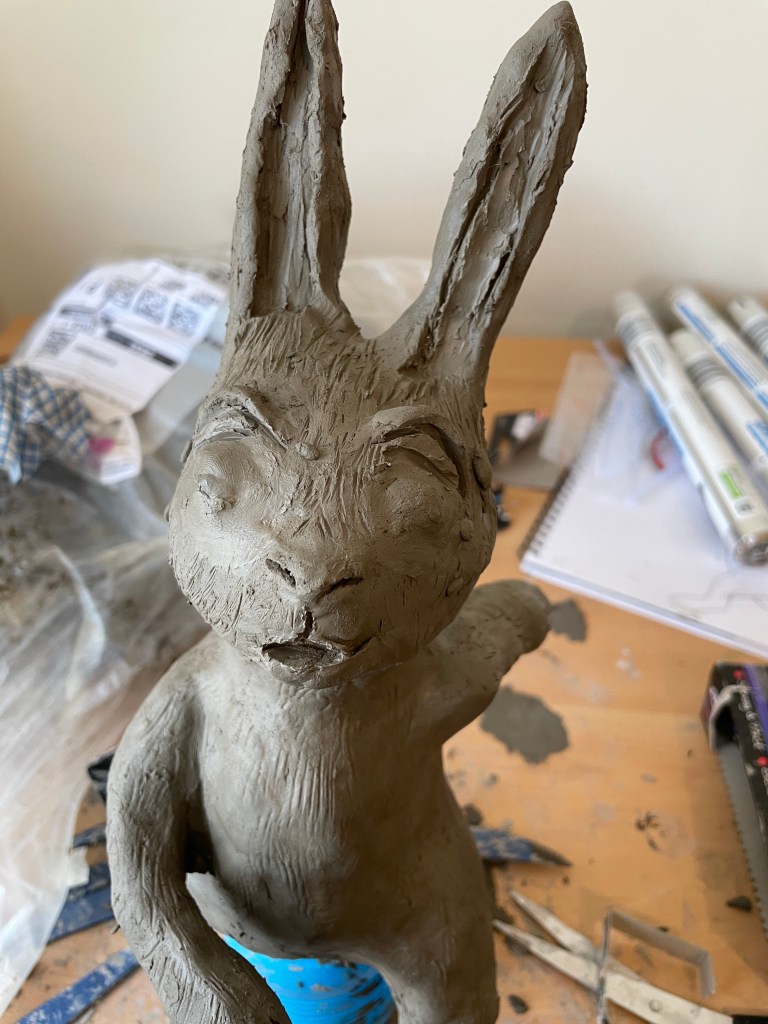
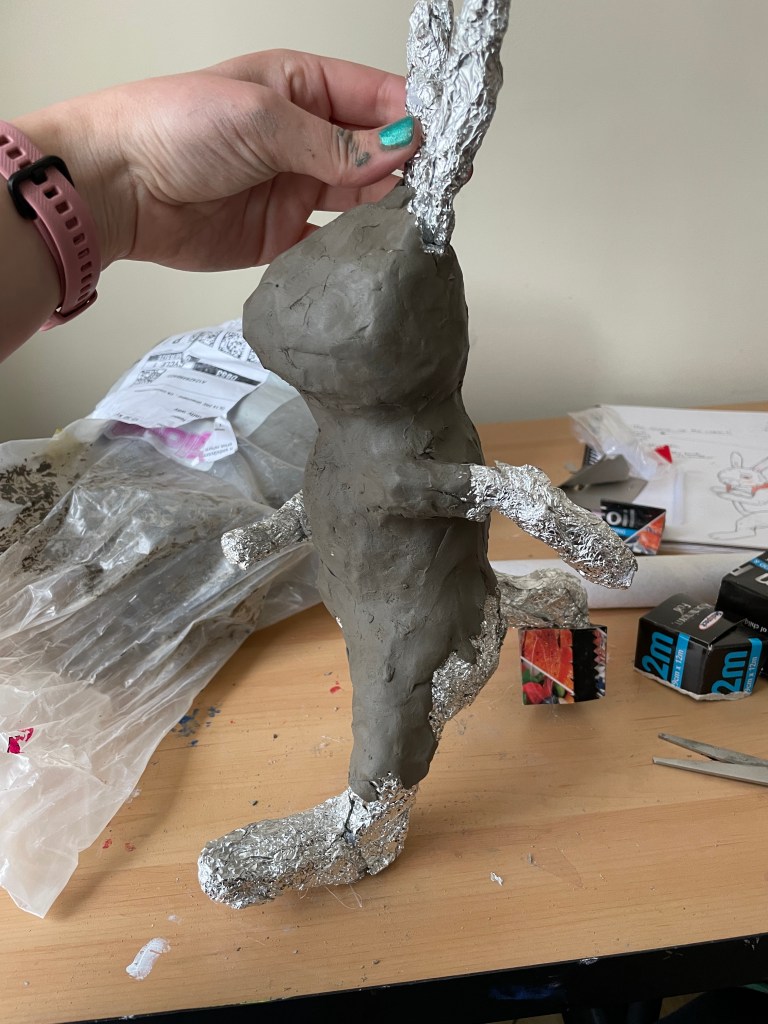
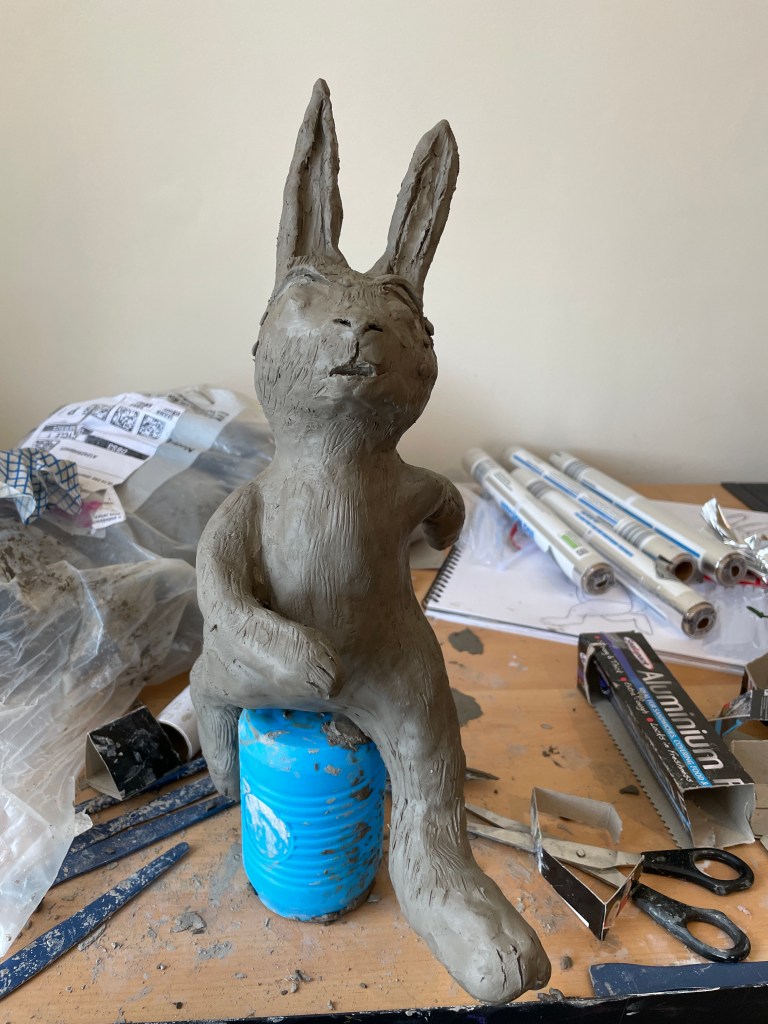
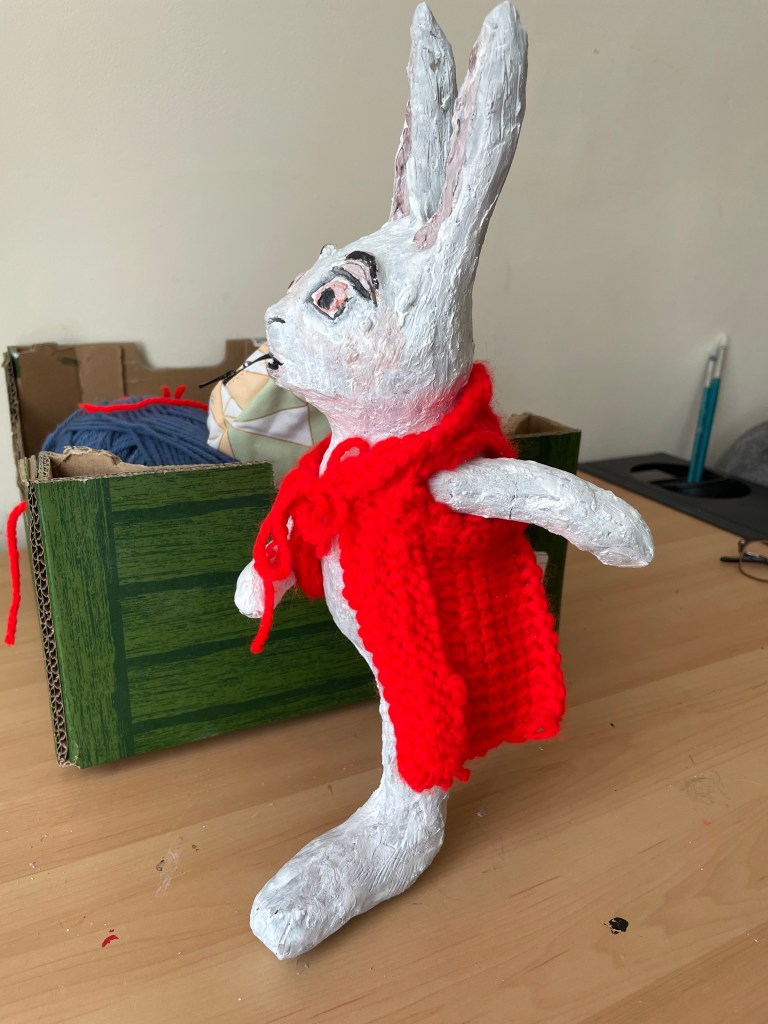
The first piece I created was what I imagined the white rabbit would look like, and I used my initial sketch as a reference. Thinking about the artist that I researched previously, I decided that I would create the character out of clay. I began by creating a foil frame that I then stuck the clay to and carefully sculpted the white rabbit.
Fig. 29 Rabbit sculpture (2024)
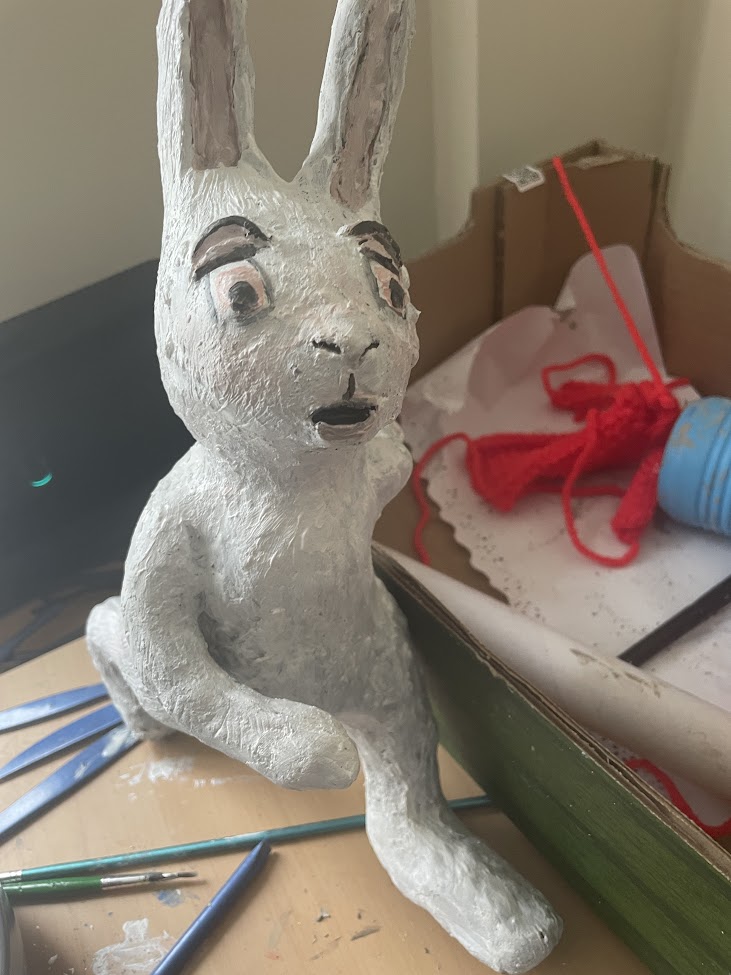
As I worked, I found myself immersed in the creative process. After the clay had dried and hardened, I was disappointed to see that it had numerous cracks. To try to mend it as best I could, I mixed PVA and clay slip and painted it over, filling the gaps. After the mixture had set and dried, I painted the rabbit white with a pink nose and black eyes.
Fig. 30 Painted rabbit sculpture (2024)
Thinking about the artist Annie Montgomerie’s animal creations and the garments they wear, I thought about doing something similar and making the rabbit’s waistcoat myself. I’ve had a secret desire to learn how to crochet. Never having tried before, I joined a social club at a cafe with a friend, where two older ladies taught me the basics of Tunisian crochet. For the majority of that hour, I had an empty needle and a knotted ball of wool, but by the end, I had managed to make a simple square. Using the newly acquired skills, I crocheted a waistcoat for the rabbit and attached my own pocket watch, which I purchased as a child.
Fig. 30 Finished rabbit sculpture (2024)
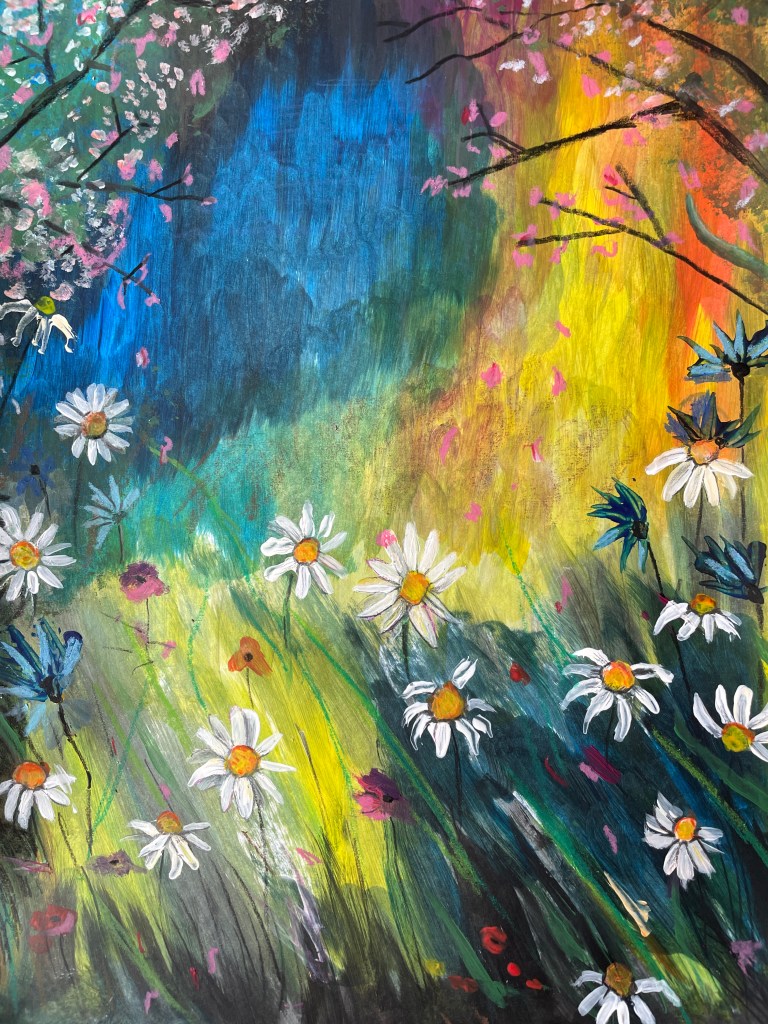
Next, I wanted to create a whimsical background for the rabbit, and I wanted it to feature daisies, which were described in the story. I decided to incorporate the daisies into a colourful backdrop using acrylic paint, using different shades of green, blue, and yellow and a small amount of pinks and reds for other flowers.
Fig. 31 Daisy Painting (2024)
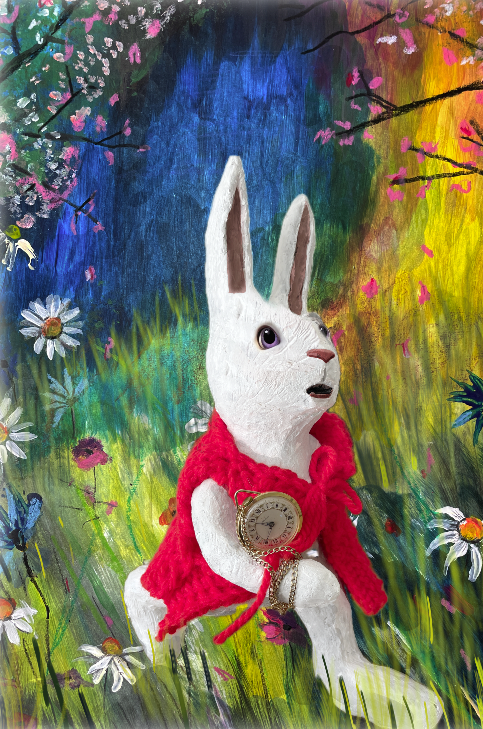
Next, using Photoshop I combined the background and the rabbit and added some enhancements.
Finished artwork
Fig. 32 I’m late (2024)
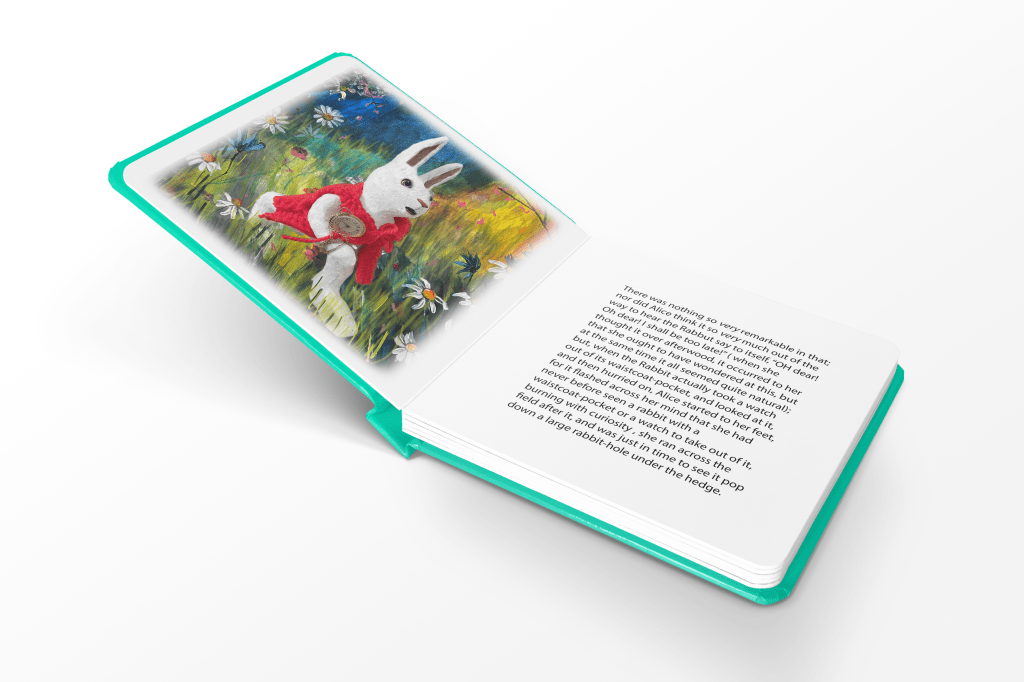
Finally, I created a mockup of a book featuring a page from the story of Alice in Wonderland using my illustration.
Fig. 33 I’m late mock up (2024)
The outcome was as I had envisioned, which made me happy. Creating something colourful and unique that came from my imagination was incredibly satisfying; looking at the mockup brought my vision to life, made me happy, and made me feel it is possible to become a children’s book illustrator.
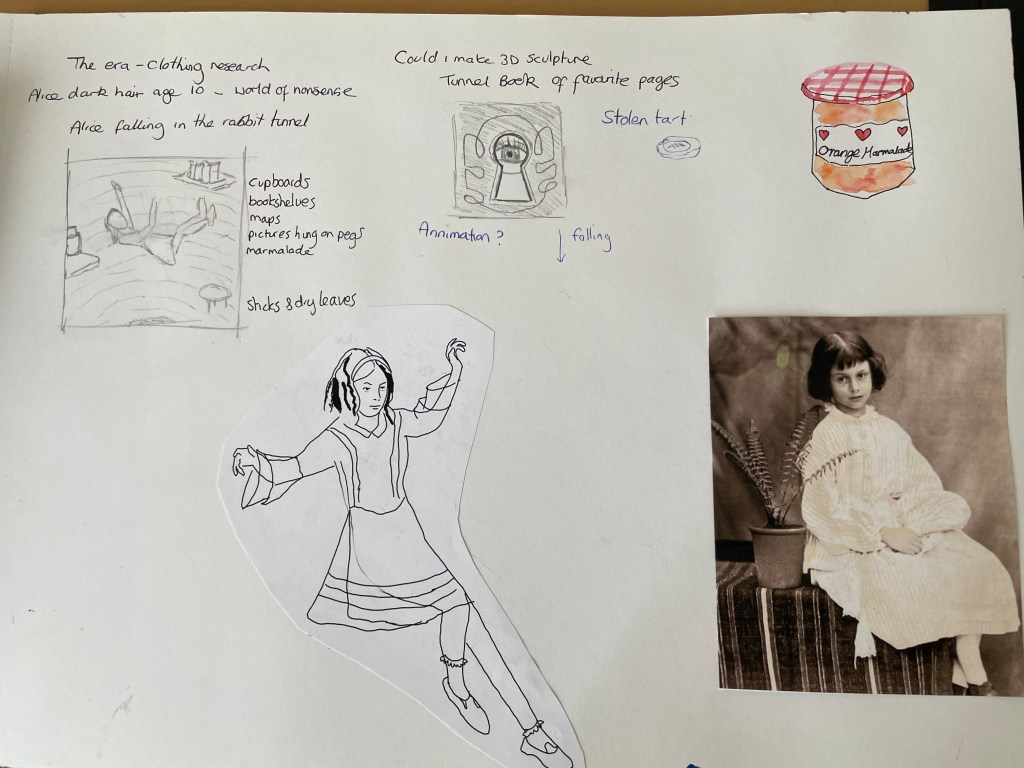
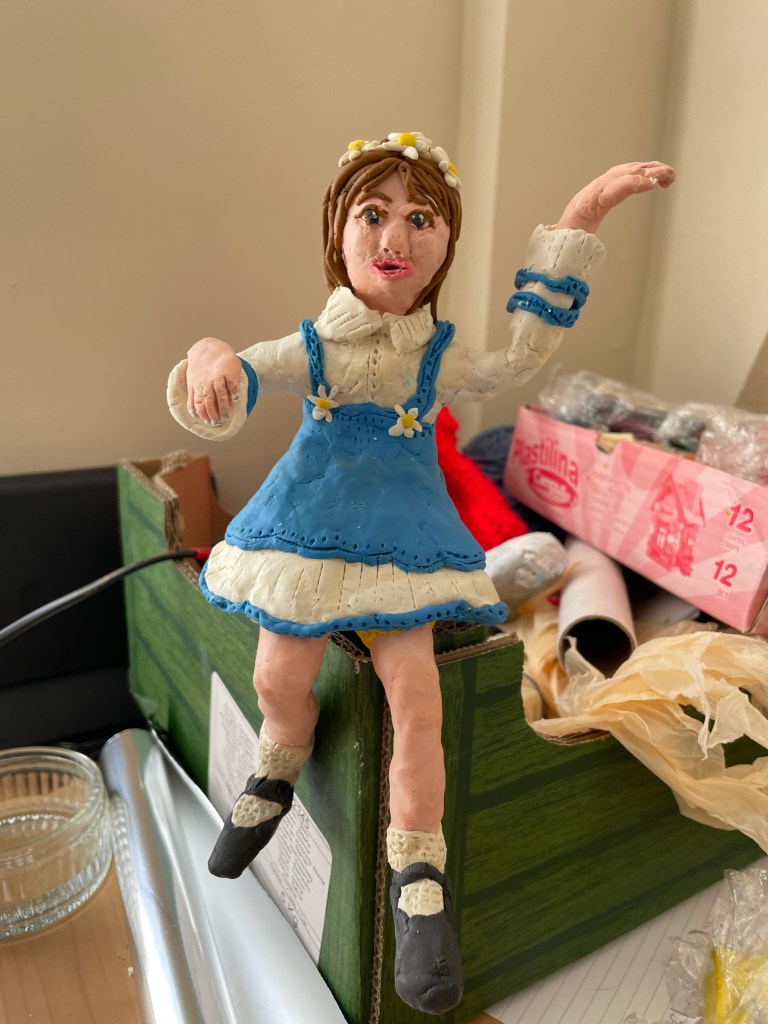
Wanting to explore the theme of Alice in Wonderland further, I decided to create my own interpretation of the character Alice. However, I wanted Alice to represent the real Alice Liddell, who had brown hair and eyes, not blond and blue eyed. To do this, I began exploring ideas in my sketchbook.
Fig. 33 Alice model ideas (2024)
Thinking of the scenes from the book, one of my favourites is when Alice falls down the continuous rabbit hole that features cubards, shelving, and books. As a child, I remember reading this chapter, and it really sparked my imagination, so I decided this would be my next project.
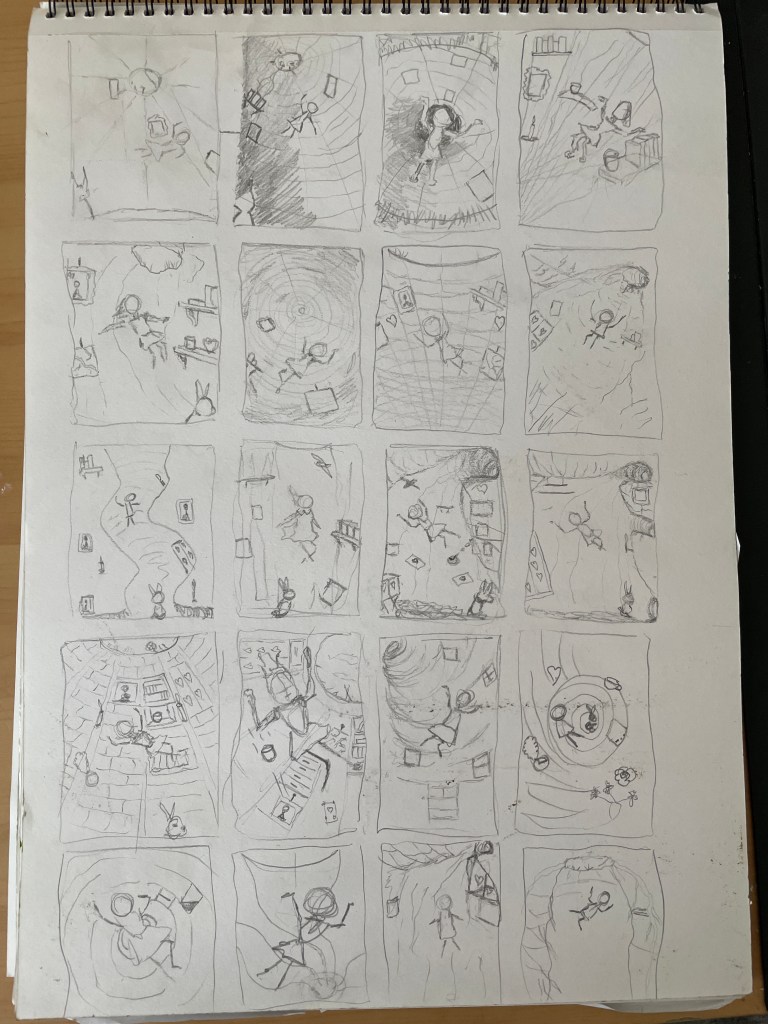
Again, I wanted to make it a unique illustration and decided to make Alice out of plactercine. Before starting, I drew many thumbnail sketches of possible compositions for the overall illustration.
Fig. 34 Thumbnails (2024)
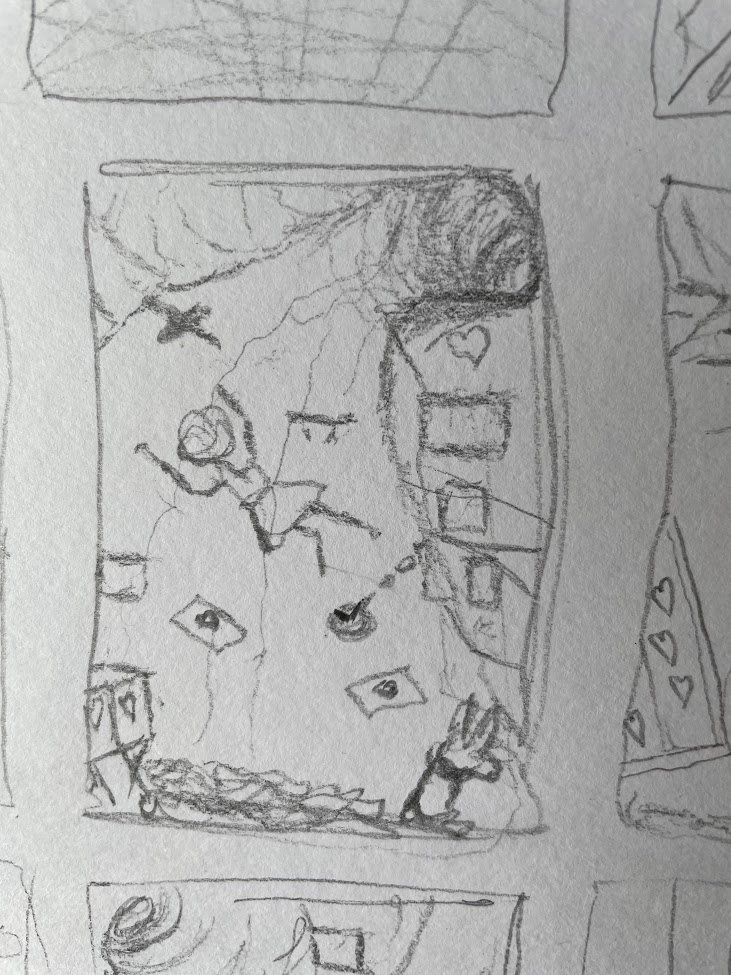
From these thumbnail sketches I selected the one shown below.
Fig. 35 Chosen Thumbnails (2024)
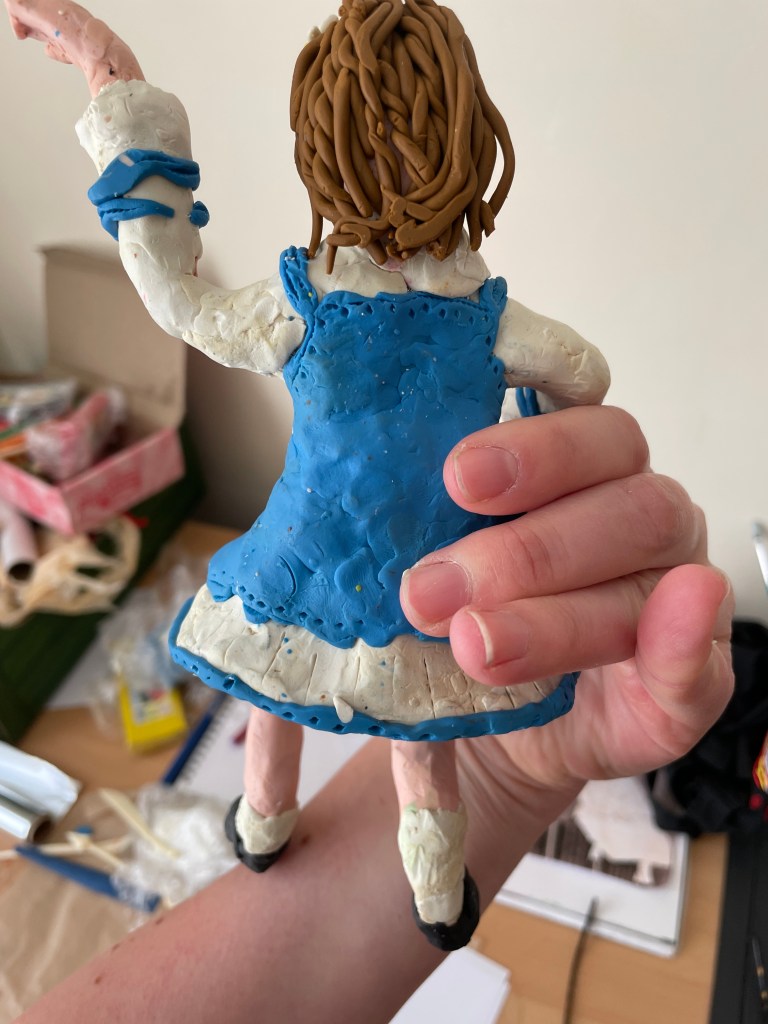
Next, I began making a wire frame for the Alice sculpture using florist wire.
Fig. 36 Wire sculpture (2024)
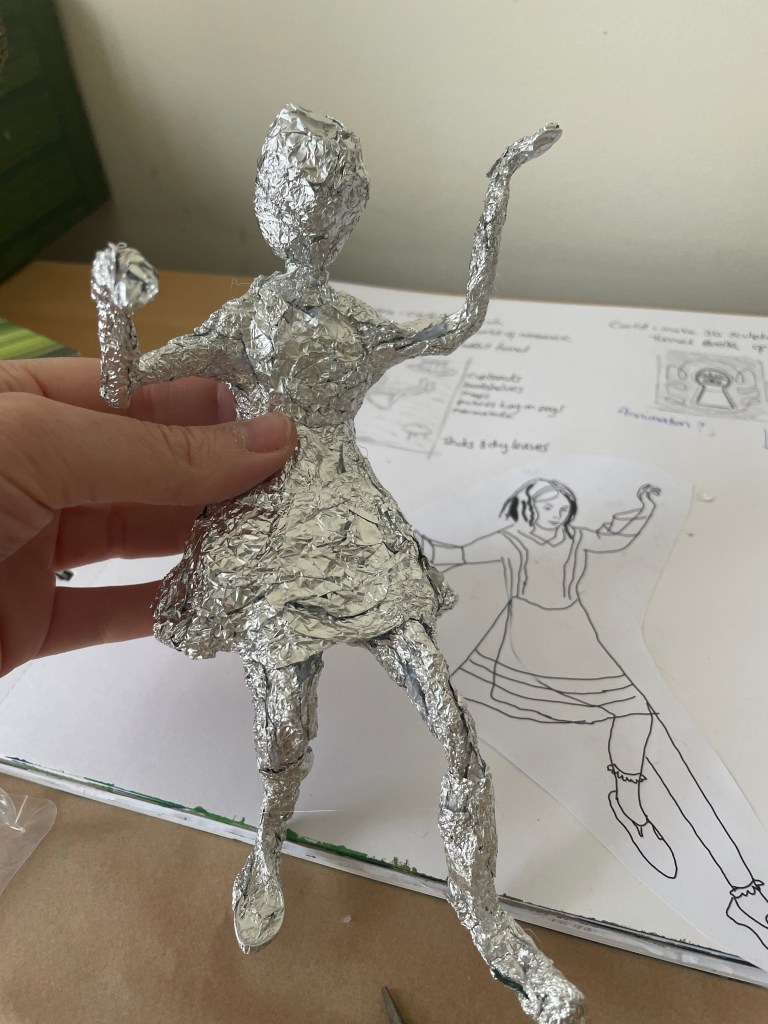
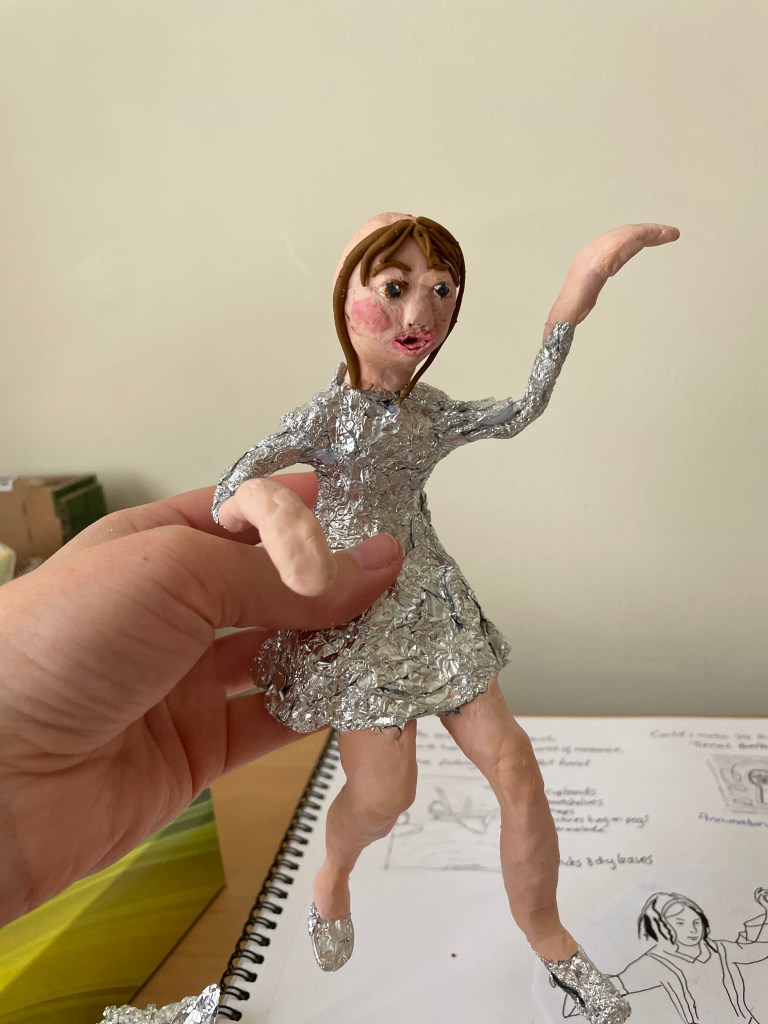
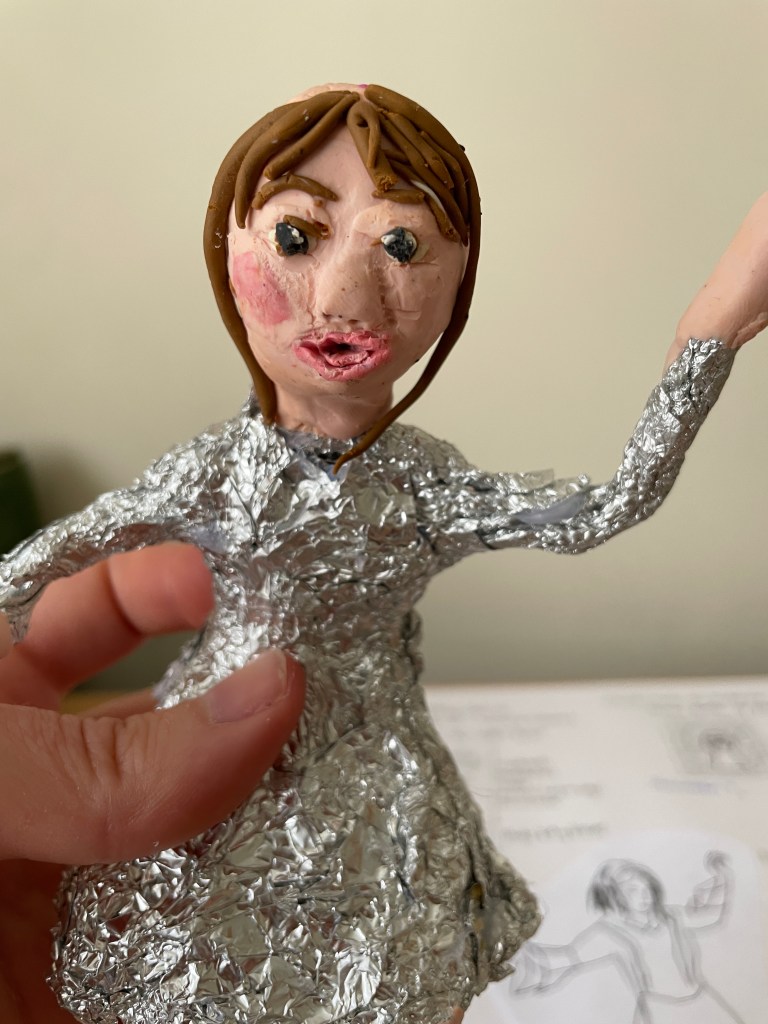
Next, I began covering the wire with tin foil and creating the shape for Alice.
Fig. 37 Foil Sculpture (2024)
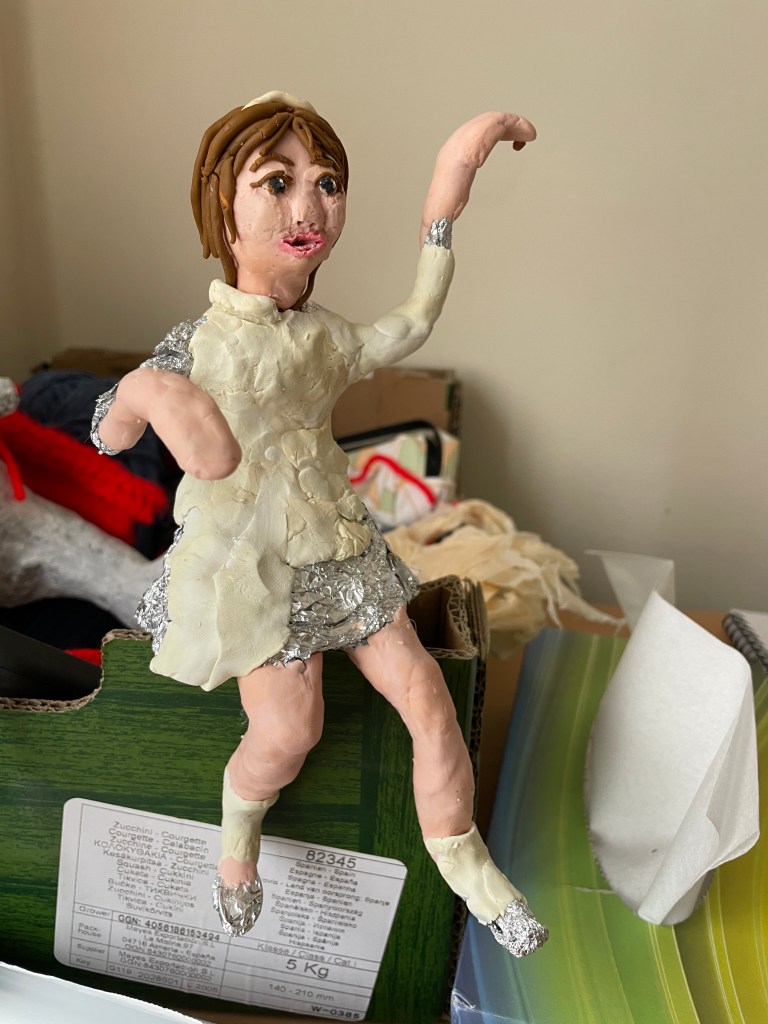
Once I was happy with the shape I began sculpting with the coloured plastercine.
Fig. 38 Plasticine modeling (2024)
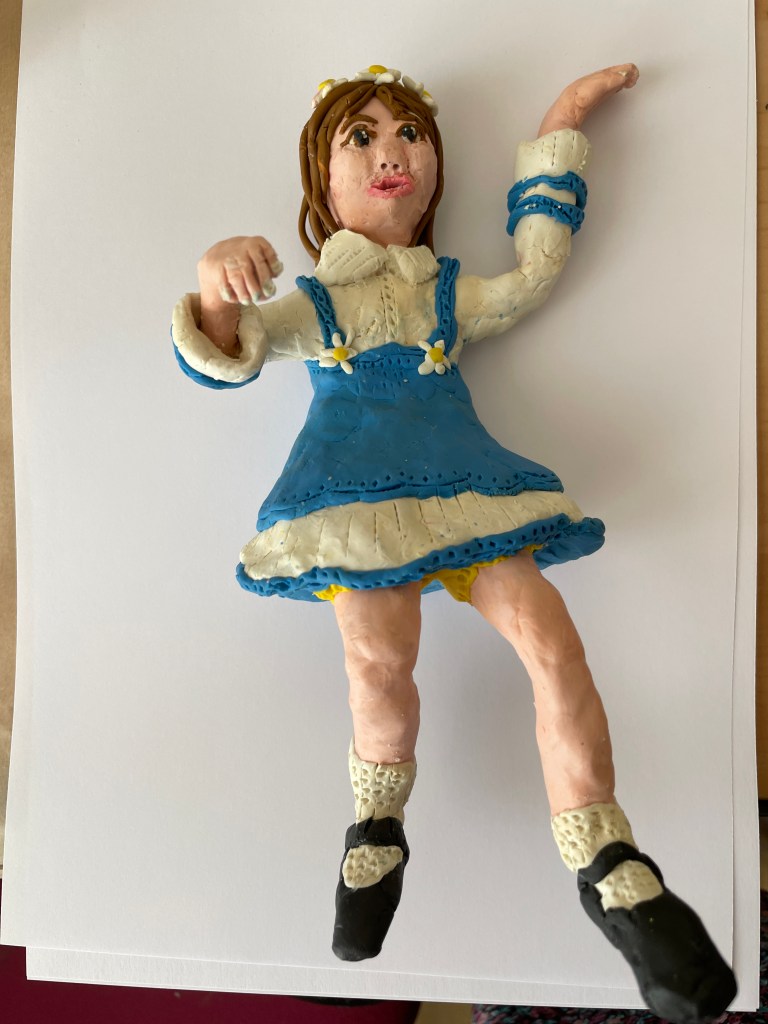
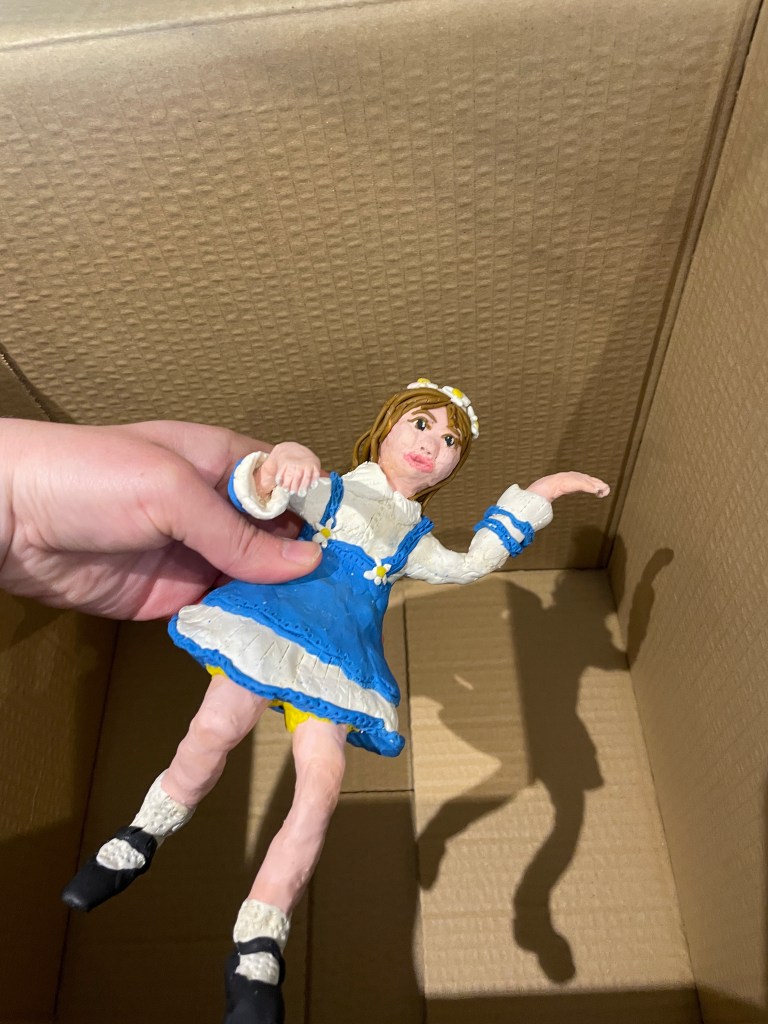
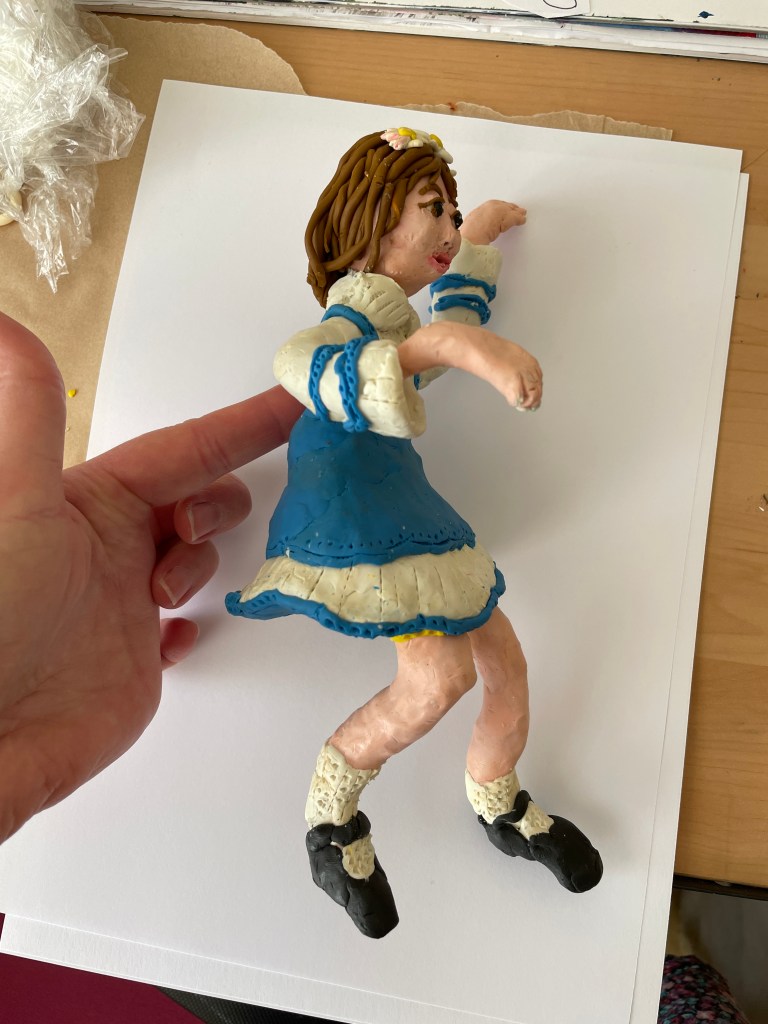
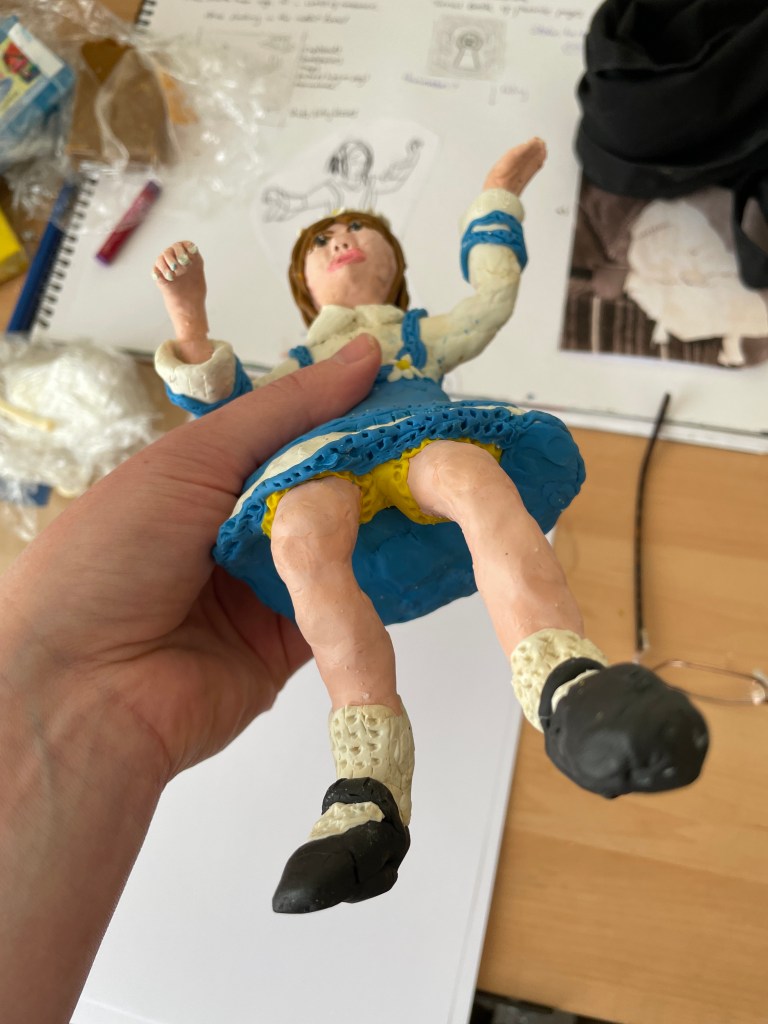
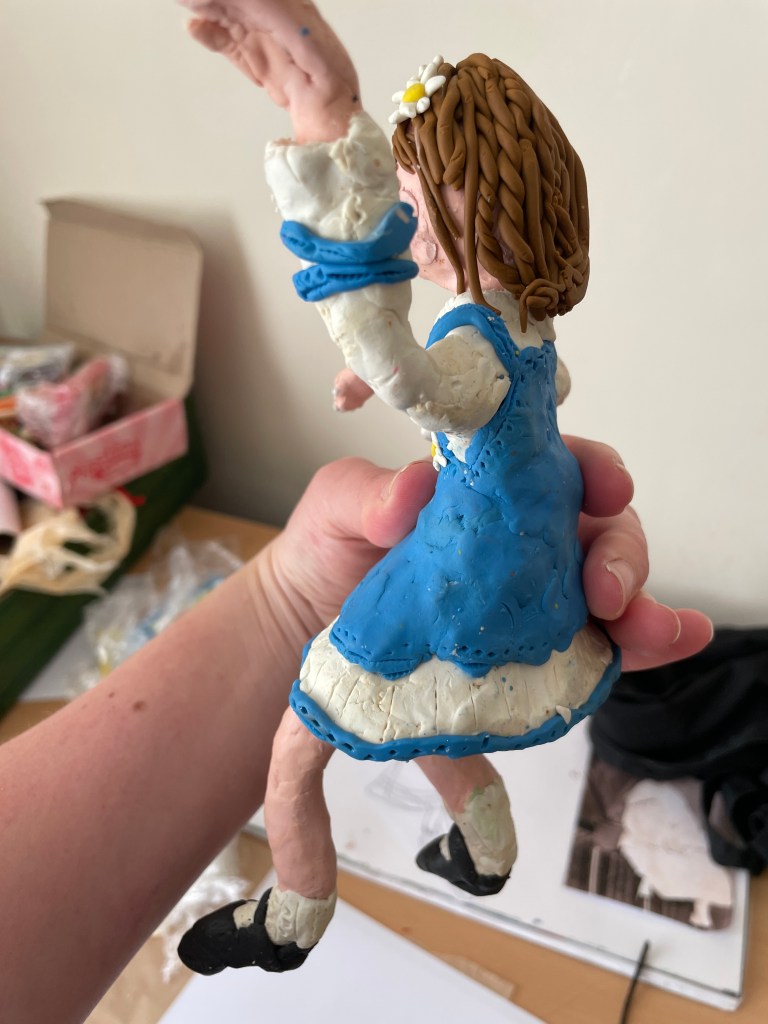
Below are images of Alice finished.
Fig. 39 Finished Alice model (2024)
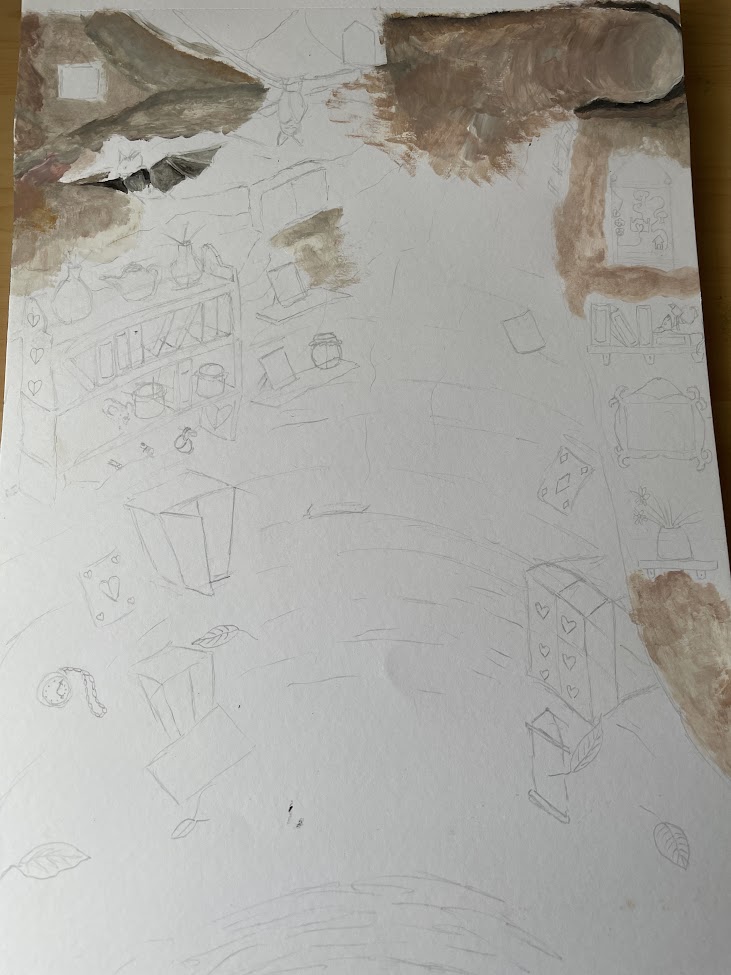
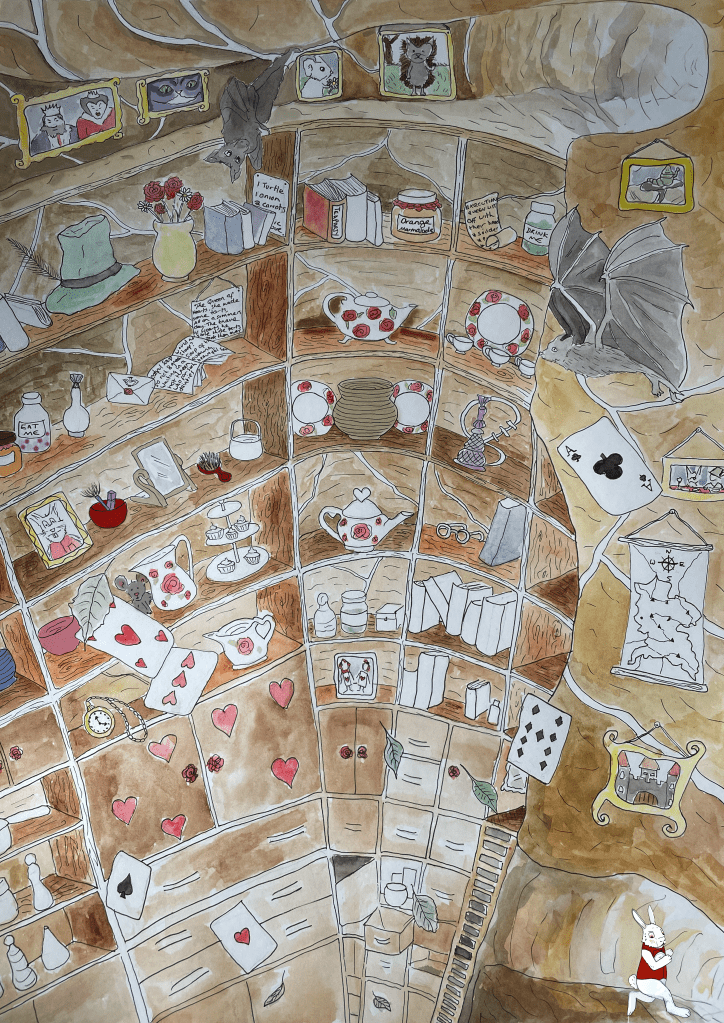
Next, I begain painting the background for the final illustration using Acrylic paints.
Fig. 40 Failed background (2024)
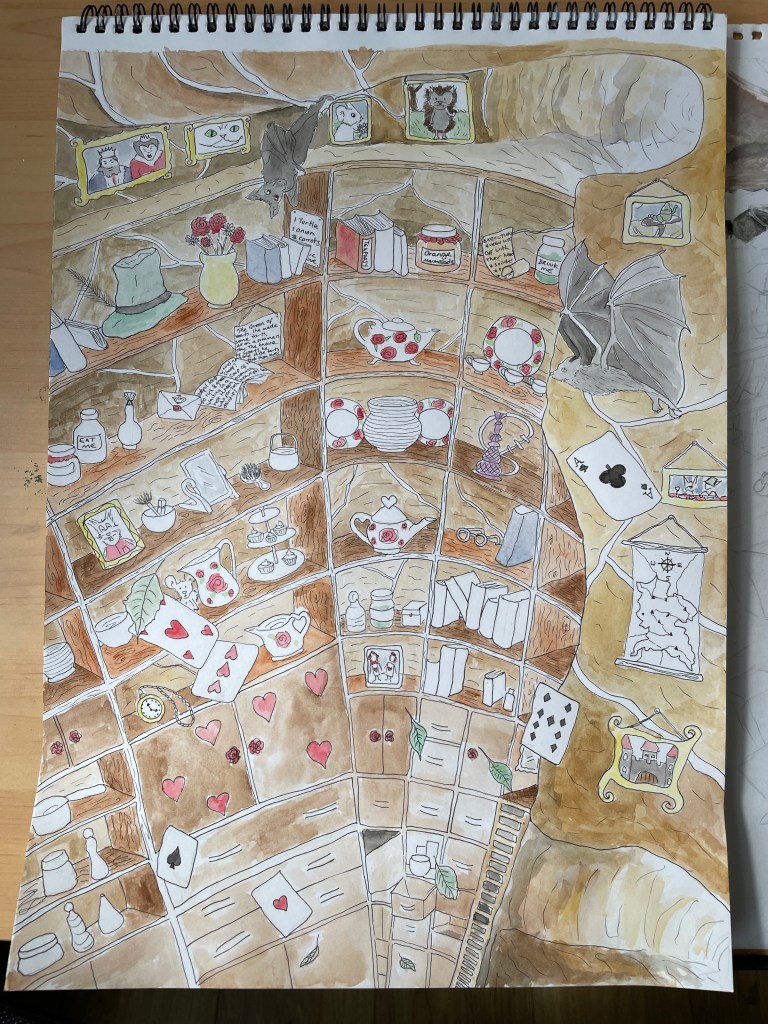
However, once I began, I realised it wasn’t the right medium for the task. There is a lot of detailed information I wanted to include in the illustration, and I felt acrylic paint would lose this aspect. Therefore, I began again, but this time using watercolour and black fine liner pens.
Fig. 41 Watercolour background (2024)
Previously, I had drawn a sketch of a rabbit, which I thought would look great running away through the passage. Below is the rabbit I sketched.
Fig. Mixed media white rabbit (2024)
Using Photoshop, I added the rabbit and made some enhancements to the background.
Fig. 43 Completed Background (2024)
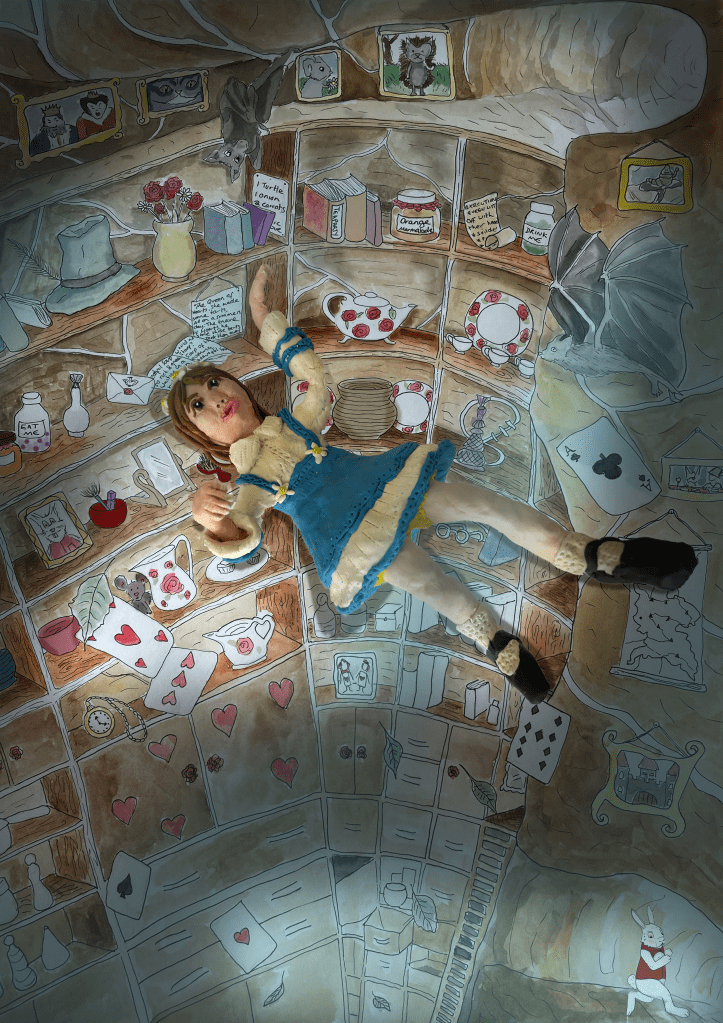
Next, I added Alice to the scene with some shaddows.
Fig. 44 Completed Illustration (2024)
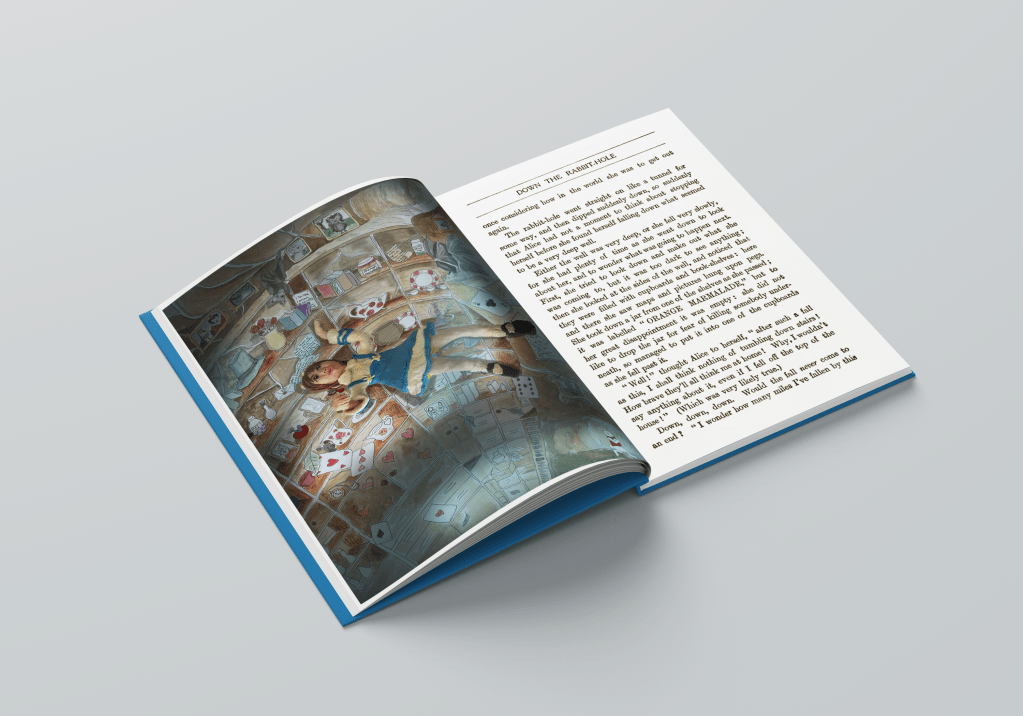
To finalise the illustration I made another mockup to see how it would look.
Fig. 45 Mockup of Alice falling down the well (2024)
After finishing this illustration, I then asked family and friends their opinions, and here are their statements.
“I’m finding it impossible to fault; it looks professional to me.”
“Excellent. You can use it to advertise.”
“Smart, first edition, please.”
“Looks good looking down the well.”
“That looks great, well done.”
Finally, my favourite comment! –
“Well done; it looks brilliant; she still has Botox lips though.”
After reading all these comments, I was very happy that I had such good feedback, as I wasn’t entirely sure if it worked. The positive feedback from family and friends reassured me that my illustration was well-received and effective. It gave me confidence in my work and motivation to continue creating further work.
This assignment has been really enjoyable and one that I could continue as I have so many other ideas for scenes in the book. It has been enjoyable to explore ideas from my own imagination.
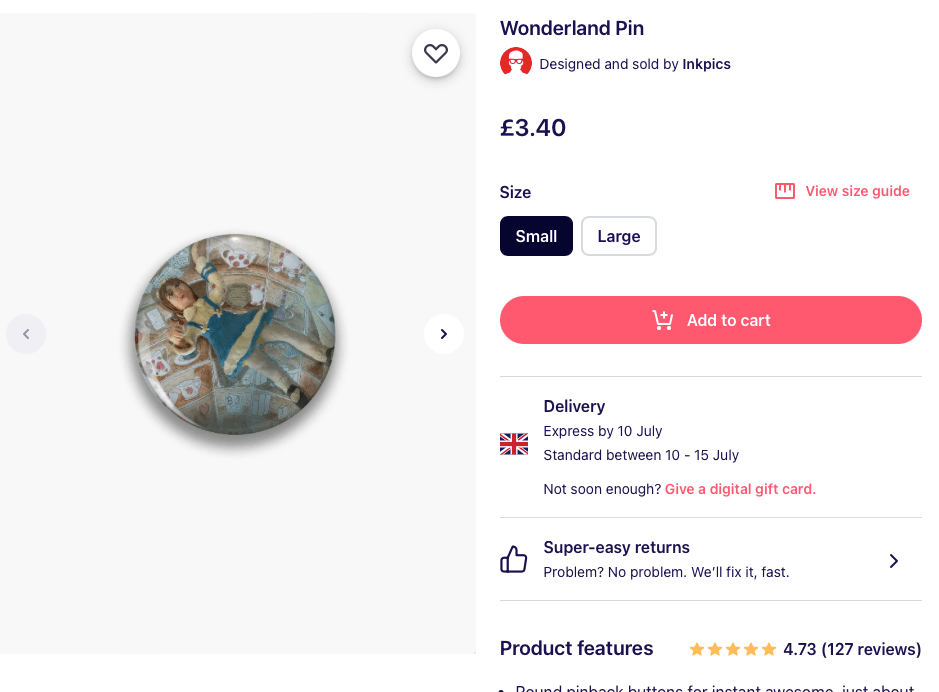
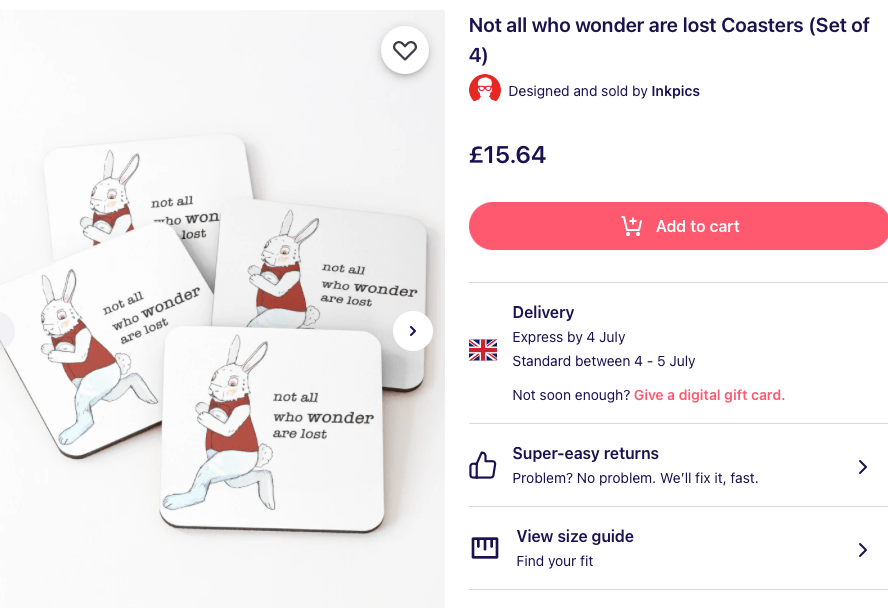
Using a Website called Redbubble I set up a shop called Inkpics where people can purchase items with my artwork on certain products. This was fun to see my work online and available to purchace. Below are some exmples of some of the products available.
Fig. 46 Wonderland Pin (2024)Fig. 47 Not all who wonder are lost (2024)
Creating products to sell online has made me realise the possibility I have with my illustration work and that I need to start setting up my own personal online shop and website. This way, I can showcase my designs and artwork to a wider audience and potentially reach more customers. I am excited about the opportunity to turn my passion for illustration into a profitable business venture.
Illustration list
Fig. 1 Fowler, G (2024) Imagination Brainstorm [freeform screenshot] In possession of the author: Gloucestershire.
Fig. 2 Fowler, G (2024) A Place Brainstorm [freeform screenshot] In possession of the author: Gloucestershire.
Fig. 3 Fowler, G (2023) Flower characters [WordPress screenshot] In possession of the author: Gloucestershire.
Fig. 4 Fowler, G (2023) Mockup page 1 [WordPress screenshot] In possession of the author: Gloucestershire.
Fig. 5 Fowler, G (2023) Mockup page 2 [WordPress screenshot] In possession of the author: Gloucestershire.
Fig. 6 Fowler, G (2023) Video of Bad Magic zine [Youtube video] In possession of the author: Gloucestershire.
Fig. 7 Fowler, G (2024) Notes [Freeform screenshots] In possession of the author: Gloucestershire.
Fig. 8 Fowler, G (2024) Down the Rabbit Hole page 4 [Photograph of printed text] In possession of the author: Gloucestershire.
Fig. 9 Fowler, G (2024) Down the Rabbit Hole page 5 [Photograph of printed text] In possession of the author: Gloucestershire.
Fig. 10 Fowler, G (2024) Sketch of white rabbit [Photograph of pencil sketch] In possession of the author: Gloucestershire.















 Visual Skills 2